The managing director of Ferrocarrils de la Generalitat Valenciana (FGV), Alfonso Novo, defended his company's "good job" on the day of the 2024 flood. "It was exemplary, it proceeded normally, with all the professionalism required for such a day," he said, emphasizing that "protocols were applied" and only one sworn guard was injured, with no other staff or passengers affected.
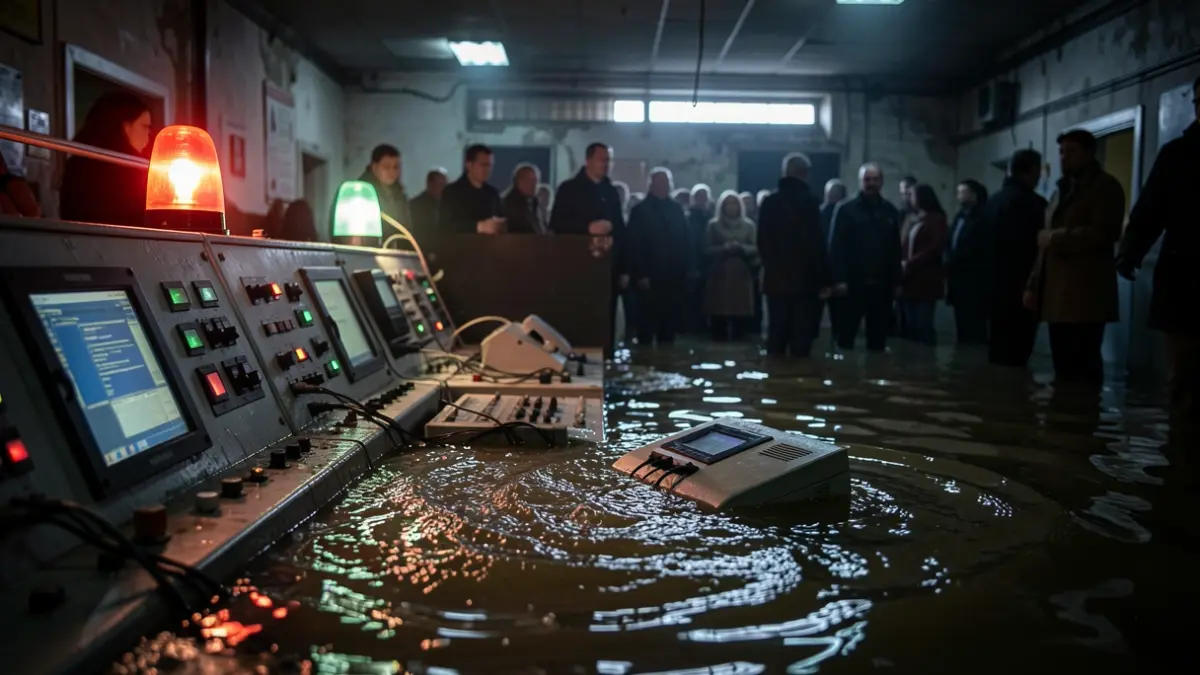
During his appearance before the congressional commission investigating the catastrophe, Novo explained that everything that happened that day until 7:40 PM "was normal," but afterward they faced an unprecedented situation, in his experience. At that hour, FGV's command center in the Valencia Sud complex, located 1.2 kilometers from the Barranco del Poyo, was flooded, and he stressed that they received no warning from the Júcar Hydrographic Confederation (CHJ).
Early that day, he recalled, there was a yellow alert, which later turned red, leading to the decision that "non-essential personnel" would not come to work and, for example, training matters were suspended. "Only the core operations were maintained," he stated, underlining that they are an "essential service".
Therefore, they prioritized "the requirement to provide service as long as the mechanisms were safe" and "service was stopped when they were not." In his opinion, "all personnel worked very well to provide the service under the best conditions," and "the protocol was strictly applied." "Preventive measures were taken from minute one, and service was always provided under safe conditions; when not, it was suspended," he summarized.
Novo emphasized that "the protocols and the two-way channel with the drivers worked perfectly" although "no one warned them of what was coming," referring to the overflow of the Barranco del Poyo, as at 7:30 PM they only knew of the risk at the Forata dam. "If we had had the slightest information that this could happen, we would have acted differently," he admitted.
The witness stated that they received "no DANA warning" before October 29th, "neither from the CHJ nor from any other emergency organization." As he communicated to the court investigating the criminal case, "beyond the warnings received for meteorological alerts, about adverse atmospheric phenomena, and special notices directed globally to public organizations," FGV "did not receive specific instructions or recommendations for the DANA from the Emergency Department regarding the command post".
The service suspension was decreed at 7:40 PM, five minutes after the command center was flooded. "I have no notion of meteorology, I trust what official mechanisms say, but we never received the slightest warning from the CHJ that the upper part had many problems and that this would come down. Nor did Cecopi receive it, as far as I know," Novo let slip.
In this context, he denied that a Metro Valencia train traveled over a practically overflowing ravine. "That is impossible because all protocols state that when water exceeds the tracks, the train must stop. That is what was done," he emphasized, adding that this section will continue to flood "as long as the CHJ works are not executed".
Furthermore, he denied that "hundreds of people seeking refuge" arrived at the command center. "The only train that arrived, which remained in Valencia Sur, was perfectly assisted, the train doors were opened, and they could stay there overnight because it was indeed not safe to move it," he indicated, stressing that when the service suspension was decreed, each train was instructed where to stop.
That day, as he explained, he spoke with the regional secretary of Infrastructure and Transport, Francisco Javier Sendra, but not about the need to notify the President of the Generalitat, then Carlos Mazón. He also added that he was in contact with the Transport Minister's team, Vicente Martínez Mus, but only spoke directly with him on two occasions.
The Compromís deputy, Alberto Ibáñez, recalled that the witness was the Councilor for Transport of Valencia when the 2007 metro accident occurred in which 43 people died, but he denied any similarity between what was "an accident" and the DANA tragedy.
He was also asked about the "hand-picked" award of a 4.2 million contract for post-DANA works to CHM Obras e Infraestructuras, whose top executive is convicted in the 'Gürtel' case and avoided prison after a deal with the Prosecutor's Office. "These are technical decisions," Novo pointed out, emphasizing that it is an "emergency contract" that is "perfectly defined by law".