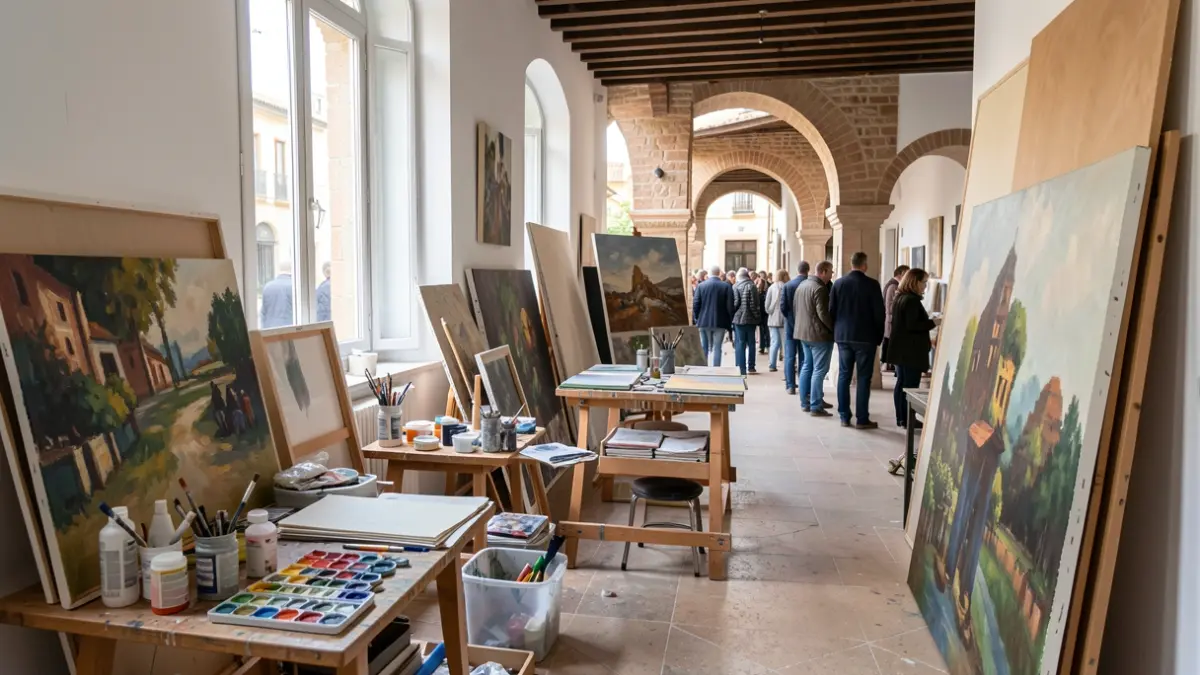
Galleries, cultural centers, and exhibition halls are typically the visible face of Valencia's artistic ecosystem. Far less visible are the places where artworks take shape before reaching these spaces: workshops, shared studios, former industrial warehouses, or converted premises. For three days, a part of this network will open its doors to the public through Obert Estudis, a self-managed initiative that will bring together over a hundred artists distributed across 22 studios in the city.
The event will take place on June 12, 13, and 14, offering free visits to workspaces located in Ayora, Benimaclet, Benicalap, Monteolivete, Russafa, and Patraix. Beyond showcasing finished works, the project focuses on the creation processes and on venues that usually remain outside the most visible cultural circuits.
The initiative arises precisely from the difficulty of tracking a particularly dynamic artistic scene. Studios appear, disappear, or change locations frequently. "It's a reality that is constantly changing. Without going any further, when summer passes, many studios will disappear," explains Tomás Fernández, one of the project's initiators along with Marta Bueno. The urgency to materialize the project from the initial idea stems from this instability.
A significant part of the work involved simply locating existing studios. Without common structures or official registries, the mapping has been built through personal contacts and recommendations among artists. "The artist is almost the best person to know where a studio is," explains Bueno. "It has been a chain of contacts and word-of-mouth." The result is a map that functions as a snapshot of a specific moment in Valencia's creative ecosystem, acknowledging that the image will have changed in a few months.
For its organizers, this mutable condition is part of the project's essence. "What's interesting about this is that it's not fixed, but organic, it evolves, and it will be presented differently each year," states Bueno. The intention is for Obert Estudis to become a regular event capable of documenting the evolution of these spaces and creating a collective archive of the local artistic fabric. "It can serve as a press archive that shows the richness of Valencia's artistic scene," she adds.
The initiative inevitably brings to mind Abierto València, the annual event promoted by contemporary art galleries. However, the organizers emphasize that the objective is different. While galleries showcase works already presented to the public, Obert Estudis directs attention to the place where that work is produced. "Obert Estudis is born precisely from the need to show where ideas and art originate. Being able to see the pieces within the context in which they were created allows for a much deeper layer of understanding," explains Marta Bueno.
The visit will not be limited to observing artworks. It also allows for an approach to the creators' everyday environments: accumulated materials, sketches, tools, or even the neighborhoods where they work. "The space affects your work. Understanding an artist's studio helps you comprehend why their output is one way or another," argues Tomás Fernández.
This desire to bring the public closer to the 'kitchen' of artistic creation also translates into great freedom for participants. The organization has not imposed a single model of opening. Some studios will show ongoing work processes; others will opt for more exhibition-like formats or specific activities. "The request is simply that they open their doors and let people in. That they exhibit what they want. If they want to produce work, great; if they want to show a more curated space, that's fine too," summarizes Bueno.
One of the most significant features of Obert Estudis is its self-managed nature. The project has been driven without external funding and through a network of collaborations between artists and cultural agents. Its organizers acknowledge that this situation reflects some of the structural difficulties facing the cultural sector, especially among emerging creators. "We don't have money, but we have a lot of energy. In Valencia, there is a critical spirit and an impressive artistic fabric. Being aware of this and coming together to give voice to the collective is also a strength," states Fernández.
To facilitate visits, Obert Estudis has divided the route into three days. Friday will be dedicated to Ayora and peripheral spaces; Saturday to Benimaclet and Benicalap; and Sunday to Monteolivete, Russafa, and Patraix. A total of 22 studios and over a hundred artists will participate. Admission will be free, and spaces can be visited in the morning and afternoon.