The debate surrounding large tourism projects in natural settings intensifies in Gandia with the Ohai Gandia project, presented as an ecological 'glamping' site. The article criticizes that, under labels like 'eco-village' or 'sustainable tourism', large-scale infrastructures are hidden on non-developable land, such as in the vicinity of the Molí de Santa Maria and the Marjal de la Safor.
The Declaration of Community Interest speaks of a 'tourism camp' occupying 163,011 square meters, with 7,166 square meters built and a 30-year validity. The subsequent activity project details a plot of 190,397 square meters, with 3,974 square meters of constructions, 2,431 for sports facilities and pools, 10,230 for roads, and 3,474 for parking. These figures far exceed the idea of an intimate experience with nature, being comparable to the area of nineteen Santiago Bernabéu stadiums.
The complex plans for 220 accommodations with a capacity for 624 people, plus 198 staff during high season, resulting in a total of 822 individuals. This constitutes a 'private tourist village' with 24-hour activities, including a restaurant, cafeteria, bar, event rooms, gym, spa, and outdoor cinema, all requiring specific legal permits.
The management of water and wastewater resources also highlights the infrastructure's complexity. A connection to the municipal drinking water and sewage network is planned, with its own treatment and pumping systems. Rainwater and wastewater will be discharged into the municipal network or nearby waterways. The presence of hydrocarbon separators in parking areas underscores that this is not a 'natural' use of the land.
The public swimming pools, awaiting a specific license, are another key point contrasting with the 'contact with nature' narrative. The project necessitates access improvements, road expansions, and potential land expropriation, indicating it is not a minor activity but a complex infrastructure requiring public support for its viability.
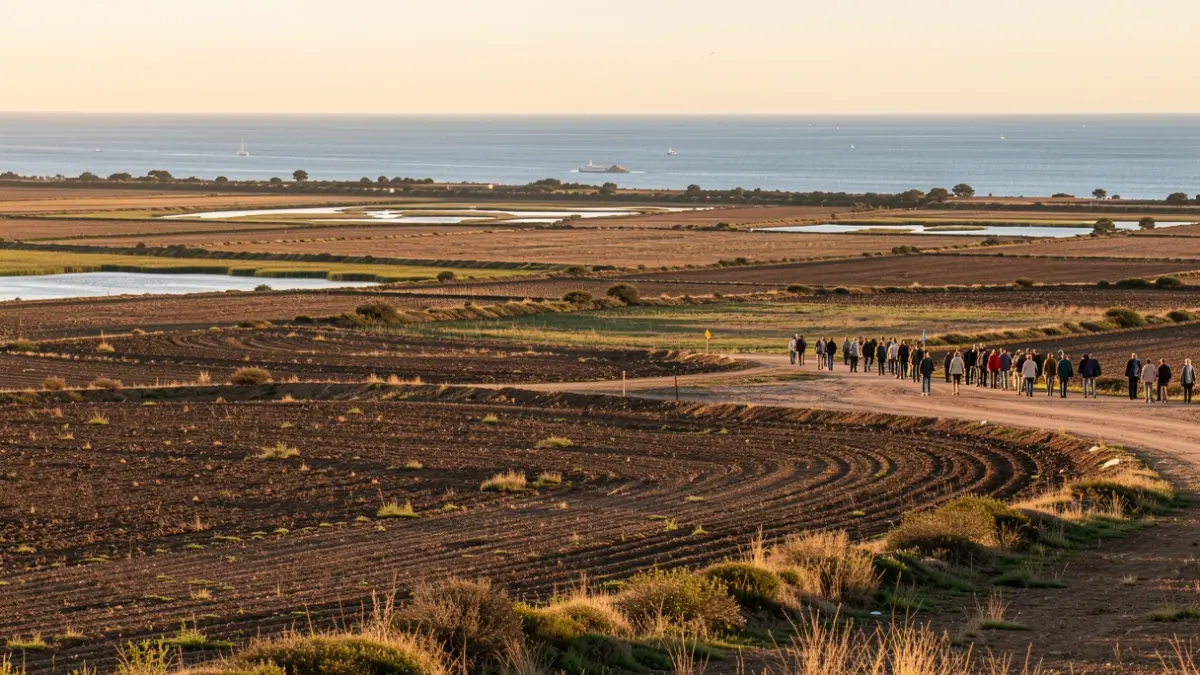
Although marketed as an economic opportunity with investments exceeding 20 million euros and job creation, the article questions the proposed tourism model. The location in the Marjal de la Safor, included in the ZEPA Mondúber-Marjal de la Safor, raises concerns about transforming a protected natural area into a backdrop for luxury experiences.
The criticism focuses on the dichotomy between the appealing narrative ('eco', 'sustainable', 'integration') and the material reality (size, constructions, 24h services). It argues that the marshland's value lies in its biodiversity and historical memory, not in its conversion into a tourism business. The future, it is argued, should involve protecting the territory and sustainable tourism management, not additional construction in valuable areas.