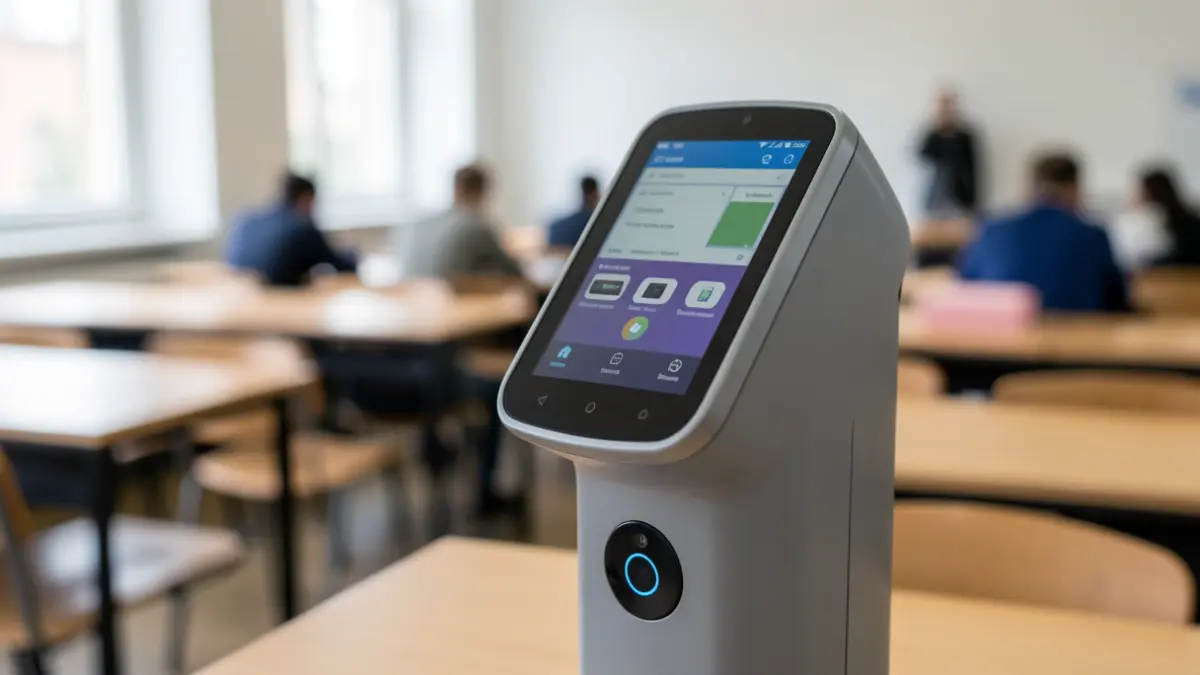
The major innovation this year at UNED Valencia is the implementation of advanced security technology to locate mobile phones, earpieces, and other electronic systems. The aim is to prevent academic fraud and safeguard equal opportunities among the center's 7,500 students and international students taking the Specific Competence Tests (PCE).
The volume of tests is distributed between the center's two locations. The Valencia campus will host 6,036 exams in the first week and 4,705 in the second, from June 8th to 12th. Additionally, 3,525 exams for 813 international PCE students are included. Meanwhile, the Alzira campus plans to administer 4,620 general exams and 949 tests for 251 PCE students.
With this implementation, Valencia joins the centers in Madrid, Barcelona, Orense, Baza, and Calatayud, which have already piloted the project. The new instruments include a material detector, capable of revealing the presence of induction coils or electronic circuits even when turned off, and a frequency detector that reacts to any electronic transmission signal operating within a range of 0 to 10 Ghz.
The management of UNED Valencia emphasizes that the use of these detectors is governed by criteria of 'proportionality, objectivity, and minimal interference.' Furthermore, the university clarifies that the devices do not violate students' rights, as they do not capture personal content, record images or sounds, nor perform any type of biometric identification.