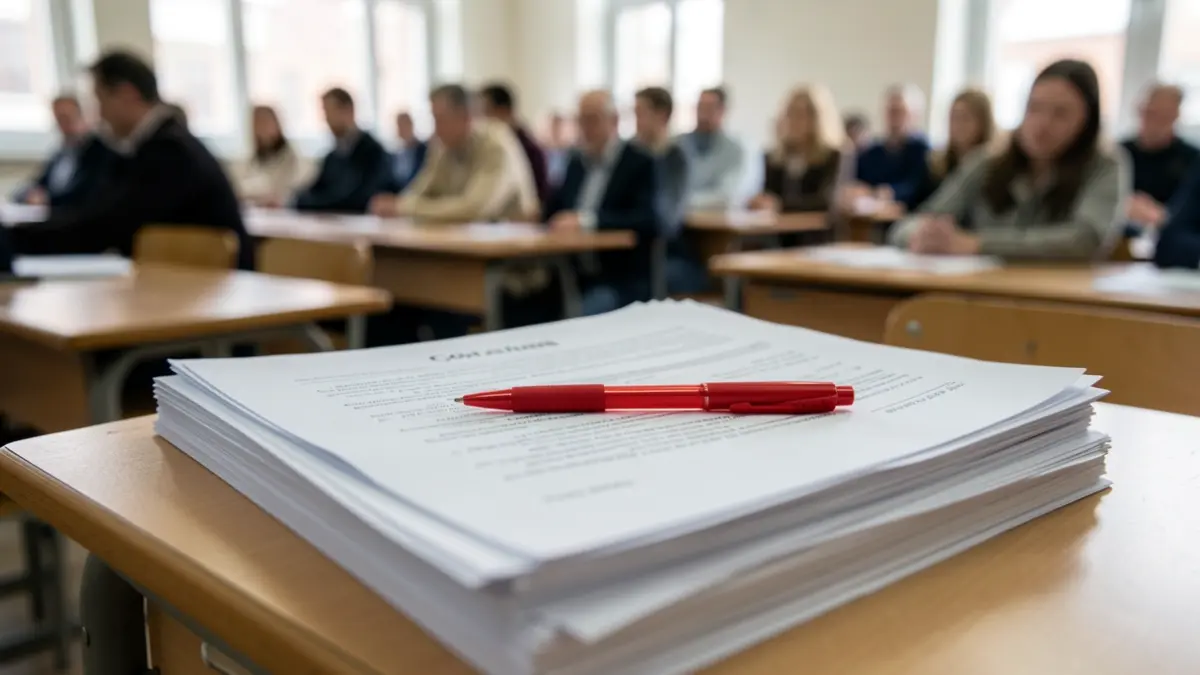
The ordinary session of the PAU exams is scheduled for next week, between June 2, 3, and 4, while the extraordinary session will take place on June 30 and July 1 and 2. This comes amidst a labor conflict in Valencian public education, with teachers on an indefinite strike since May 11.
The Assembly of Correcting Teachers, a platform representing over 250 specialists, has announced a series of strong measures due to the stalled negotiations. They denounce the "incapacity" of the Ministry of Education, Culture, and Universities to address the needs of the public system and criticize its lack of flexibility regarding union proposals.
The collective's discontent stems from a "structural degradation" of Valencian Baccalaureate education. Among their complaints are proposals for improving student-teacher ratios that still result in overcrowded classrooms, the elimination of groups in the Artistic Baccalaureate track, precarious working conditions with unpaid tutoring and reduced dedication hours, and a heavy bureaucratic workload that leaves teachers "burned out." They also criticize a "disregard" for the Valencian language and the educational curriculum itself.
As a pressure tactic, the teachers are considering not attending the tribunal constitution, scheduled for June 2, or submitting mass resignations on that same day if there are no "political movements." Furthermore, they are contemplating "more forceful actions" regarding the submission of student grades.
"We are forced to take these measures, which are not political but just demands for quality public education," state members of the assembly, who prefer to remain anonymous for fear of reprisals. They insist that their objective is "in no case" to harm the future of students or their families.
Additionally, the teachers strongly criticize the five public universities in the Valencian Community (Universitat Jaume I de Castelló, Universitat Politècnica de València, Universidad de Alicante, Universitat de València, and Universidad Miguel Hernández de Elche), accusing their rectors of maintaining "silence" and "scarce solidarity" with the grading collective, despite isolated support from some departments.
They demand "real" institutional support and "sincere" commitment from the universities towards Baccalaureate students, reminding them that this group forms the foundation of the student body from which the public campuses draw. The Ministry of Education now faces a crisis that could compromise the proper execution of the year's most important exams for thousands of Valencian students.