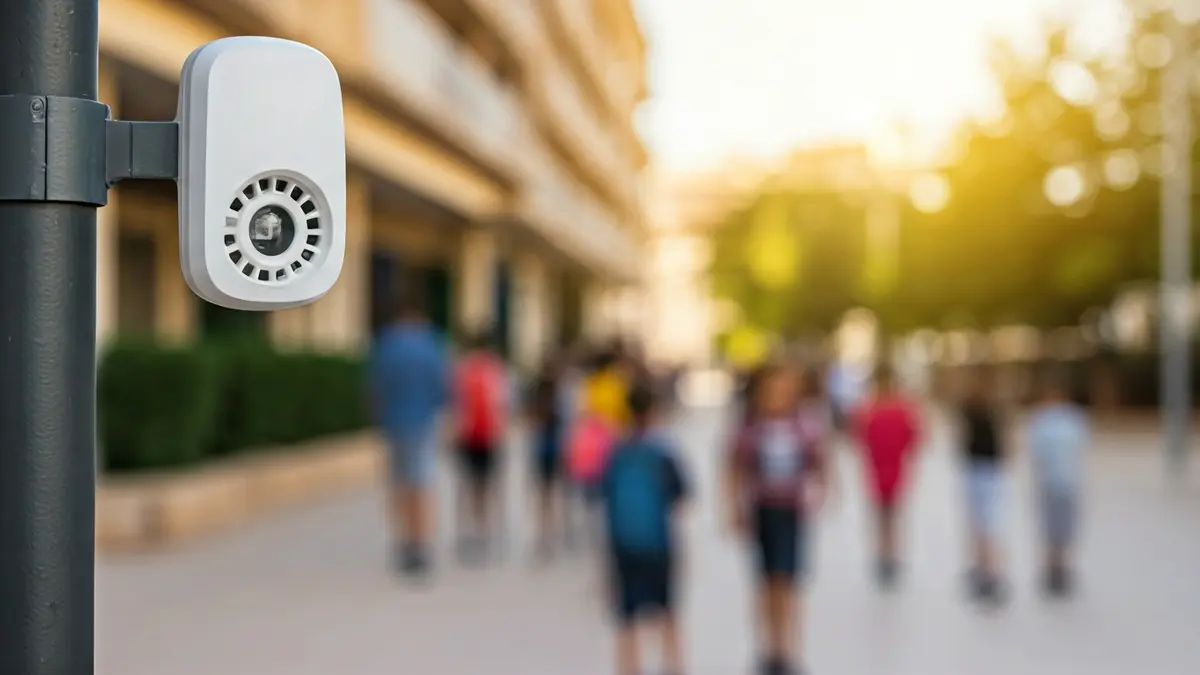
The air breathed daily by hundreds of children in Valencia and its metropolitan area presents pollution levels above those considered safe. This is evidenced by a study carried out by the associations Acció de València, València en Bici-AE-Agró, and Soterranya in ten educational centers. In these, six exceed the daily nitrogen dioxide (NO2) limit recommended by the WHO, and all surpass the annual threshold set by this organization to protect health.
The concentration of this pollutant is expressed in micrograms per cubic meter (μg/m³). International organizations establish two references: a daily value, reflecting occasional episodes of high pollution, and an annual value, measuring continuous exposure. The worst data are concentrated in six centers in Cap i Casal, all of them close to major traffic routes such as Gran Vía, Guillem de Castro, Ronda Nord, or the V-30.
Among the centers exceeding the WHO daily limit (25 μg/m³) are CEIP Cervantes (Extramurs), CEIP San Juan de Ribera (l'Eixample), CEIP Juan Manuel Montoya (Natzaret), IES Baleares (Camins al Grau), CEIP Antonio Machado (Rascanya), and Centre Educatiu Misericordia (l'Olivereta). This daily exposure implies breathing air associated with an increase in hospital admissions and mortality from respiratory and cardiovascular diseases.
“"Valencia has many avenues and a lot of traffic, and that means nitrogen dioxide does not have time to disperse."
In contrast, three other centers—CEIP Vivers (Trinitat), IES Cabanyal (La Carrasca), and CEIP Cristóbal Colón, in the municipality of Benetússer—do not exceed that daily limit, but they do surpass the annual limit recommended by the WHO and the one that will be set by future European regulations. The lowest records are observed at IES Andreu Alfaro in Paiporta and CEIP Federico Maicas, Lope de Vega, and Virgen del Rosario in Torrent, thanks to lower urban density and more green areas.
Nitrogen dioxide primarily comes from the combustion of fossil fuels, especially road traffic. In dense cities like Valencia, with numerous avenues and high circulation, this pollutant accumulates easily. This lack of dispersion is evident in schools located next to major arteries or surrounded by tall buildings. The case of CEIP Juan Manuel Montoya also adds proximity to the port, a constant source of emissions from maritime and freight traffic.
The analysis also highlights that 90% of the analyzed environments already exceed the future threshold of 20 μg/m³ that the new European directive will establish for 2030. The consequences of this exposure in childhood include the aggravation of previous illnesses, more asthmatic crises and respiratory infections in the short term, and an increased risk of chronic cardiovascular and respiratory diseases in the long term.
The proposed measures directly target traffic: reducing the number of vehicles in school environments, limiting speed to 20 km/h, avoiding double parking at entrances and exits, and transforming parking spaces into green areas. The implementation of Low Emission Zones (LEZ) is also proposed, accompanied by efficient public transport and safe infrastructure for pedestrians and cyclists, as well as the creation of school paths and the naturalization of educational environments.