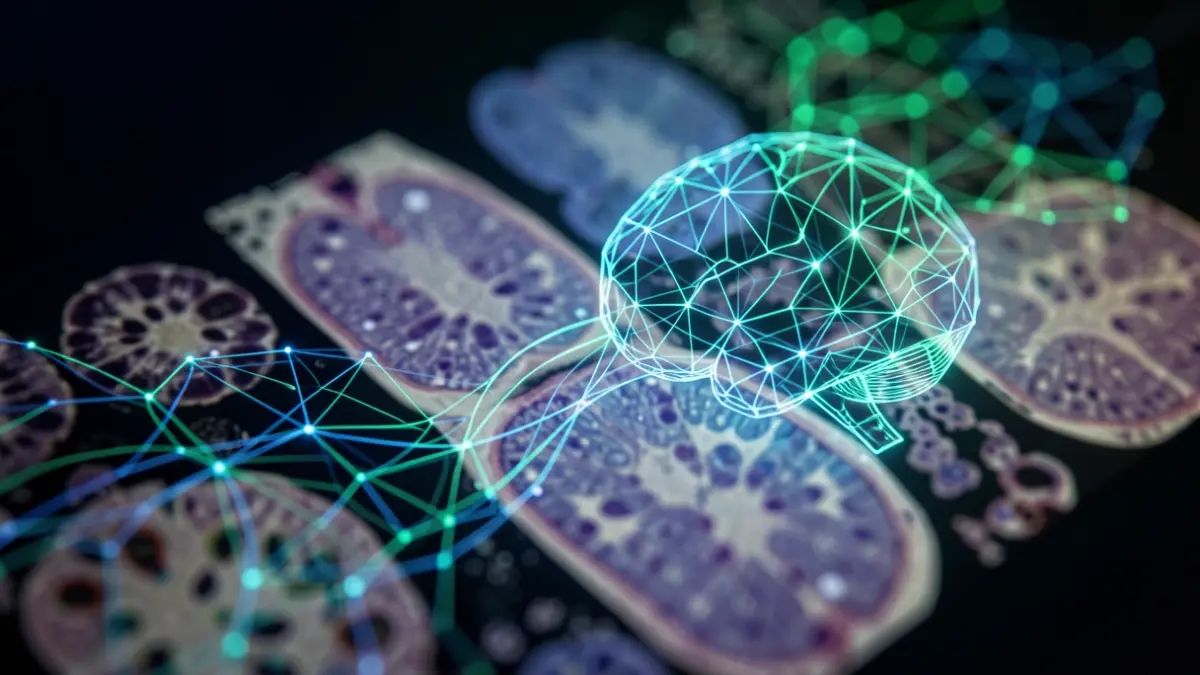
An innovative artificial intelligence (AI) system has been developed by experts from the German Cancer Research Center (DKFZ) and Heidelberg University, capable of classifying Central Nervous System (CNS) tumors with unprecedented accuracy. This system, named Hetairos, analyzes standard microscopic tissue sections and delivers results within minutes, a substantial improvement over classical methods that can take weeks.
The research, published in the journal Nature Cancer, addresses a significant challenge in neuropathology: the lengthy wait for molecular results. Hetairos was trained and validated using data from 9,606 patients and over 11,000 tissue samples from 11 centers across four continents. The AI learned to recognize 102 CNS tumor subtypes from digitized images of standard hematoxylin and eosin stains, the material routinely used in pathological anatomy laboratories, achieving an accuracy close to 87%.
This advancement is particularly relevant in a field where diagnosis increasingly relies on complex tests. The World Health Organization's (WHO) classification for CNS tumors is based on molecular profiles, with DNA methylation analysis considered a gold standard. However, these tests require specialized equipment, sufficient tumor material, and time. Hetairos is presented as a supportive tool that works with routine material and can guide the selection of additional tests.
In a blind evaluation involving 210 cases, five certified specialists achieved an average accuracy of 30% for the primary diagnosis, while Hetairos reached 68% when considering the top three hypotheses. Furthermore, the AI achieved an 84% success rate compared to the specialists' 50% across all alternatives. The complete molecular diagnosis averaged 12 days, whereas Hetairos generated its report in just 12 minutes after the sample was digitized.
Hetairos has also demonstrated the ability to narrow down differential diagnoses and resolve difficult cases, especially in situations with limited tissue or inconclusive methylation results. The system is not intended to replace neuropathologists or molecular analyses but rather to expedite the process, provide interpretive information, and prioritize cases that truly require more costly or complex tests. It is estimated that methylation analysis costs around 400 euros per case, while Hetairos could operate for 1 to 2 euros per sample, utilizing digital images and more accessible equipment.