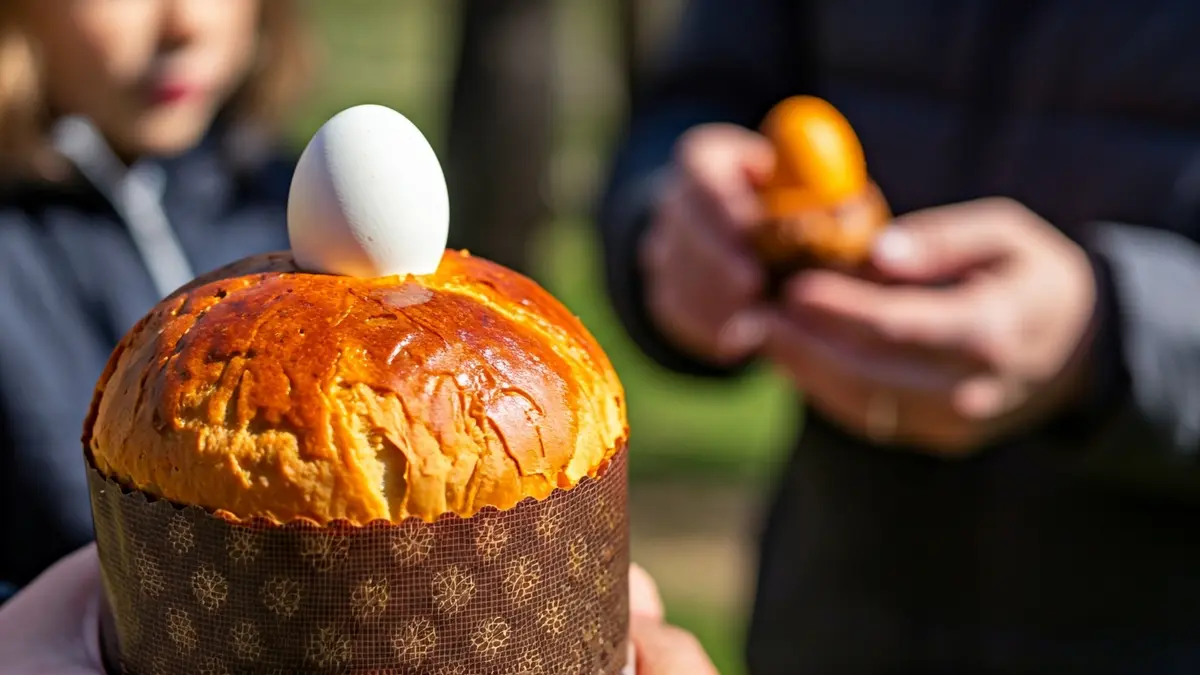
Across Alicante, Easter Monday always has a distinct flavor: that of the mona. Whether in its classic form, with the traditional bun and boiled egg, or in its more contemporary versions, with fillings ranging from pistachio to Kinder Bueno, the tradition of sharing it in the countryside, park, or beach remains intact. This sweet transforms, but its essence of intergenerational gathering endures.
This Monday, the city's public spaces were filled with people who took advantage of the good weather, with temperatures above 20 degrees Celsius, to enjoy this tradition. Some, like Rosa and her daughter Vanessa, accompanied by their friend Gloria, were doing it for the first time at El Postiguet beach. Rosa commented: "A client gave it to me, and we're going to eat it for the first time; it actually looks good because it has a lot of chocolate on top."
In El Palmeral, another emblematic spot for this celebration, dozens of families shared lunch among the gardens. Jose, one of the attendees, pointed out that "we come every year" and acknowledged that "the little ones are in charge," so he usually chooses the mona with a chocolate egg. The children ran around trying to "smash" each other's eggs, a characteristic sight of these days.
“"A client gave it to me, and we're going to eat it for the first time; it actually looks good because it has a lot of chocolate on top."
Although the exact origins of this custom are not clearly defined, one of the most accepted explanations points to the product itself. The consumption of eggs was prohibited during Lent, and Easter marked the moment when it was allowed to eat them again. Thus, breaking the eggshell also symbolized breaking with the Lenten restriction.
Also in El Palmeral, Lucía and Isabel had gathered their grandchildren to enjoy the mona. With tables and chairs, they had organized their particular picnic area to keep the family tradition alive. In this case, the chosen sweet was a "fogaseta," a name it receives in the Elche area and the southern regions of the province, and which, unlike in the capital, does not include a boiled egg.
The mona, although the traditional version remains the "queen" of Easter Monday, has evolved with a wide variety of shapes and flavors. The classic recipe, with a hard-boiled egg due to the Lenten prohibition, has given way to innovations. At Pastelines, Inés García's bakery, they have decided to go a step further this year: "We make monas of about 700 grams, for several people, and we fill them by hand with flavors like chocolate, Kinder Bueno, Pantera Rosa, or pistachio," explains García.
Inés García, who started in baking two years ago by vocation, without prior family tradition, emphasizes that the mona is a sweet that has not lost popularity: "People buy it a lot, even after Easter Monday. We sell it throughout April." At the door of Pastelines, Ana Salas, laden with sweets, confirmed this trend: "I was going to take four for a colleague, but in the end, I took one for my family and another for my boyfriend." Her bag contained classic, chocolate, and filled monas, demonstrating that there are options for all tastes, but the most important thing remains the tradition of sharing.