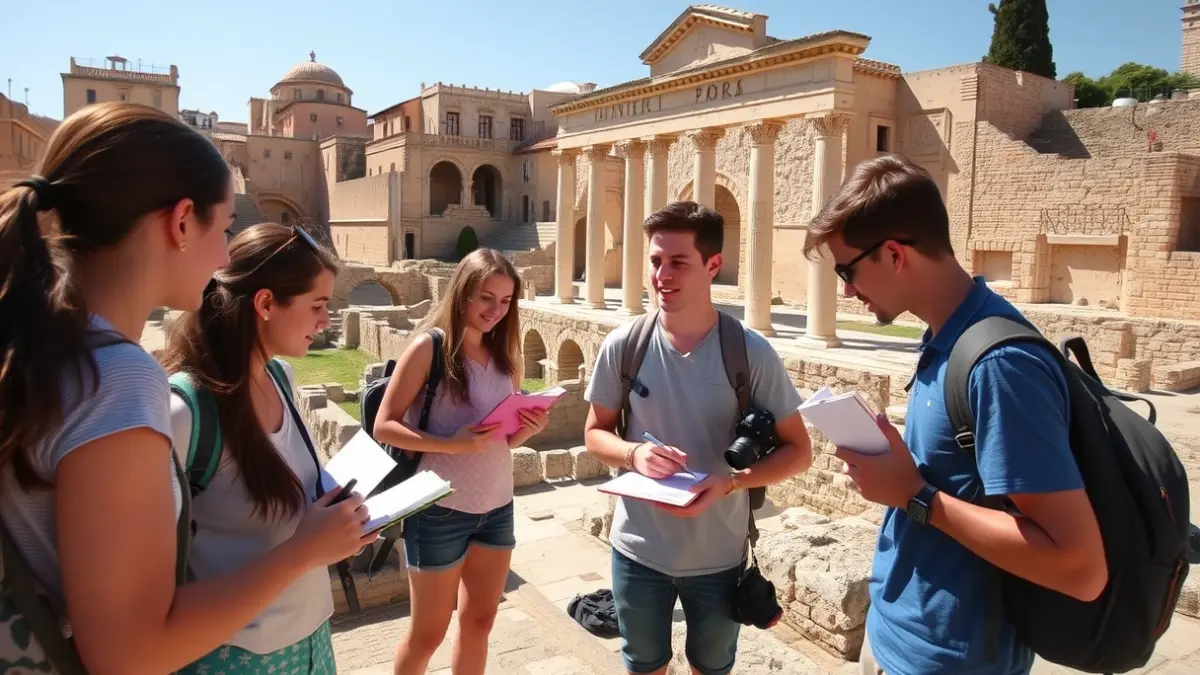
The historic monuments of Sagunto recently hosted an international group of students. Armed with notebooks, cameras, and many questions, they toured some of the city's most emblematic heritage sites to learn firsthand about conservation efforts.
This activity is part of the 'Conservation and Intervention Project' course within the Master's in Architectural Heritage Conservation at the Universitat Politècnica de València, as part of the international MURAA+ workshop. This program collaborates with several European universities, including the Politecnico di Milano, the Universitatea de Arhitectură și Urbanism “Ion Mincu” of Bucharest, the Università degli Studi di Firenze, and the Universidade do Porto.
During the day, students explored key historical sites such as the Roman Theatre and its surroundings, the Plaça del Fòrum Municipal, and the Vía del Pòrtic. Beyond the technical visit, the itinerary allowed them to observe firsthand how these archaeological sites coexist with the modern city and how they have been integrated into the urban landscape.
“"The day served to approach different intervention approaches in cultural heritage, exemplifying the restoration of the Roman Theatre and the Vía del Pòrtic, where archaeological remains are not only preserved but also enhanced within the daily use of the city."
Beyond the academic aspect, the visit also fostered a sense of exchange: students from different European countries shared perspectives, questions, and ways of understanding a common goal: to conserve and give a future to a shared past.