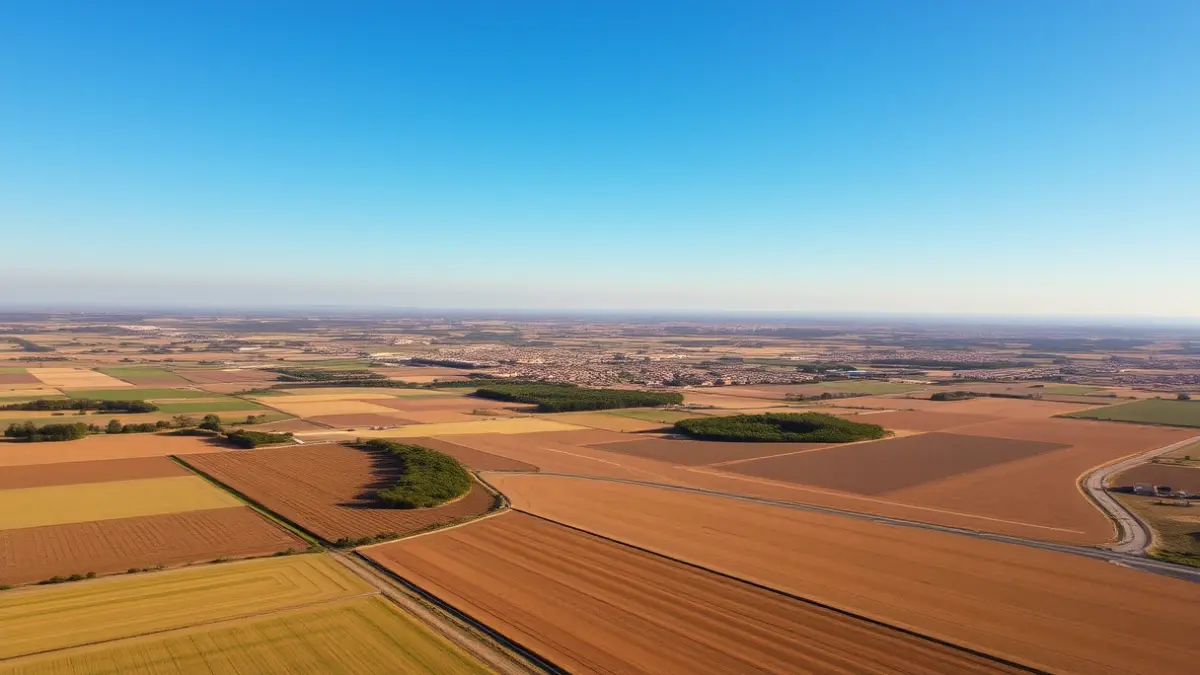
The deployment of renewable energies continues to generate tensions in the Valencian territory, and increasingly, municipalities are choosing to regulate their implementation before projects become consolidated. L'Olleria has taken a step further in this direction after definitively approving punctual modification number 6 of its General Urban Planning Plan (PGOU). This change does not prohibit renewables but does restrict them within its municipal boundaries.
For the first time, the municipality establishes what type of installations can be developed, where, and under what conditions. The objective, according to the report published this Friday in the Official Gazette of the Province (BOP), is to prioritize self-consumption and limit large-scale photovoltaic plants on undeveloped land. Specifically, the new regulations allow solar and wind installations throughout the municipality of L'Olleria when they are linked to self-consumption —either on the property itself or through energy communities— and provided they do not exceed the user's needs.
In the case of wind power, the margin is even narrower, as only installations of up to 3 megawatts (MW) intended for self-consumption are permitted, thus excluding any larger-scale development. Furthermore, the report indicates that energy production plants as an economic activity will be located on rainfed agricultural land with lower productive value. This excludes areas of high environmental value, such as the Clariano river plain.
The report emphasizes that large solar plant installations could negatively affect the landscape, agricultural use, or natural resources if not properly managed. From there, the requirements that these projects must meet are detailed. For example, solar plants cannot exceed 20 hectares, must maintain minimum distances between them, and must integrate into the environment respecting topography, existing roads, and vegetation.
On the other hand, at least half of the plot must remain designated for agricultural or forestry use. Conditions are also set for evacuation lines, prioritizing their underground placement, the restoration of land when installations are decommissioned, and the obligation to minimize visual impact. Additionally, the modification introduces other elements of landscape protection, such as the preservation of unique trees and the delimitation of the municipal green infrastructure.
It is worth remembering that, in recent months, various municipalities in the Valencian Community have chosen to revise their urban planning to set limits on the implementation of solar and wind plants. In the Vall d'Albaida region, the Aielo de Malferit City Council also approved a similar modification to restrict the expansion of large-scale solar plants in its municipal area.
Other councils have opted to suspend building permits while reviewing their planning, which led the Consell to intervene. In this regard, the government of the former president approved the Administrative Simplification Law in July 2024, which expressly prohibits municipalities from suspending permits for the installation of photovoltaic plants.
“"City councils may not adopt the suspension of permit processing provided for in the Land Management, Urban Planning, and Landscape Law (LOTURP) for the implementation of photovoltaic installations."
However, this measure does not prevent councils from modifying their urban planning, as L'Olleria or Aielo de Malferit have done, to regulate the conditions under which these types of projects can be installed.