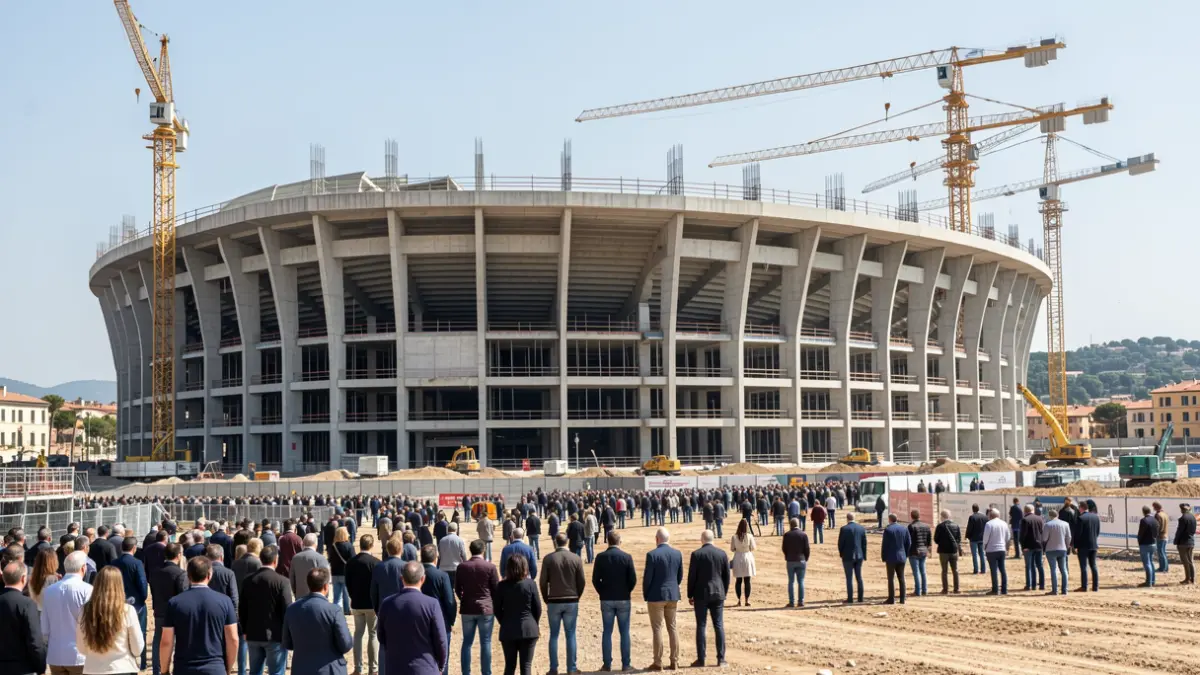
The works for the future Gandia Arena pavilion are progressing as planned and have reached nearly 20% completion. This was announced yesterday by the mayor of Gandia, José Manuel Prieto, during a visit to the site along with the president of the Higher Sports Council and Secretary of State for Sport, José Manuel Rodríguez Uribes, who reiterated his institution's support for an infrastructure set to become a benchmark for sports and large-scale events.
Prieto and Uribes were accompanied by councilors Jesús Naveiro and Elena Moncho, the general coordinator of Urban Planning, Maite Alonso, as well as municipal technicians and representatives of the construction company.
During the visit, Rodríguez Uribes expressed the Higher Sports Council's "great satisfaction" upon observing the progress of a project he described as "extraordinary" and with which the organization maintains a firm commitment. The Secretary of State highlighted that the future pavilion will host national and international competitions in disciplines such as handball or basketball, in addition to becoming a modern facility at the service of the citizens.
He also emphasized the comprehensive nature of the initiative, driven by the Gandia City Council with the collaboration of various administrations and academic entities, including the Universitat Politècnica de València. "Conceptually, it couldn't be better. It's a fantastic opportunity for the young people of Gandia, who will be able to enjoy modern facilities in a privileged setting next to the beach and the university campus," he noted.
Prieto explained that Gandia Arena is born with a dual purpose. On one hand, to meet the needs of local clubs and athletes, who will have a modern, versatile space adapted to current demands. On the other hand, to position the city as a venue for major competitions and events capable of attracting visitors year-round.
In this regard, he indicated that the first phase of the pavilion, once completed, will allow the facility to be fully operational for hosting national competitions and top-level sporting events, as well as becoming a space ready to host concerts, shows, and other large-scale cultural activities.
"The Gandia Arena is an infrastructure designed to transform opportunities into wealth and activity for the city. It will allow us to host events that we cannot currently receive due to the lack of an adequate venue and will provide a significant boost to sectors such as tourism, hospitality, commerce, and services," he stated.
The mayor announced that the tourism sector is already working in coordination with the City Council to design future operations linked to the celebration of sporting and cultural events. The goal is to leverage the potential of the new facility to attract visitors and generate economic impact throughout the year, also contributing to the de-seasonalization of tourist activity.
Prieto also emphasized the project's economic planning, highlighting that the City Council has opted for a responsible and realistic execution model. "We have planned an ambitious infrastructure, but with our feet on the ground. We have committed only what we can finance and execute, ensuring the project's viability without compromising the municipal economy or mortgaging the city's future," he said.
Finally, the mayor thanked the involvement of all the administrations and collaborating entities that have made the project possible and expressed his recognition to José Manuel Rodríguez Uribes for his continued support to the city. "Whenever we have approached the Higher Sports Council, we have found collaboration and commitment. That support has been fundamental to continue improving our sports facilities and to realize strategic projects like the Gandia Arena," he concluded.
The Gandia Arena has a projected global investment of 18.5 million euros, distributed in three phases. The first, currently underway, has a budget of 8.5 million euros and a 24-month execution period. The second and third phases involve investments of 5 million euros each.
The project's financing involves the participation of various administrations and collaborating entities. Among them is the contribution of 3.2 million euros made by the Generalitat Valenciana during the previous Consell chaired by Ximo Puig, as well as the collaboration of the Diputació de València and other entities that will join the project soon.
Once the first phase is completed, the pavilion will be fully usable on its ground floor, allowing for the celebration of sports competitions and major events. The venue will initially have a capacity for over 1,300 seated spectators and up to 4,000 standing.
The new pavilion will be three times larger than the current multipurpose pavilion of the municipal sports center. The facility will feature a central court of 32.10 by 57.30 meters, prepared to host a longitudinal court for futsal and handball, as well as three transversal basketball courts.