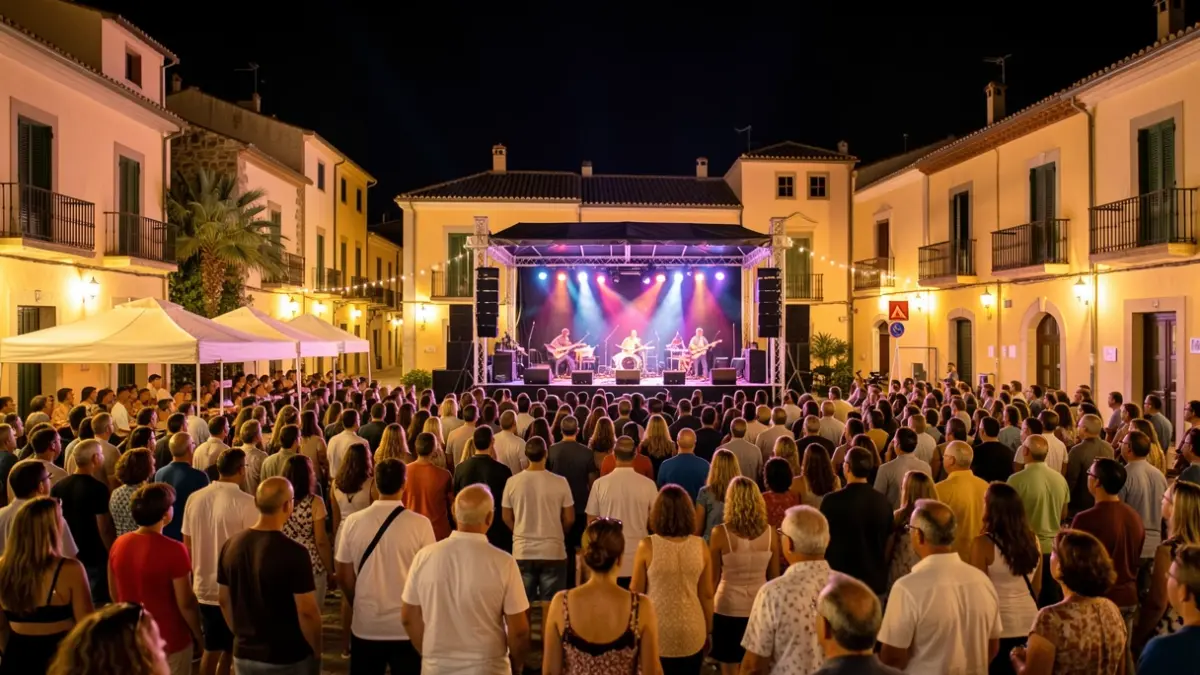
The Corbera Blues Festival reaches its eleventh edition, held from June 26th to 28th. According to David Preus, one of its founders, the festival's name reflects its triple purpose: 'Festival' for its organization of activities in a specific space and time; 'Blues' to showcase the music, social, and cultural history of this genre; and 'Corbera' to promote the municipality and attract diverse audiences.
Preus, who lives in Berlin, was interviewed at a jazz club in the city. Regarding the question 'What is blues?', which he used to ask artists, he states there is no single answer, as it is a personal feeling. Blues is born from within each individual, and its understanding is intrinsic.
The festival began eleven years ago from an idea by Corbera's Festivals Councilor, Maribel Gayón, to bring 'emigrant' artists to the town. Preus's rock-blues band, 'One for the Road,' joined the project. The unexpected success led a one-off event to be repeated year after year, becoming the Corbera Blues Festival.
Despite Corbera's limited resources, the festival survives thanks to a municipal subsidy and numerous selfless aids and collaborations from the local community. Collective work, the will to find solutions ('how could we do it?' instead of 'it can't be done'), and faithfulness to the essence of promoting blues, combining established and emerging artists, have been key to its growth.
The festival has hosted international figures such as Billy Branch, Vasti Jackson, Tony Coleman, and Tommy Castro, without forgetting visibility for regional and local groups. Preus highlights the good treatment of musicians, who typically do not have 'rock star' attitudes, and their satisfaction with the experience in Corbera.
One of Preus's best experiences has been witnessing people's involvement and seeing projects come to fruition, as well as meeting incredible individuals. He also emphasizes the South African musician ‘Smoke’ J. Lawrence as an authentic bluesman and a life lesson. The main current problem is the lack of accommodation in Corbera.
For the current edition, the band Chicago Summer Tour, featuring guitarists Stephen Hull and Giles Corey, generates excitement, as do the solo performances by Richard Ray Farrell and the collaboration between Richard ‘White Boy’ White and Noémie Delavennat.
Preus believes that blues, as a minority music, preserves its primitive essence and truth. Although not 'mainstream,' there are people dedicated to giving it visibility. The health of the blues is what corresponds to it, attracting those who carry it within. The current music industry, however, prioritizes industry over music, limiting the potential of many talents.
The festival's impact on Corbera, a town of 3,000 inhabitants, is noticeable during the weekend, attracting over a thousand people. It has put Corbera on the music festival map, mainly for promotion. The festival's future depends on people's willingness to organize it, a minimum budget, and maintaining the audience.
Preus hopes the festival will be remembered as an example of altruistic collective work, the good times experienced by attendees, and the quality of the concerts. Blues, besides being the foundation of many modern music genres, can teach about history, culture, and awaken deep sensations.