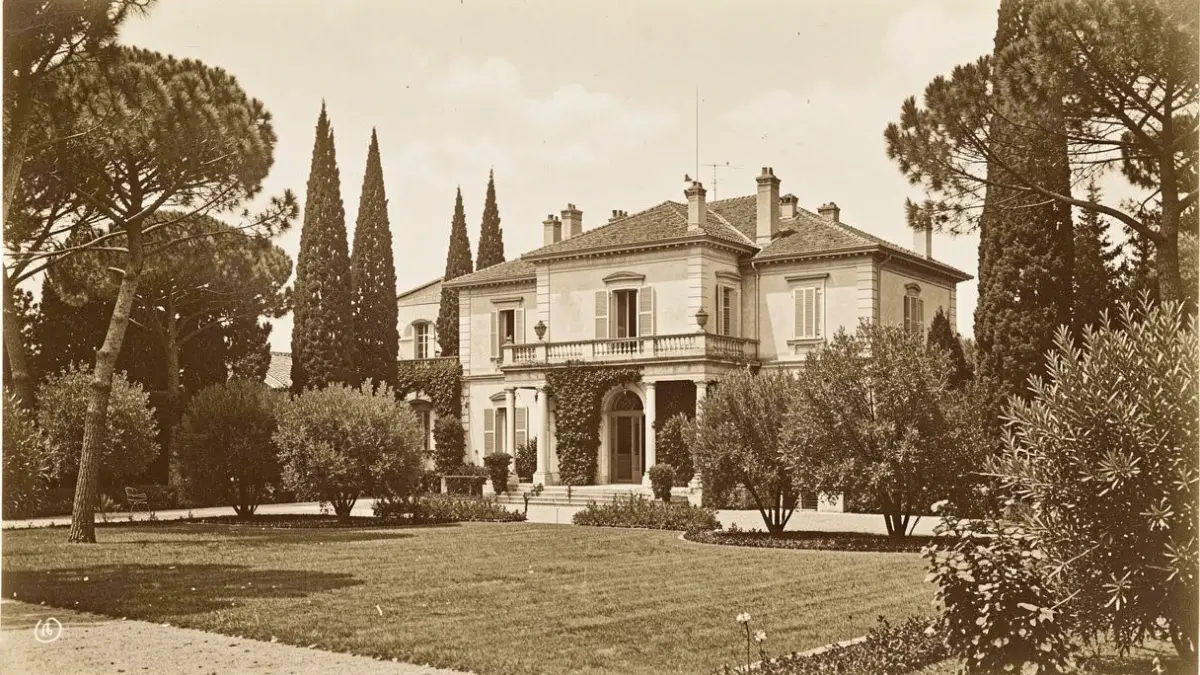
In the early decades of the last century, Castellón residents with greater economic means distinguished themselves by settling in their country houses (masets) during the summer, in an area between the current Villarreal Avenue and the Gran Vía. Along with Enrique Gimeno Avenue, this zone gathered distinguished families from the city who could afford a very different type of summer rest compared to the majority.
A century ago, the end of July, with the festivities of Saint James the Apostle and Saint Christopher, marked what Heraldo de Castellón defined on July 27, 1925, as 'the first exodus of the poor's summer'. The newspaper noted how the city became 'dead' in favor of El Pinar, the farmhouses (alquerías), and the masets, highlighting the role of gunpowder on summer nights and calling for the 'August exodus' around the feast of the Assumption and Saint Roch.
However, in the 1920s, the second residence of the more affluent residents was not yet in Benicàssim. The preferred summer location for those who could afford it was the area between the current Villarreal Avenue and Gran Vía, near the railway line and next to Enrique Gimeno Avenue. With names like Villa Paraíso, Los Arrayanes, or Torre Valencia, this environment gained increasing importance in the early 20th century, hosting the masets of numerous well-positioned families.
On August 20, 1915, Heraldo de Castellón reported a significant improvement: the installation of the electric line, from the municipal factory, to provide light to this new area. The newspaper specified that the masets in the zone would 'gain extraordinarily with this improvement', in parallel to a naturalistic urban planning trend promoted by figures like Ebenezer Howard, who advocated for the garden city concept with green spaces near the urban center.
Providing the necessary services to what would become known as the Ciudad Jardín was not simple, partly due to its distance from the urban core and because it was an agricultural Castellón that prioritized field work. On June 12, 1919, Heraldo published that the esplanade of the Provincial Hospital had become a threshing floor, questioning whether the agricultural tasks had permission from the Provincial Council and demanding that the wheat-threshing work be done in a place that did not bother passers-by.
The improvement of the neighborhood's security and communications were constant concerns in the press. On July 24, 1919, Heraldo de Castellón reproached the mayor José Forcada Peris for the failure to restore municipal lighting on the Gran Vía and the lack of repair of the access roads via the Lucena road and the 'tiro de palomo', which presented an 'evident danger to road traffic'. The newspaper described a 'picture of abandonment' and an 'impassable' road due to accumulated earth.
On July 21, 1925, the newspaper directed by José Castelló i Tárrega ironically celebrated that the 'auto-tanker' had passed through the dusty Gran Vía and watered it, considering it a sign of municipal interest in the expansion. It was requested that the auto-tanker pass whenever possible and, if the budget allowed, that the ditches be cleaned and the embankment repaired to improve Castellón Avenue.
Little by little, improvements were achieved. On August 1, 1929, the same newspaper announced the replacement of an 'old pipe with one of much larger diameter' on Doctor Clará Avenue, by the company Fomento Agrícola Castellonense (now Facsa). These works aimed to bring water to the masets of the Ciudad Jardín, already consolidated as a summer resort, contributing to the city's expansion with a permanent bus service.
Five years later, the bus service would be consolidated. On July 7, 1934, Heraldo reported the reorganization of transport to the masets and the Ciudad Jardín, after the service on Enrique Gimeno Avenue was suspended due to the poor road conditions. Bus departures were scheduled for morning and afternoon times, following the route Gran Vía, Villarreal Avenue, and the Alcora road.
However, the pace of improvements was not always as expected. On April 19, 1926, the newspaper lamented the 'slowness' in decongesting the capital and promoting permanent habitation in the surroundings of Castellón. It called for agility in the expansion plan designed by architect Vicente Traver Tomás and for the City Council to improve access roads, provide them with public lighting, and prevent the accumulation of garbage.
By June 1936, things remained the same, and Heraldo continued to call for the urbanization of the Gran Vía road and the repair of the 'tiro de palomo' field, works that could provide employment for many laborers. Despite the difficulties, in the following decades, until times changed with urban growth and the exodus to Benicàssim, the Ciudad Jardín remained the epicenter of Castellón's summer life.
“"The president of the Generalitat, Eduardo Zaplana, and the secretary general of PSPV-PSOE, Joan Ignasi Pla, starred in the edition of Friday, June 15, 2001, with their 'historic pact for the language', consisting of the agreement on the composition of the new Valencian Language Academy (Acadèmia Valenciana de la Llengua), which was to include five Castellón residents as academics: Ascensión Figueres, Alfred Ayza, Mª Soledat González, Josep Palomero, and Lluís Meseguer."