
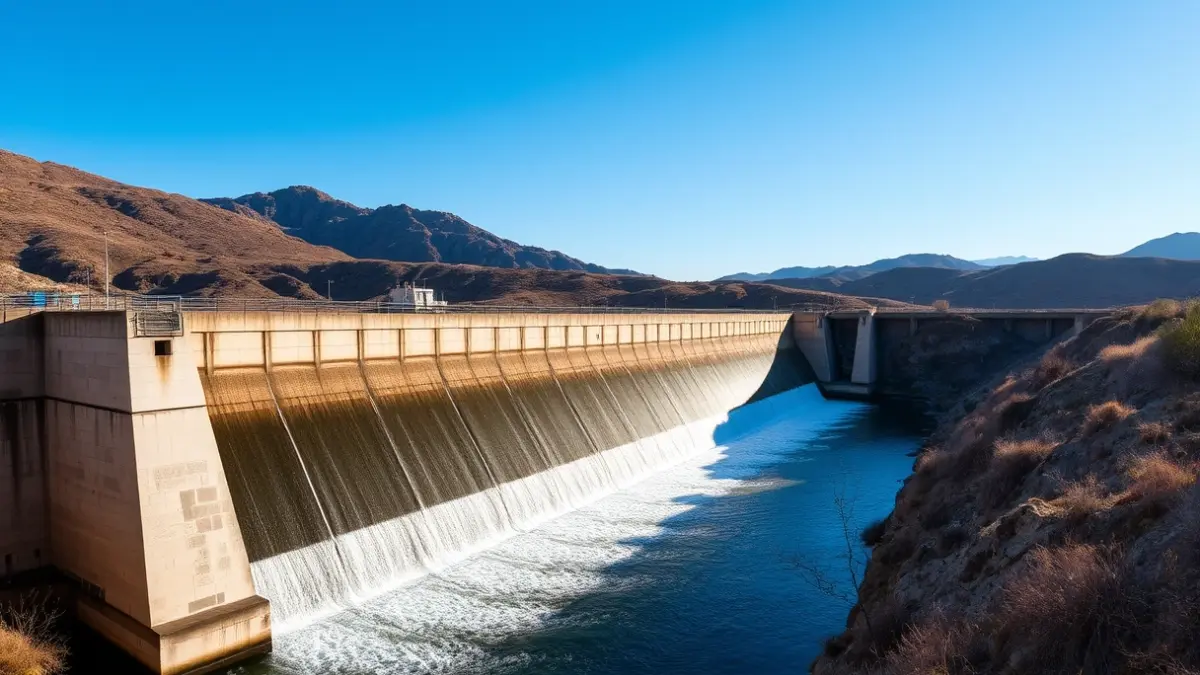
Most of Castellón's hydraulic infrastructures are over half a century old, with the María Cristina dam celebrating its centenary and the Onda dam approaching 75 years. Only the Arenós dam, at 45 years old, is the youngest. This age, coupled with the increasing frequency of adverse weather phenomena, has led the Ministry for Ecological Transition to classify all reservoirs in the province with a risk level A.
This classification implies that a potential failure or incorrect operation could cause very significant material or environmental damage, severely affecting urban areas or essential services. Experts emphasize the importance of adequate maintenance and greater investment to ensure the safety of these infrastructures.
“"There is no need to alarm the population, because measures are taken to prevent a rupture or malfunction of the reservoirs."
One of the preventive measures applied is the control of the reserve volume, which establishes the maximum water retention capacity to prevent overflows. For example, in the Arenós reservoir, the maximum capacity is 110 cubic hectometers, but the reserve volume is reduced to 65 cubic hectometers from January to August, and to 52 cubic hectometers from September to December, a period of higher risk of intense rainfall.
The need for investment is evident, as demonstrated by the budget allocated to improve the safety of an unstable wall in the Arenós reservoir. The College of Civil Engineers warns of a lack of professionals for dam operation and calls for more support for these infrastructures, which play a key role in river containment and flood prevention.