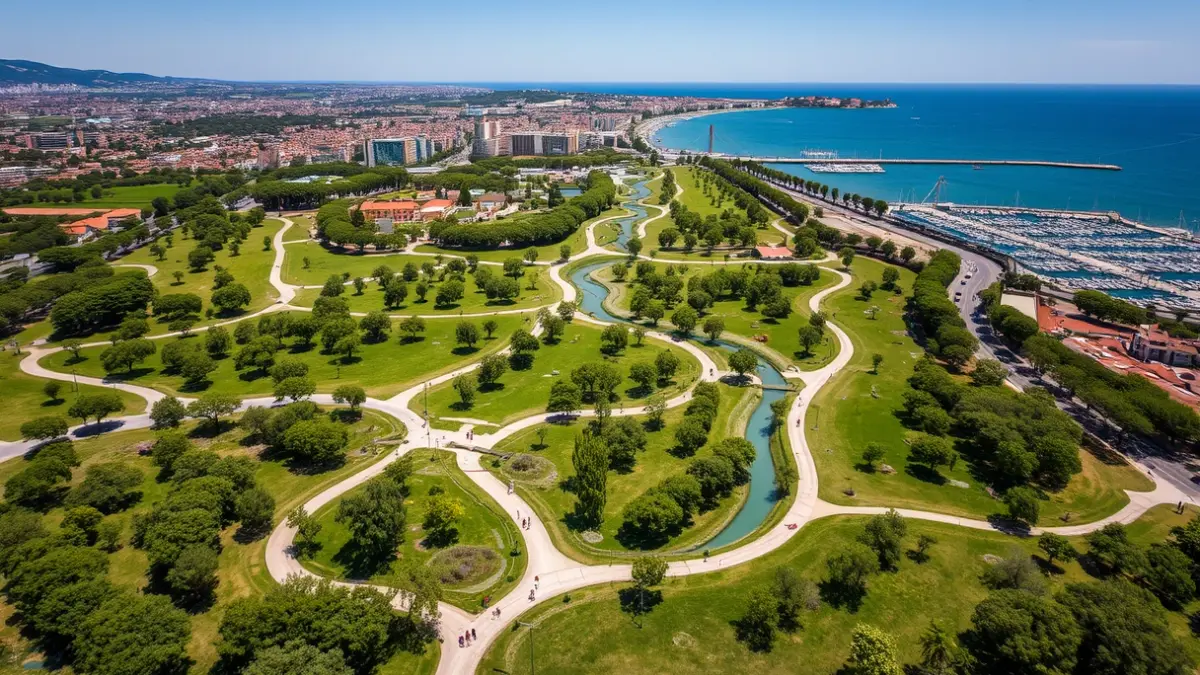
This urban project will provide over 160,000 m² of green areas, becoming a key piece to complete the city's largest green corridor. Additionally, it incorporates an integrated water management system designed to reduce flood risk in a particularly sensitive environment.
The Grao PAI's commitment to green areas is reflected in the reservation of 41.7% of the sector's total surface for public spaces, a proportion that more than triples the private buildable land, which accounts for 14.2% of the area. In absolute terms, the PAI will add 105,000 m² of new green areas within the sector, known as the Green Delta.
These will be joined by the 54,000 m² of the final section of the Turia Garden, whose landscaping is part of the provisions that developers will contribute to the City Council. In total, the city will gain over 160,000 m² of green spaces directly linked to this action. The Green Delta will not only be a large green lung in the urban fabric but, by being located at the confluence of the Turia Garden and the Marina Real, it will complete the green corridor that runs through the city from west to east.
Together with the future Desembocadura Park and the Cabanyal Greenway, it will form the city's new green coastal front. The project also includes a significant climate protection component, especially after the DANA of October 2024. This involves an integrated water management system operating on three fronts.
Firstly, all green areas will be equipped with sustainable drainage systems (SUDS) that promote the infiltration of rainwater into the subsoil and aquifer recharge, reducing surface runoff that contributes to flooding. Additionally, the project includes a 6,000 cubic meter storm tank, connected to the existing collector and co-financed with a specific contribution of 4.5 million euros from the developers, which will reduce initial rainwater discharges and alleviate pressure on the Pinedo treatment plant.
Finally, the construction of three low-pressure irrigation wells connected to the municipal network is planned, capable of meeting the irrigation needs of green areas, street trees, and fountains in the sector, and supporting the rest of the city through interconnection. The presence of green areas in the rest of the sector is materialized with the provision of 430 new tree pits in the tree-lined streets of the future neighborhood, which will help reduce urban temperatures and improve air quality.