The town of Dénia had two main access points: one to the west, which is today the entrance to the Castle of Almohad origin, and another to the east, the Portal dels Reis or dels Socors, which connected with the maritime facade and port facilities. This more enigmatic eastern portal has been cleared of a stratum of over four meters of rubble and infill thanks to an intervention subsidized by the Ministry of Housing and Urban Agenda.
Historical documentation, such as the Nominal Census of Houses and Lands (c. 1590) and the Council Books (1495-1627), already referred to different names for this access, such as the "portal de la vila de la mar", the Portal dels Socors, the portal de la vila del Verger, and finally, the Portal dels Reis. Its connection with the "mirador de la mar" (Book of Masses, 1575) and the portal de les Barreres del Verger (Council Book, 1494) suggests its antiquity.
The toponym Portal dels Reis could be linked to the stay of Kings Philip III and Margaret of Austria in Dénia. A chronicle recounts how the king had to be transported by chair through this portal due to its steep location, after suffering sunstroke during a fishing trip. This event prompted the construction of a covered passageway by the Duke of Lerma, which Philip III already used in 1604.
Vespasiano Gonzaga's Perspective of Dénia (1575) and a canvas by Vicent Mestre (1613) depicting the embarkation of Moriscos are the oldest graphic documents showing this access. The recovery of the Batería de la Mar and the Portal dels Reis or dels Socors, along with the creation of an accessible ramp to the Verger Baix, has been the objective of the project, authorized by the Directorate General of Heritage.
The Area of Archaeology and Museums of the Dénia City Council requested the subsidy in 2019. The project has suffered delays due to technical difficulties in the recovery of the Galliner tower and the creation of the ramp, requiring a redesign of the initial project to adapt it to the new topographical circumstances.
During the works, the door dels Reis or dels Socors has been cleared of the substantial burial layer. The portal, located at the eastern end of the southern section of the wall, is protected by the Galliner tower and the "torre del Portal dels Socors". The "mirador" articulates a double portal: one for access to the fortress ("Portal dels Reis") and another to the town ("Portal dels Socors"), controlling three key accesses, the wooden bridge, and the port entrance.
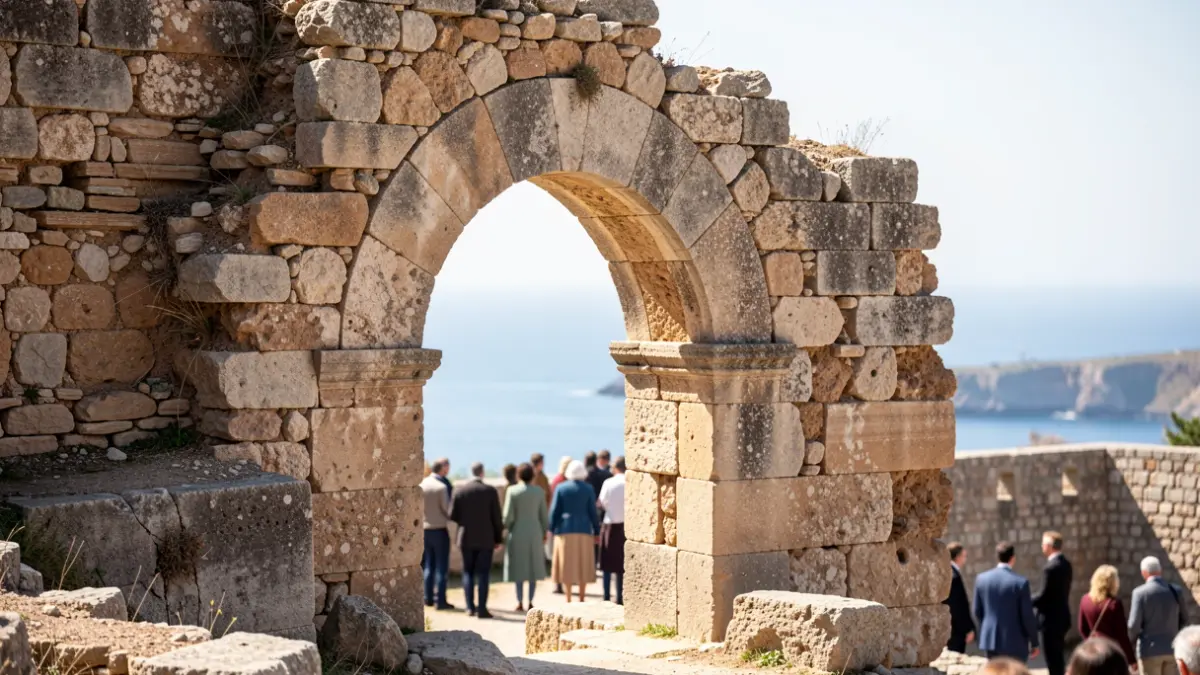
The Portal dels Reis features a semicircular arch and a short lowered vault, with a path delimited by a wall extending to the Verger enclosure. The archaeological intervention has uncovered a limestone threshold and a pavement considered foundational from the Islamic period. The portal's construction is related to 16th-century defensive reforms, such as those of the Verger, Galliner, and Portal dels Socors towers.
The Portal dels Socors, the access to the town, is in a poor state of conservation but of great architectural interest. From the Portal dels Reis, a path turns 180 degrees westward along Calle de Avall. The layout of this street, documented since the 16th century, connects with the town's gate.
Both portals form an access unit from the southeast, reinforcing the defense. Their structure is linked to the Islamic phase, with adaptations in the 16th century. A staircase with a bench overcomes the slope towards the town's gate, which has jambs of ashlar masonry with bossed stonework, preliminarily dated to the 11th century, reinforcing the hypothesis of Islamic origin.
The Portal dels Socors shows strong fire marks, possibly from bombardments during the Wars of Succession. The gate, of Islamic origin, might have been crowned with a horseshoe arch. The interior passage, delimited by the wall, preserves remains of real tapial and has been consolidated.
An angled gallery, with walls featuring multiple layers of plaster and graffiti, leads to a lowered arch. Behind it, a small oratory or chapel, with a niche for an altarpiece and a tiled altar, possibly under the invocation of Mare de Déu dels Socors.
The destruction of the portal complex may have occurred during the War of Succession. The disappearance of the Portal dels Reis before 1928 allowed the construction of houses on the wall, preventing its complete recovery. The Portal dels Socors now connects with the Portal dels Reis and the Verger Baix via a walkway.
The completed intervention has enabled communication between the portals and the Verger Baix. The rehabilitation of the Portal dels Reis and the Galliner tower remains pending. These actions are part of Dénia's exposed geographical position, which has historically required coastal defense systems against Berber piracy.
Dénia's fortification, of Islamic origin, was reinforced with new military constructions in the 16th century, such as the Verger, Galliner, and Portal dels Socors towers, adapted for artillery. In parallel, the urban center was consolidated, with the suburb transforming into a vibrant hub with institutions like the wheat granary and the hospital.