The reopening of this infrastructure, the first of five structures in the town to be put into service, was attended by the Minister of Transport and Sustainable Mobility. The minister expressed his satisfaction with the return to normality in Picanya, one of the areas most affected by the DANA.
The reconstruction of the footbridge has been carried out with criteria of resistance and robustness, designed to face the effects of climate change. In addition to the María Cambrils footbridge, the Ministry is working on four other nearby infrastructures: the Avenida del Mediterráneo Bridge, the Poeta Ángel González footbridge, and the Calle Valencia and Diputación crossing bridges.
“"The criteria used to reconstruct the infrastructures in the DANA zone are criteria that address the reality of the future, in which we will have more extreme climatic events, with more rainfall or more heat. These constructions must serve to withstand them."
The action plan in Picanya is part of an agreement signed on March 5, 2025, between the Ministry and the Picanya City Council, to address the damage from the DANA. This agreement is part of an immediate response plan that includes several Valencian municipalities and involved the activation of 34 million euros in emergency funds.
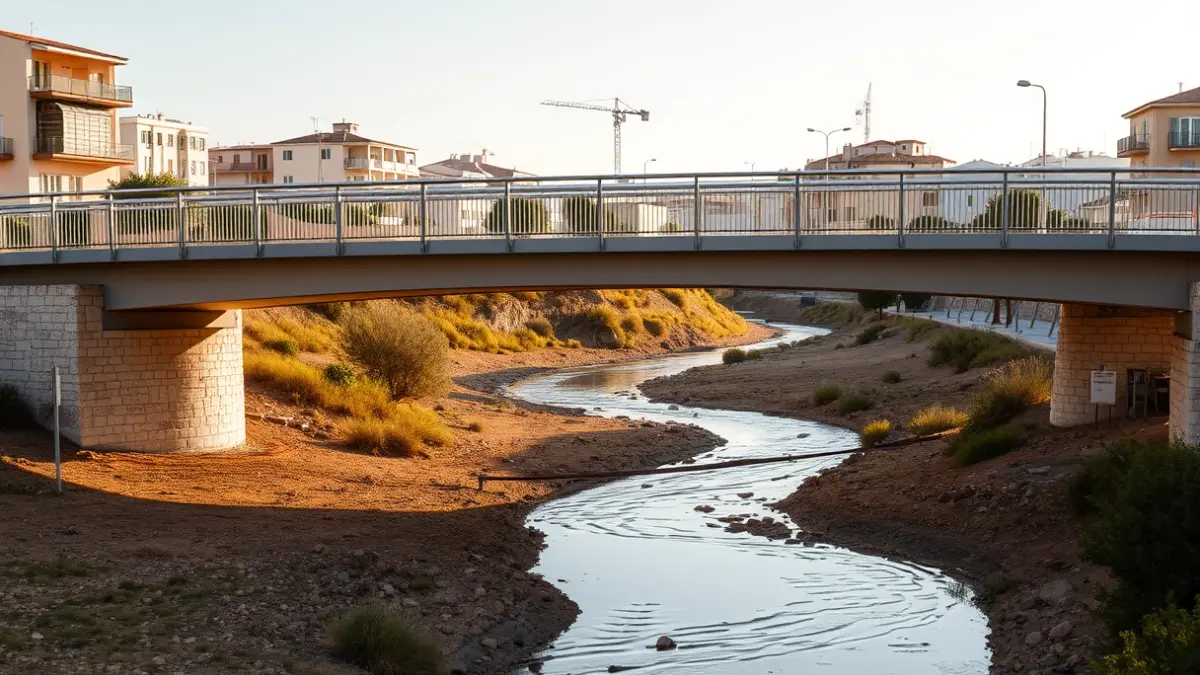
The new María Cambrils footbridge, designed for pedestrian and cyclist use, has a usable width of five meters and a total length of 82.10 meters. Its design incorporates reinforced concrete pillars founded at depth and a deck that combines a metallic structure with a concrete slab, minimizing channel occupation and facilitating water flow in case of floods. The railings are designed to yield during strong floods, protecting the main structure.