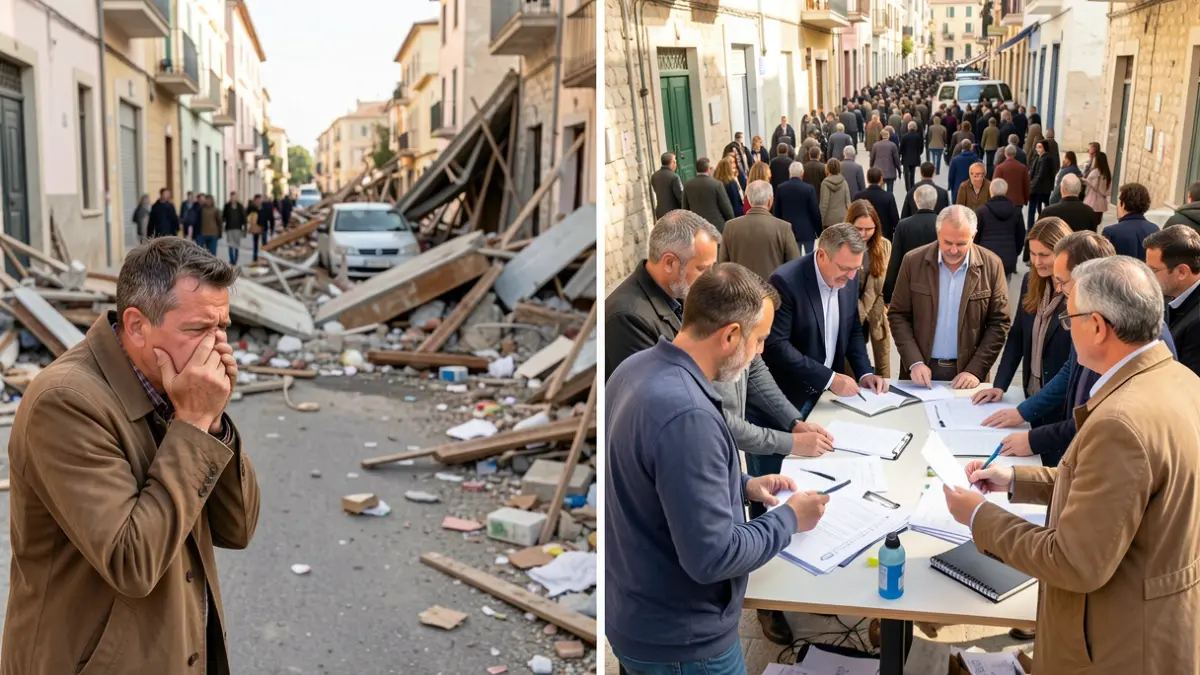
Just a year ago, L'Horta Sud represented one of the main focal points of Valencian municipalism. The profound citizen frustration following the management of the DANA on October 29th led to the emergence of neighborhood groups and citizen platforms that proposed channeling this discontent to the polls through independent candidacies. Locations like Paiporta, Catarroja, Benetússer, and Picanya witnessed speculation about new local formations for the 2027 elections.
However, a year later, this initial momentum seems to have lost strength. Of all the initiatives that emerged, only the creation of Picanya Avanza has been publicly materialized. Other projects are still in the work phase or have become diluted. The Unión Municipalista, which groups independent parties, confirms ongoing discussions in towns such as Paiporta, Torrent, Xirivella, Quart de Poblet, and Benetússer, with the latter presenting the most advanced project.
Not all post-DANA initiatives have been linked to this organization. Movements arising from the associative fabric also considered the possibility of entering municipal politics, an option that, for now, has not materialized. The political debate has gradually returned to usual municipal, regional, and state management issues, and the initial discontent has subsided.
The electoral landscape in L'Horta Sud appears competitive. The historical weight of the PSPV, the recovery of the PP, the presence of Vox, and the influence of the Valencia city campaign reduce the space for new independent options, making it difficult to transform initial discontent into institutional representation.
In contrast, L'Horta Nord presents a different situation. While the municipalist phenomenon is losing strength in the South, it is consolidating in the North, where local candidacies have deeper roots. Unlike the neighboring region, independent formations in the North are not starting from scratch; some already have institutional representation, have participated in governments, and have even held mayorships.
Cases like Massalfassar, with former Ciudadanos leader Higinio Yuste as ex-mayor, or Massamagrell, where Juan Zamorano was close to becoming mayor, illustrate this reality. Furthermore, new local formations have been established in Alboraia, and similar projects are being developed in El Puig. The municipalist strength extends towards El Camp de Morvedre, with Iniciativa Porteña as a consolidated reference.
In conclusion, while L'Horta Sud seems to be moving away from the post-DANA political effervescence, L'Horta Nord is confirmed as the main growth area for independent candidacies in the metropolitan area of Valencia.