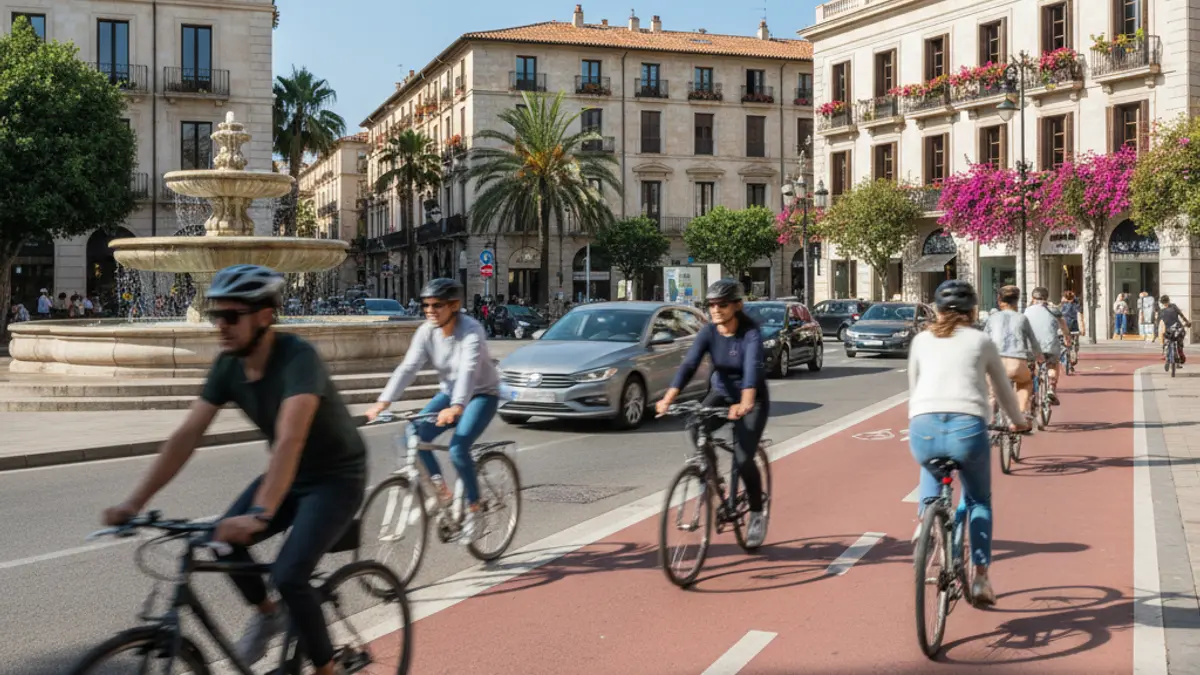
Accesses to Valencia registered a daily reduction of 6,000 vehicles in April compared to the same period in 2025. These figures, analyzed by the City Council, also reveal a decrease in traffic on the city's main inner roads and a significant increase in the use of the bike lane network, which now exceeds 225 kilometers.
The Mobility Councilor, Jesús Carbonell, noted that the Average Daily Intensity of accesses in April, although higher than in previous years, is 5.48% lower than in 2019, a year he defined as the peak of urban traffic. This data places the current evolution of circulation below the levels prior to that traffic peak in the city.
On Valencia's main inner roads, the monthly study by the City Council also points to a reduction in circulation. Average Daily Intensities have decreased by 4% compared to 2025, 1% compared to 2023, and 7% compared to 2019. The City Council interprets this data as a sign of stabilization of internal private vehicle mobility.
“"The most important and complex urban work carried out in Valencia in recent decades."
This evolution occurs while the city faces the redevelopment of Giorgeta-Pérez Galdós avenues, an action that the mayor last week described as "the most important and complex urban work carried out in Valencia in recent decades." Despite the scope of these works, inner traffic data does not reflect a general increase in circulation on the main roads analyzed.
The City Council advocates for a global analysis of the data versus partial traffic readings. Jesús Carbonell explained that the Municipal Government maintains rigorous criteria to analyze traffic evolution in Valencia. The councilor warned that describing the urban mobility situation using specific data from certain roads and extrapolating that data to the entire city is not fair and does not reflect reality.
Bicycle use grew by 10% in April, reinforcing the commitment to sustainable mobility. The City Council highlights this growth, linking it to the advancement of sustainable commutes. Carbonell emphasized that citizens are increasingly prioritizing the use of sustainable transport modes, including bicycles and public transport, with reference to the EMT.
The municipal reading of April's figures depicts a city where private vehicles maintain a significant presence, but where inner traffic stabilizes or decreases compared to previous years. At the same time, bicycle use grows and public transport gains passengers, two indicators that the Municipal Government links to a progressive transformation of daily mobility.