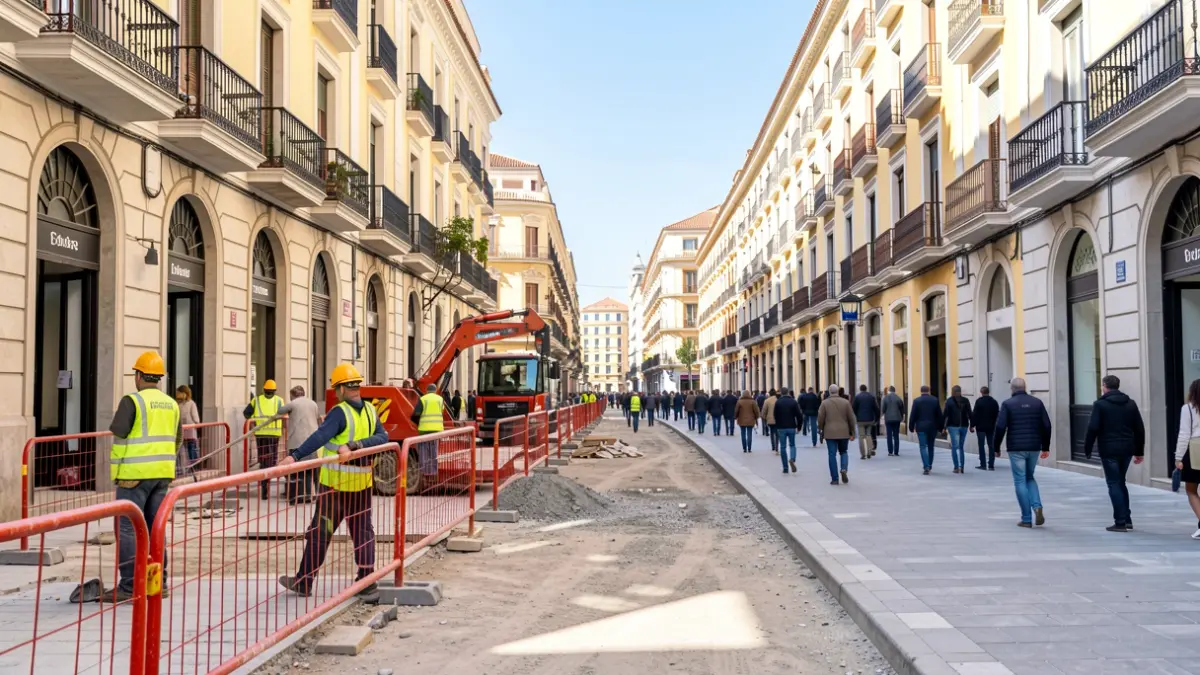
Renovation works on Valencia's Colón street, one of the city's main commercial and public use arteries, began this Monday as scheduled. The project will last for the next five months and will not require the cessation of commercial activity in the establishments, as the work will be compatible with the daily operations of the businesses.
The work schedule has been planned to ensure completion before the Christmas shopping season to avoid negatively impacting local businesses. The Mayor of Valencia, María José Catalá, emphasized during the initiative's presentation that this was "a basic premise" of the project, the city council highlighted.
The renovation includes increasing pedestrian space, installing sound-absorbing asphalt, and unifying the pavement. The Councillor for Urban Planning, Juan Giner, attended the start of the works this Monday morning along with representatives from the local neighborhood association and the Association of Historic Center Merchants.
Giner assured that the city council will be "in permanent contact" with these groups "throughout the entire construction period to address any issues and inconvenconveniences" that arise, aiming to "minimize them as much as possible." "All construction causes inconvenience; patience is needed, but we want, and it is our objective and we will be very demanding about it, for the works to be completed by the Christmas campaign," the councilor insisted.
The official, also responsible for Licenses, detailed that the works have started with two teams: one on the sidewalk of the even-numbered addresses starting from Porta de la Mar, and another on the odd-numbered ones from the beginning of Colón street. "By the end of July and in August, a third reinforcement team will tackle the street's epicenter, specifically the plaza de los Pinazo," added Giner, who highlighted the project's 2 million euro investment.
The municipal official pointed out that this reform will represent "the first action within the 'Plan Valentia' for urban identity" proposed by the local government for the city. This is a "new urban identity that will be present in the strategic transformation actions of Valencia's historic center".
"We are reclaiming the sidewalks for pedestrians," stated the mayor when announcing the renovation. To achieve this, "inappropriate elements" such as bicycle racks and motorcycle parking, or Valenbisi stations, will be removed. Wider tree pits will also be installed to allow for tree growth and provide more shade. Giner assured that this will increase pedestrian space, while also noting that the Mobility department is working on new locations for motorcycles and bicycles, which will be distributed in nearby streets like Cirilo Amorós or Navarro Reverter.
The renovation affects an intervention area of 21,900 square meters, encompassing Colón street, the plaza de los Pinazo, and Cerdán de Tallada street.
In total, 12,000 square meters of sound-absorbing asphalt will be installed to reduce noise from vehicle traffic by up to 10 decibels and pollutant gas emissions by 20 percent. Additionally, 8,137 square meters of granite pavement, 6,100 meters of curbs and gutters, urban furniture (60 benches and chairs, 40% more than currently, and 90 trash bins), bollards at intersections to favor public transport, wider pedestrian crossings, and specific traffic lights for bicycles will be installed.
"This is a comprehensive redevelopment aimed at improving urban quality, mobility, and the experience of those who live, work, walk, or visit this area of the city for any reason," municipal officials added.
Furthermore, the city council emphasized that the works will proceed without halting commercial activity or completely blocking vehicle passage.
The municipal government, in coordination with the Urban Planning and Mobility departments and the contracted company, has designed a work schedule and mobility plan with a dual objective: to meet deadlines and, fundamentally, to cause the least possible disruption during the execution period.
The construction execution plan is designed to maintain access to establishments at all times, as the width of the sidewalks on this urban street allows for sector-by-sector work, balancing commercial activity with renovation efforts, the City Council detailed.
Moreover, it was highlighted that Colón street will never be completely closed to traffic. Asphalt work will be carried out at night, and the most sensitive tasks will be scheduled to minimize disruptions. Some temporary closures are planned for work on curbs or intersections, although most of these already have the same granite pavement, facilitating integration.
The Councillor for Urban Planning added that next June 22nd, the asphalting of Gran Vía Marqués del Túria, a nearby urban street with heavier traffic, will begin. "Therefore, for the start of the work on Colón, we wanted to wait until the school year ended, activity in schools decreased, which means less school transport, and also a time when residents are going away on vacation," noted Juan Giner.
Within the 'Valentia' plan, Colón street, the first urban project under this program, will integrate the 'Valentia' seal into its pavement as part of the renovation.
Actions in the Plaza de San Agustín and the Plaza del Ayuntamiento, currently in various stages of processing, will also be carried out under this new urban identity framework.
The seal to be placed on the pavement, created by Valencian artist David Cercós, is inspired by the founding inscription of Titus Livius located in the Plaza de la Virgen.
The design features the legend 'Valentia' and a bat, a symbol of identity, in a monochrome piece that will be discreetly yet recognizably integrated into the pavement. From now on, every project developed under the Valentia Plan will incorporate this seal.