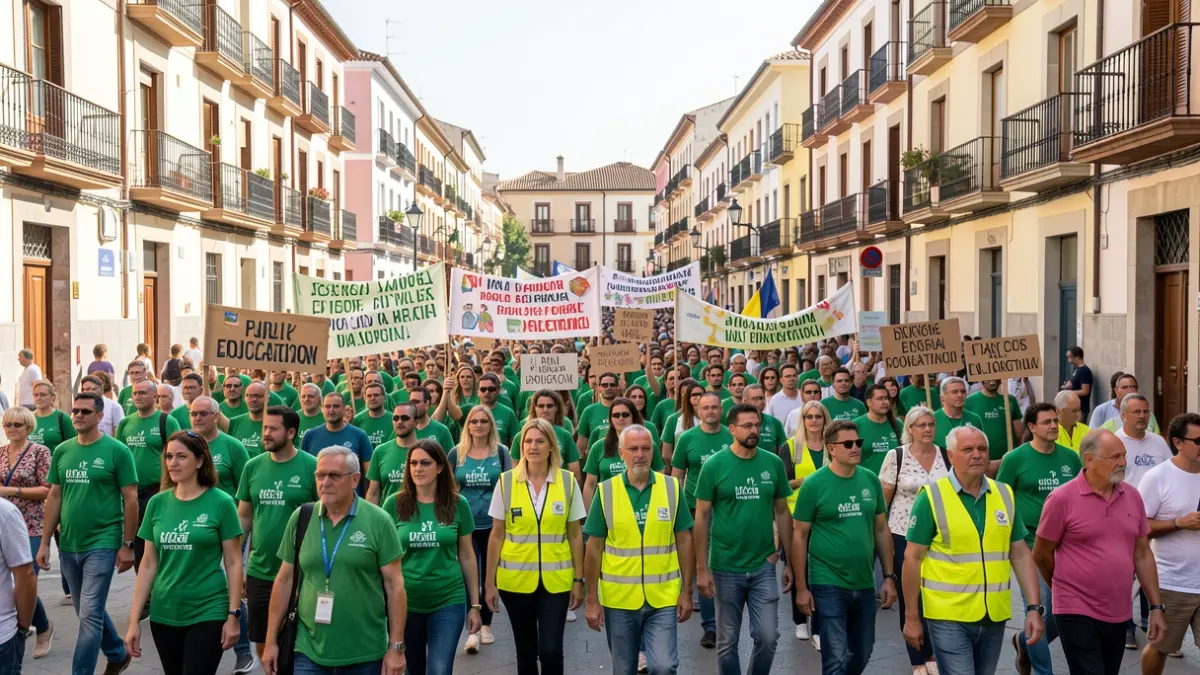

Caritas Diocesana de Valencia this morning called for the establishment of "a social pact in favor of people whose rights to housing, dignified work, or sufficient social protection are violated." This call was made during the presentation of its 2025 Annual Report, an event attended by the auxiliary bishop of Valencia, Arturo García, the director of Cáritas Valencia, Aurora Aranda, and the institution's general secretary, Belén Lado.
This document outlines the institution's actions last year, a period marked by a significant increase in assisted individuals, partly due to interventions following the October 2024 DANA (cold drop) event. The number of people accompanied has risen by 33% compared to the previous year, although the percentage of foreign nationals assisted has decreased by 9 points.
The entity has detected a 17% increase in first-time assisted individuals, a figure also linked to those who, without having previously needed help, requested it after the floods.
“"The assistance provided due to the DANA does not explain the chronic nature of poverty and social exclusion; the persistence of the same difficulties people face in accessing basic rights for a decade, or the normalization of precariousness we are witnessing."
During 2025, Cáritas Valencia's actions benefited over 73,742 people, of whom 34% are minors. "Once again, we find that the number of people accessing our resources is growing, and we have to support them for longer," Aranda added.
The most frequently assisted profiles follow previous years' trends: migrants in irregular administrative situations (61% of foreign nationals assisted), single mothers with children, young couples with children, large families, and people in precarious housing situations. Reports like the FOESSA Comunitat Valenciana 2025 highlight that households with a migrant and/or female breadwinner, and those with minors, show higher levels of exclusion, indicating gender and origin as cross-cutting factors affecting access to rights.
The entity also points out that housing is the main factor of inequality: 4 out of 10 people assisted have this right violated, either due to homelessness, housing that does not meet family needs, or rented or sublet properties without a contract.
Faced with this reality, Cáritas Valencia has called for a social pact involving institutions and citizens. Aurora Aranda stated: "Valencian society has shown enormous capacity for solidarity. The challenge now is to transform that occasional solidarity into sustained commitment to social justice, and that commitment must be assumed by all of civil society, public administrations, the business sector, the media, political parties, and especially, Christian communities."
“"The Christian cannot consider the poor merely as a social problem; they are a 'family matter,' they are 'one of ours.'"
Aranda added that "the levels of inequality that reports and our Memory show us require broad agreements and sustained responses over time. A social pact of this nature implies building basic agreements on how we want to coexist and what rights we are willing to collectively guarantee so that no one is left behind."