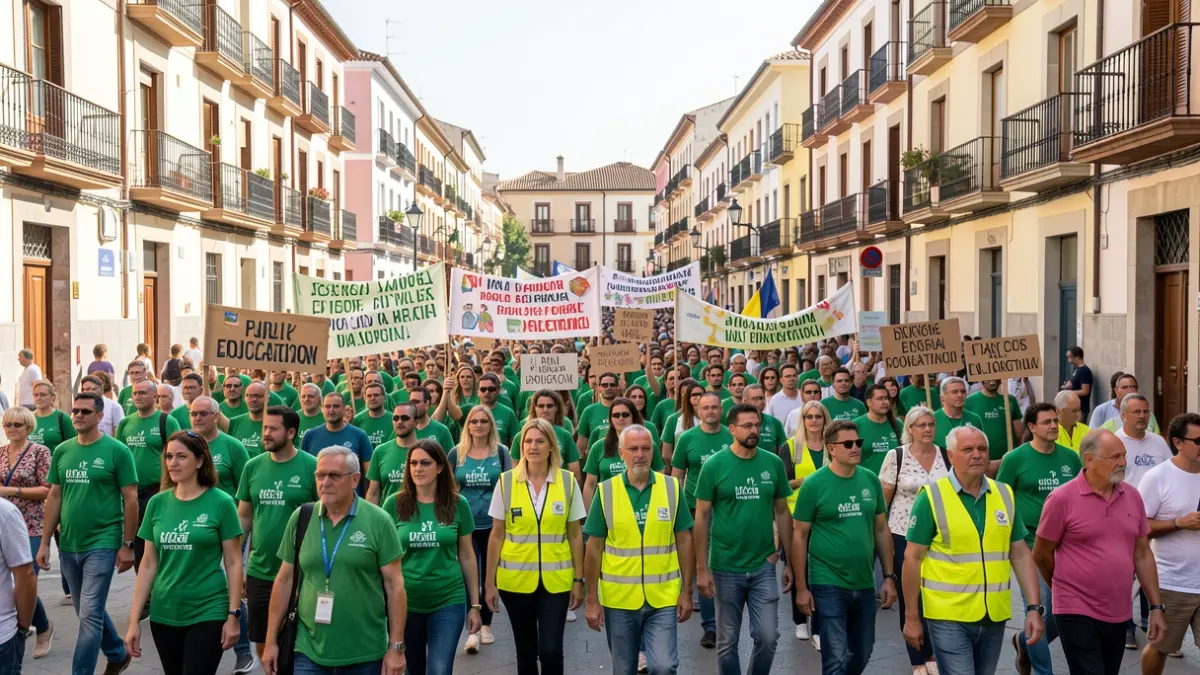
The Ministry of Education, Culture, and Universities will have a budget of 7.749 billion euros in 2026, 450 million more than the previous year. These accounts consolidate the Generalitat's largest investment effort in these areas and place Valencian families at the center of all public policies.
The Minister of Education, Culture, and Universities, Carmen Ortí, highlighted that 'three out of every ten euros entering the Valencian coffers are allocated to education,' thus expressing a political priority to support every Valencian family. The Valencian Community ranks as the third autonomous community with the highest educational spending per student, at 7,600 euros, 19% above the Spanish average.
In terms of teaching staff, the first economic allocation for the agreed-upon salary improvement is included, with over 22 million euros in 2026 to initiate a salary increase that will reach 200 euros per month by 2028. This will place Valencian teachers with an annual salary of 37,556 euros and Secondary school teachers with 41,750 euros. The Valencian education system will have over 78,500 active teachers, its highest figure ever.
The budgets incorporate for the first time an Educational Infrastructure Master Plan, with 32 million euros for the Thermal Comfort Plan. Added to this investment are nearly 230 million for the Edificant Plan, 70 million for new schools, 41 million for expansions and repairs, 10 million for the new RECOLE Plan, and 3 million for the second phase of the Zero Plan to install photovoltaic panels.
Educational inclusion receives 176.6 million euros to reduce absenteeism and improve results. At least 36 UECO classrooms (Specific Units in Ordinary Centers) will be created with over 4.5 million euros. Additionally, 6.3 million are allocated for innovation projects and 5.8 million for social participation and support for family associations.
Support for families is strengthened with nearly 163 million euros for free education from 0 to 3 years, 76.3 million for school meal aid, over 73 million for school transport, and 71 million for the Book Bank, an increase of 25 million from the previous year.
Vocational Training increases its budget by 24.9%, with 14.85 million for more innovative and international FP, 9.69 million for inclusion and business collaboration, and the full financing of Social Security contributions for nearly 100,000 students.
The Secretariat of Cultural Autonomy will have 190.6 million euros. The Directorate General of Cultural Heritage has 71.18 million, including the Restaura Plan (19.95 million) for heritage conservation, with planned actions at the Monastery of Santa María de la Valldigna, the Charterhouse of Valldecrist, the farmhouses of Morella, and the Monumental Complex of Sagunto. Funds are also allocated for the recovery of assets affected by the recent storm (dana) and the restoration of BIC and BRL properties affected by the flood.
Key cultural institutions such as the Valencian Institute of Culture, Les Arts, the IVAM, the Consortium of Museums, and the IVCR+i are strengthened. The agreement with the Hispanic Society of America to bring works by Joaquín Sorolla to the Valencian Community stands out.
For the first time, the ordinary funding for public universities exceeds 1 billion euros, with a global budget of 1.234 billion. Current transfers increase by nearly 25%, thanks to the Multiannual Funding Plan.
The increase in university scholarships is over 65%, rising from 30 million in 2025 to over 51 million in 2026. More than 29 million are allocated for teaching and research staff, 4 million for infrastructure at the University of Valencia, 2 million for the future Faculty of Veterinary Medicine, and 113 million for science and research.
Minister Carmen Ortí concluded that these budgets represent a clear direction to improve public education, strengthen culture, and guarantee the future of universities, thus supporting every Valencian family.