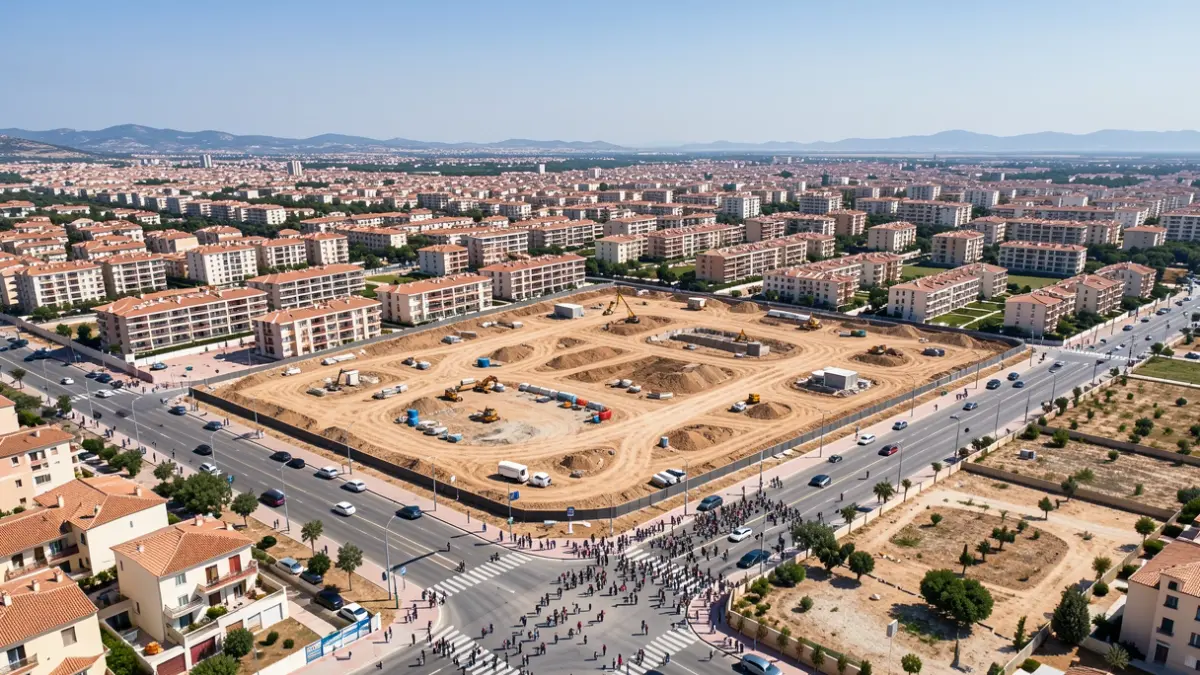
The urban developments planned in Valencia, which include the construction of 8,300 homes spread across different sectors such as Parque Central, San Marcelino, Camí Real, Moncayo, Ingenieros, Artilleros, Malilla Sur and Norte, and Escultor Hino, are crucial to tackle the "urgent need" for housing in large cities. This was stated by the city council in an official statement.
These new developments are expected to generate an estimated increase of 20,400 additional vehicles daily. Faced with this forecast, the Councilor for Mobility and Local Police, Jesús Carbonell, explained that "it is not advisable for the future demand of the new urban developments (PAIs) to be absorbed solely by the existing roads", such as San Vicente street, Carrera de Malilla, and Ausiàs March avenue.
The design of Central Park and the García Lorca Boulevard is based on a rigorous analysis conducted by municipal technicians with the advice of external expert engineers. According to this study, the new García Lorca Boulevard is conceived as a "way to manage the mobility" generated by the new developments.
The analysis concludes that, while currently 23,200 vehicles pass daily through San Vicente street, the previous proposal by the municipal government (Compromís and PSPV-PSOE) anticipated 32,000 daily vehicles with the new developments. With the García Lorca Boulevard solution, only 18,700 vehicles are expected to pass, which is 20% less than currently and 41% less than with the green corridor.
On Carrera de Malilla, where 10,200 vehicles pass daily today, the forecast with the green corridor was 13,900. With the new boulevard, 8,800 daily vehicles are projected, a 14% decrease from the current situation.
Regarding Ausiàs March avenue, which currently registers 56,200 daily vehicles, the green corridor proposal estimated 69,000. The García Lorca Boulevard solution projects a traffic flow of 61,700 daily vehicles, 10% less than with the green corridor.