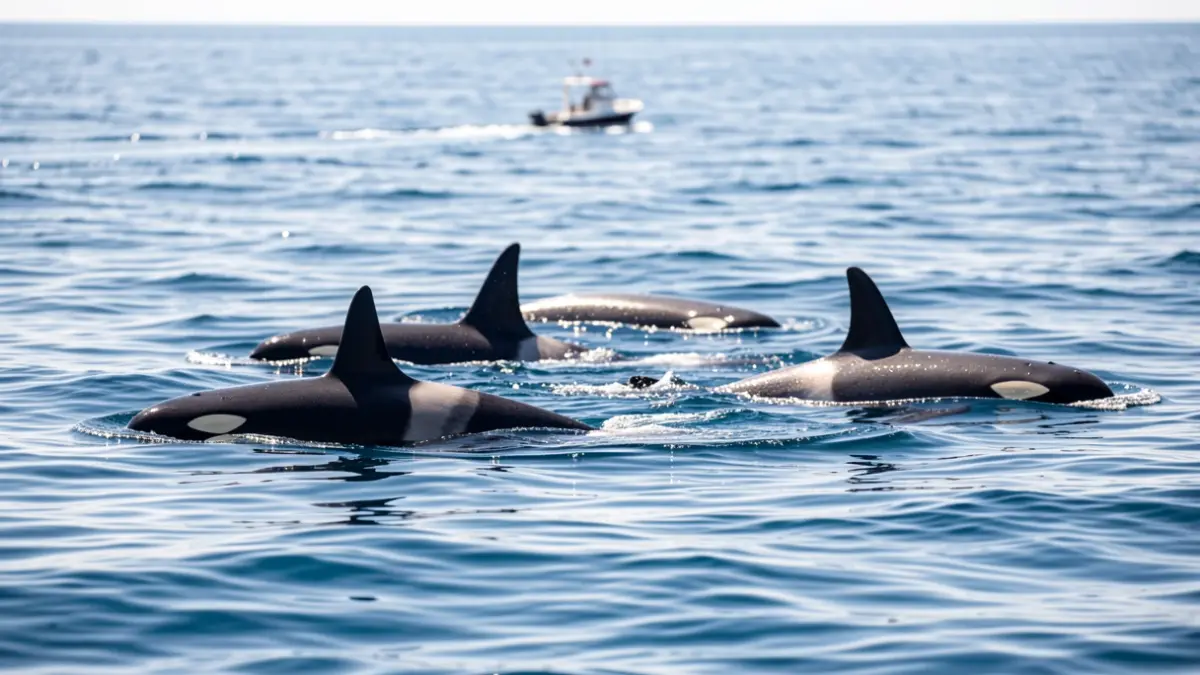
Orcas are recognized as one of the most powerful predators in the oceans, hunting a wide variety of prey including rays, seals, porpoises, and even large baleen whales. They even confront great white sharks, driving them away from feeding grounds or sometimes killing them. Despite this voracity, there are no verified records of wild orcas deliberately killing humans. Recent studies suggest that, in certain circumstances, these animals interact friendly with people, even offering them food as 'gifts'.
These behaviors highlight the complexity of orcas, contrasting with their usual image as ruthless predators. The damage caused to small boats in the Strait of Gibraltar area for some years does not seem to be an attempt to attack humans, but rather their attention is directed at the vessels themselves. The reasons for these actions are still under study, but most scientific opinions suggest they are not deliberate attacks.
A fundamental reason why orcas do not attack humans is the high specialization of their diet. Different populations, known as ecotypes, feed on specific prey, preferences passed down through maternal lines. Some orcas consume only fish like salmon or herring, while others specialize in marine mammals. These dietary traditions are stable, and changes in prey are very uncommon. Since humans have never been part of their established diets, orcas show no interest in us as food.
Unlike sharks, which sometimes attack humans by mistake, orcas use echolocation to navigate and hunt. This ability allows them to create detailed acoustic images of their potential prey, clearly distinguishing their shapes and sizes. This advanced capability is the most likely reason why orcas do not confuse people with their usual prey. Although their sonar capabilities are still being studied, there is no evidence that they perceive humans as a food source.
In fact, their relationship with humans sometimes shows traits of generosity. Recent research has shown that wild orcas occasionally offer captured prey to humans, as a form of gift. During a 21-year study, scientists recorded 34 instances where orcas offered fish, rays, squid, seabirds, and even a turtle to people. These 'offerings' occurred in various contexts: to people swimming, on boats, or even on the shore. In many cases, the orcas remained nearby after dropping the item and sometimes repeated the gesture if the offering was not accepted.
Sharing food is a common behavior among orcas within their groups, often as a way to maintain strong social bonds. That this behavior extends to humans is uncommon but well-documented, representing a unique example of an established social behavior being broadened to another species.