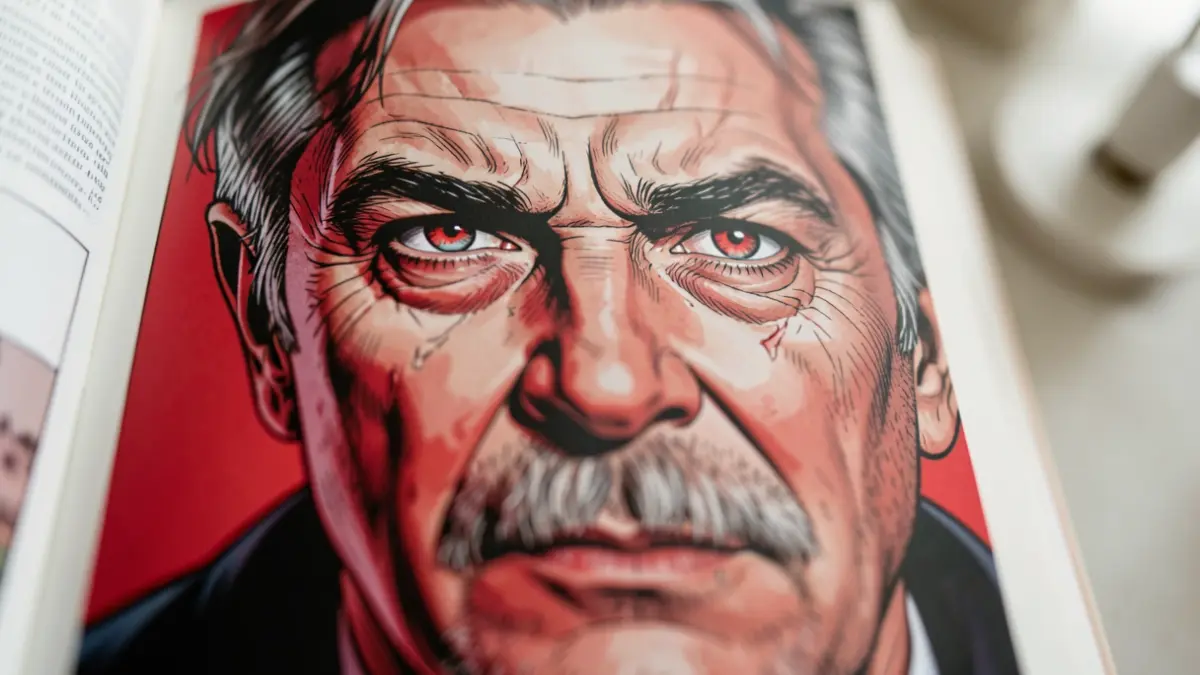
Renowned Alicante author and artist Carmelo Manresa, born in Callosa de Segura in 1965, has released his fourth graphic novel, La vida de Martín (Dolmen Editorial). This work distinguishes itself from his previous projects by setting the story in the present day and moving away from autobiography, featuring more realistic drawings and an expressive use of red to convey intensity.
The protagonist, Martín, is a 55-year-old man with an apparently ordinary life: he has worked in a bank for over 30 years and is married to Sara. However, the narrative delves into his internal struggle to recognize and accept his sexual orientation and inclinations, including fantasies and desires that remain active beyond youth. Manresa explains he chose a character of this age to better connect with him and to champion the vitality of mature years, challenging the notion that people cease to feel or experience things after 50.
The novel depicts Martín discovering a new sexual identity through his relationship with Sami, a wall painter, thereby avoiding the typical clichés often used to portray the LGTBI community in literature. The author emphasizes that diversity and repressed desires are not exclusive to the young, and that fears and difficulties in expressing identity can be more pronounced in small towns, where repressive education and societal expectations hold significant sway. Manresa thus critiques discourses that impose a single life model.
Unlike his earlier works such as Plaza de la Bacalá or Cine de verano, which explored his past and youth with an autobiographical style, Manresa aimed with La vida de Martín to create a completely new narrative. The author highlights the challenge of making the characters' relationships and the ensuing conflicts, particularly with Martín's wife, believable. The work seeks to illustrate the complexity and contradictions of human nature, moving away from simplistic black-and-white perspectives.
“"When you create a character, you always end up putting a lot of yourself into it. The difference is that in my previous graphic novels, I worked from real memories and experiences. Here, I had to invent the relationship between the characters, as well as the conflicts that arise with Martín's wife."
“"We are often made to believe that everything is black or white, that things are one way or another, but reality is usually much more complex. I think this story speaks precisely to that and shows that people are much more contradictory and diverse than we sometimes think."