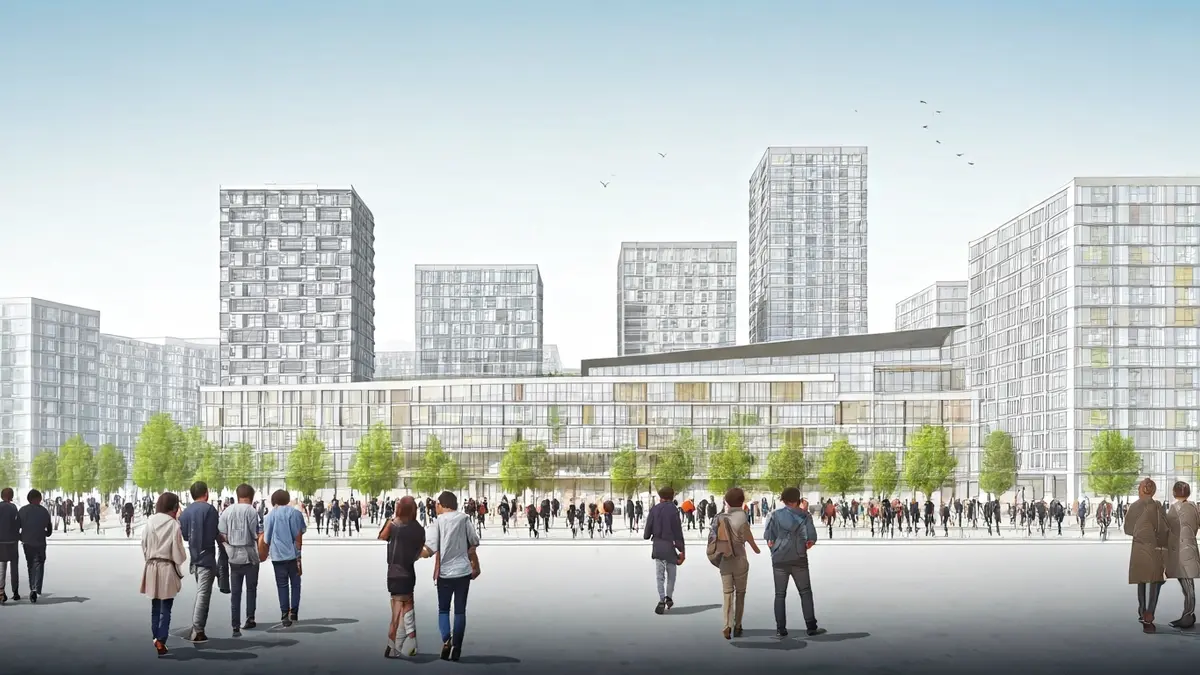
This initiative will be implemented through two main avenues: Structural Transformation Operations (OTE), which will generate 12,300 homes by converting industrial land, and Structural Regeneration Operations (ORE), which will provide an additional 2,000 homes on existing urban voids.
OTE s are designed to create new neighborhoods in areas currently occupied by obsolete industrial uses. The goal is to transform these spaces into mixed-use zones integrating residential, tertiary, and compatible productive uses, thereby creating new urban centralities. Priority will be given to incorporating protected and affordable housing to ensure a diverse residential offering and facilitate access to housing for various social groups.
The planning of these areas will be carried out through Internal Reform Plans (PRI), which will allow for gradual transformation and avoid abrupt changes in the urban fabric. During the transition, flexibility will be maintained for the continuity of existing uses compatible with the transformation objectives, ensuring progressive evolution and preventing degradation of the areas.
“"Urban regeneration is one of the major commitments of the Structural General Plan, with operations that will act on the consolidated city and on vacant or liberated spaces to generate new neighborhoods and enable more than 14,000 homes, of which approximately 40% will be protected, as well as tertiary and endowment spaces."
Among the prominent OTE s is that of Florida-Babel, covering 98 hectares with capacity for approximately 8,600 homes. This operation, located between the Vía Parque and a new articulating axis, seeks to connect adjacent neighborhoods and leverage the undergrounding of the railway line to create a new green axis linking to the coastline. Another significant OTE is that of Polígono Rabasa, spanning 41 hectares, which foresees about 3,700 homes, especially for students and professionals, strengthening its link with the university environment and the Scientific-Technological Park.
Regarding the ORE s, the PGE identifies and prioritizes key actions in the central and southern urban areas of the municipality, characterized by their density and lack of open spaces. These operations will utilize large urban voids and underutilized land. Notable among these are the ORE of Parque Central, which will create a large urban park of 150,000 m² and 1,400 homes, and the ORE of Sangueta, which will recover strategic spaces near the coast with 200 homes and an extensive green area. Finally, the ORE of Parque del Mar will reinforce the continuity of open spaces, creating a large environmental axis with 400 homes and new facilities.
These proposals were detailed in the third thematic discussion table on the PGE, held on Tuesday, which also addressed the reservation of land for 1,300 social rental homes, a third hospital, a large vocational training center, and the expansion of the UA and UMH campuses. Additionally, on Thursday, at 5:30 PM, the fourth technical table will take place at Puerta Ferrisa, focusing on urban regeneration.