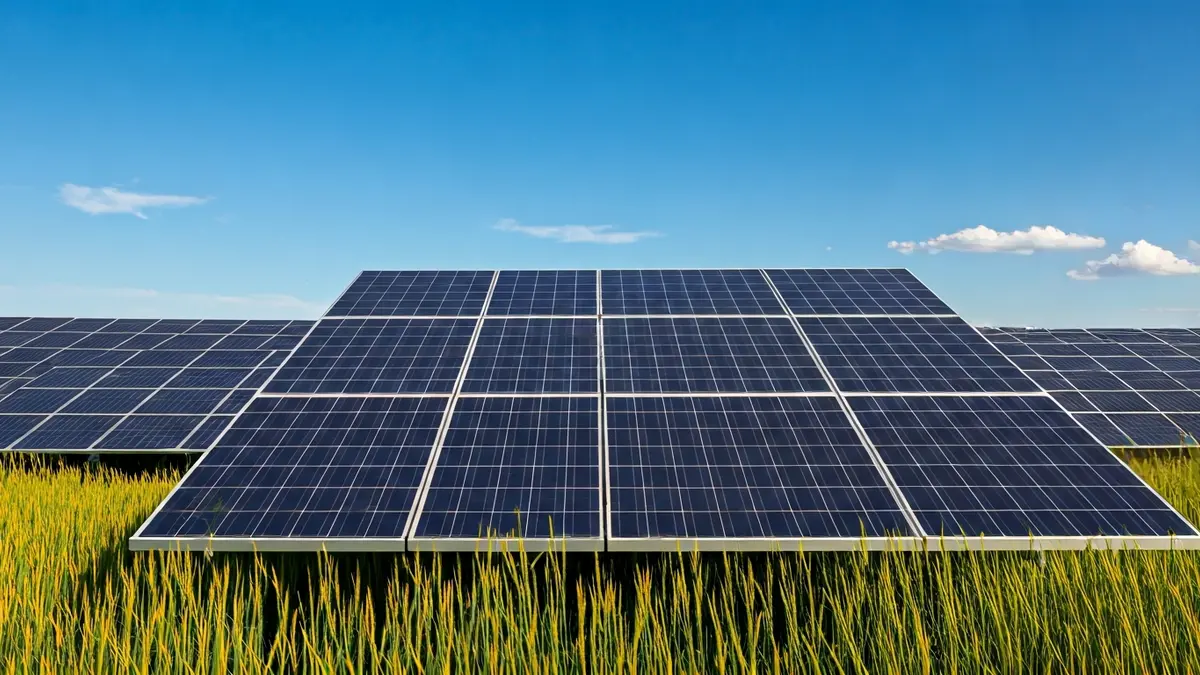
The developer Renovalia has resumed procedures for the installation of three photovoltaic plants in the municipality of Sagunt, a project spanning over 2.1 square kilometers. The company has launched a public participation plan, asserting that it follows a “strictly legal” procedure that includes mechanisms for submitting objections.
This reactivation has generated various reactions, particularly from the Plataforma en Defensa del Territori del Camp de Morvedre. This entity has expressed concern over “serious deficiencies and omissions” in the published documentation, which, in their view, prevent a transparent and legally compliant process. The platform has urged the involved municipalities to ensure urban, environmental, and territorial legality, and has demanded that Renovalia withdraw the public participation process.
“"We follow the strictly legal procedure, which includes mechanisms for anyone to object."
The project's impacts extend beyond Sagunt, also affecting the municipalities of Alfara de la Baronia, Albalat dels Tarongers, Gilet, Petrés, and Algímia d'Alfara, due to energy evacuation lines. The Sagunt City Council has encouraged interested associations to submit objections to “influence the development” of the plant. Meanwhile, the Alfara de la Baronia city council, despite not having received a public participation plan, has already prepared its own objections.
The platform has recalled that these plants, named Sagunt 1, 2, and 3, are successors to the old Morvedre 6, 7, and 8, in which “irregularities, lack of documentation, unfavorable reports not incorporated into the file, and fragmentation practices to evade more demanding environmental assessments” were detected. In addition to procedural issues, the platform has expressed “deep concern” over the massive occupation of productive agricultural land of high agro-ecological value, with the consequent loss of crops, landscape, and territorial heritage in areas such as Puvichol, Camí de Rubio, Camino Viejo de Teruel, and Cuesta del Volante, near the Palància River and the Sierra Calderona.
The serious deficiencies and omissions prevent guaranteeing a transparent and legally compliant process.
The collective has emphasized that it does not oppose renewable energies, which it considers “necessary,” but it does reject implementation models that destroy fertile territory, biodiversity, and cultural heritage, and that respond to speculative dynamics. They propose alternatives such as installing solar panels on industrial roofs, already transformed infrastructures, or degraded areas of the port and industry. The platform is composed of various entities such as Acció Ecologista Agró, the Centre Excursionista del Camp de Morvedre, Compromís per Sagunt, and Esquerra Unida del País Valencià, among others.