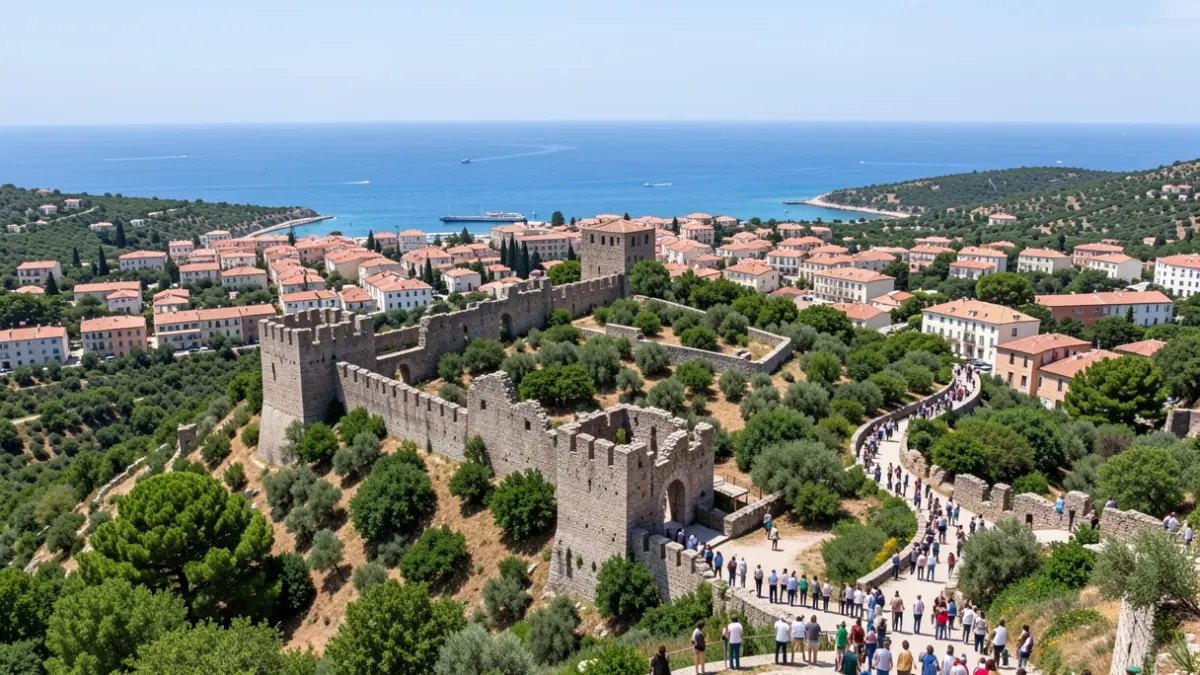
The Sagunto municipal council agreed in its ordinary June session to move towards a pioneering interdisciplinary conservation model for Castle Hill. The corporation's objective is to definitively integrate the natural heritage, history, and sustainable development of this emblematic space.
To achieve this, the Municipal Corporation will urge the Third Vice Presidency and Ministry of Environment, Infrastructure, Territory, and Recovery to create a joint working group. This united front will involve the Sagunto City Council, the Provincial Council of Valencia, and various regional departments from Education, Culture, Universities, Industry, Tourism, Innovation, and Commerce. Likewise, at the proposal of the PP, the Ministry of Culture of the Spanish Government has been included, given its status as owner of the Castle, declared an Asset of Cultural Interest (BIC).
The proposal, originally presented by Compromís per Sagunt and defended by its spokesperson Maria Josep Picó, achieved broad political consensus with votes in favor from PSPV-PSOE, PP, Compromís, and EU-Unides Podem (with abstentions from Vox and a vote against from IP).
A 'real laboratory' with over 200 species and centuries of history
Beyond a simple protection status, the motion proposes using the approximately 42 hectares of Castle Hill as an authentic real-world laboratory for interdisciplinary preservation experiments. It is an environment highly accessible to citizens, notable for its surprising biodiversity within an urban context, with over 200 registered species, including birds such as the common owl, peregrine falcon, or black redstart, as well as typical Mediterranean vegetation.
This rich ecosystem of the Serra Calderona coexists directly with archaeological remains and monuments that narrate the history of the different civilizations that have inhabited Sagunto, from an original Iberian settlement to its military use in the 20th century, including elements from Roman (like the Roman Theatre), Visigothic, Muslim, and Christian periods, as well as remnants from the Civil War or the 18th-century Calvary.
This institutional push not only seeks to safeguard the environment but also to promote responsible tourism, scientific research, and citizen participation. As stated in the motion, the agreement is fully aligned with the objectives of Agenda 2030 and serves as a key tool to achieve one of the town's great dreams: Sagunto's future declaration as a UNESCO World Heritage site.