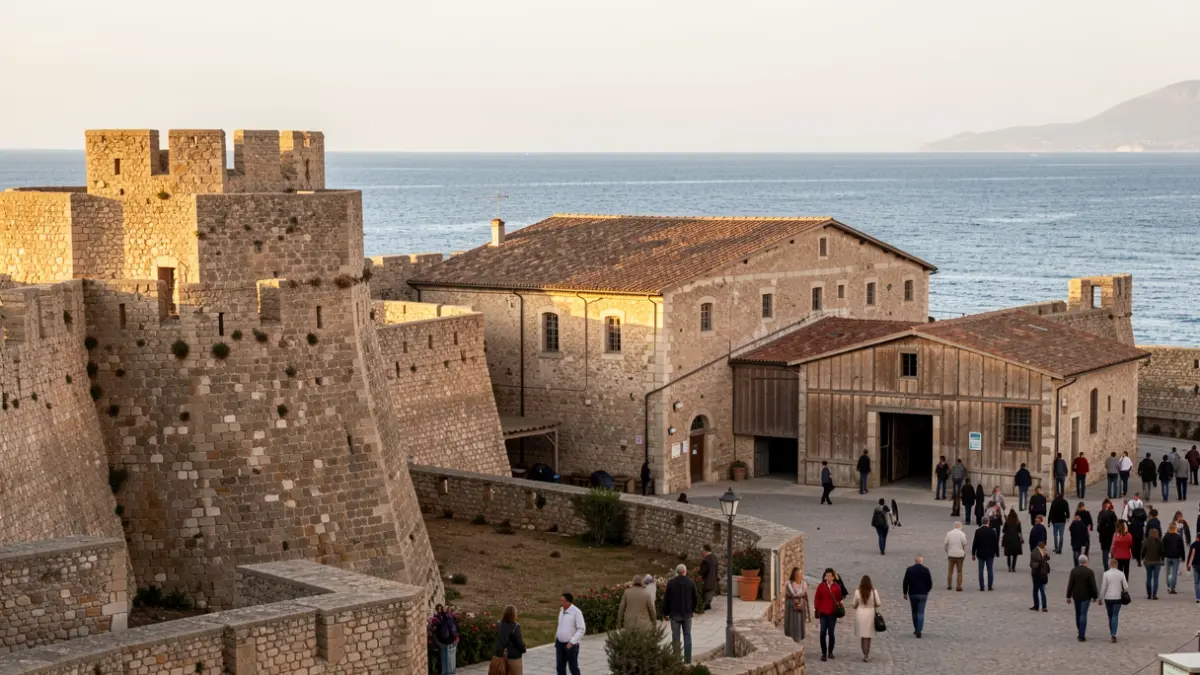
The fortified complex of Grau Vell in Sagunt has taken a giant leap in recovering its historical legacy. The new Interpretation Center for Mediterranean Culture and the Port of Arse-Saguntum is now a reality and opens its doors to the public immediately. This new interactive museum space traces the evolution of this strategic maritime enclave over the centuries, connecting the city's Iberian and Roman past with the present.
The ambitious project to rehabilitate, musealize, and theme the fort and the old 18th-century port warehouse has been financed through the European NextGenerationEU funds, within the Recovery, Transformation, and Resilience Plan. The mayor of Sagunt, Darío Moreno, highlighted during the inauguration that this work recovers «a key element of our historical and maritime heritage», thus fulfilling «a pending debt with the municipality and, particularly, with the people of Grau Vell».
The museum is designed to offer an immersive experience thanks to the use of audiovisual elements and QR codes that provide access to a complete digital guide of the space. The old warehouse houses five rooms dedicated to key areas of local heritage: the history of seafaring, from the first Iberian routes to current maritime dynamics; archaeology and environment, dedicated to the local archaeological site, marine archaeology, and the urban core of Grau Vell; the industrial port, a review of the industrial development of the Factory and the Port of Sagunt nucleus; the natural space, a window into the biodiversity of the Marjal dels Moros; and restoration, a space explaining the complex technical process to recover the Fortín.
Additionally, the complex's tower features explanatory elements and an exact replica of an 18th-century cannon, although the fortified battery is not yet visitable in this first phase. «Citizens will be able to find in these rooms the entire evolution of the city of Sagunt and its culture in relation to the sea from the Iberian-Roman era to the present day», pointed out the councilor for Cultural Heritage and Tourism, Natalia Antonino.