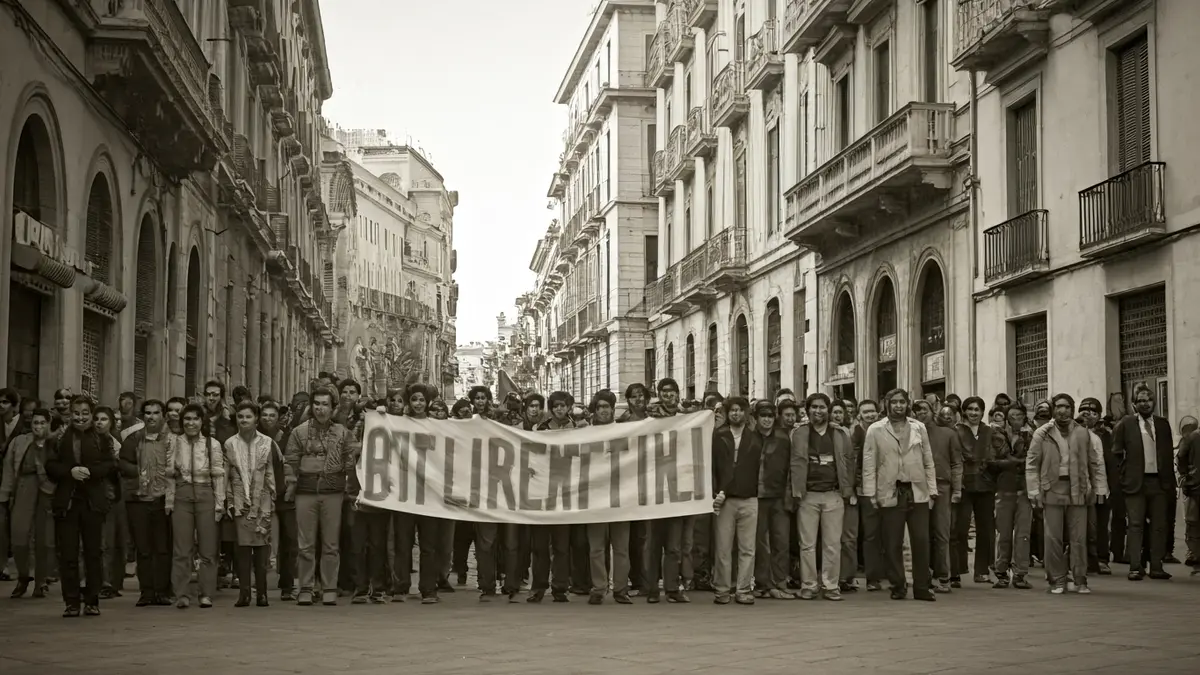
The first major post-Franco political demonstration, held on October 9, 1977, on Xàtiva Street in València, was a turning point for Valencianism. Under the slogan «Freedom, amnesty, and statute of autonomy», it filled the streets of the capital. Participants from Elx, including Joan Carles Martí, Toni Sanchis, Josep Raimon Sastre i Parres, Juli Moreno, and possibly the architect Dídac Macià i Ernica, witnessed this historic event. Their banner proclaimed «Elx per l’autonomia al País Valencià», reflecting the spirit of the Consell Popular de Cultura Catalana, an initiative that emerged from the Congrés de Cultura Catalana (1975-1977).
Toni Bru made Valencianism a way of life, a civic and political belief that also served as a personal remedy. A sonnet titled «Reloj», dedicated by P. Micó in the 1960s, already anticipated his deep dedication. Bru, a man without his own family (only his mother and a disabled sister), ill and without economic resources, sought in Valencianism a way to escape isolation. He began teaching Valencian classes and organizing Valencianist events in places like the Peña Madridista, the Coral Ilicitana, the Casino, and the Café Marfil, institutions that, despite their deep-rooted Francoist tradition, offered a space for cultural dissemination.
However, these initiatives met with resistance. Scheduled conferences in Valencian, such as those by lawyer Robert Moròder on the centenary of Joanot Martorell and by Manuel Sanchis Guarner on Pompeu Fabra, were prohibited. The situation began to change for Toni Bru when he met Maraldés and Castillejos in the mid-1960s. Later, Andreu, Juli, Joan Carles, and other young people joined, bringing new energy to the movement.
Andreu Castillejos i Furió (1942-2013), a draftsman, painter, and photographer, was one of the first to connect with Bru. In 1967, during an exhibition of his works at the Unió Excursionista in Elx, Bru was pleasantly surprised by the programs written in Valencian. Castillejos became his confidant, sharing entire afternoons of conversations and laughter. For his part, Maraldés, an entrepreneur with a cardboard box factory called Elximprés, found in the Club of Friends of Unesco a space to chat and conspire with Bru.
During the late 1960s and early 1970s, the Club of Friends of Unesco became a crucial meeting point for young people in Elx with progressive cultural concerns. Here, painting exhibitions and photography contests were organized, and Bru, Maraldés, Morell, and Martí taught Valencian classes. This space, unthinkable years before, allowed the members of the Esbart Elx Folk to sing in Valencian as a sign of identity and dignity, influenced by the Catalan Nova Cançó and the Nouvelle Chanson Française.