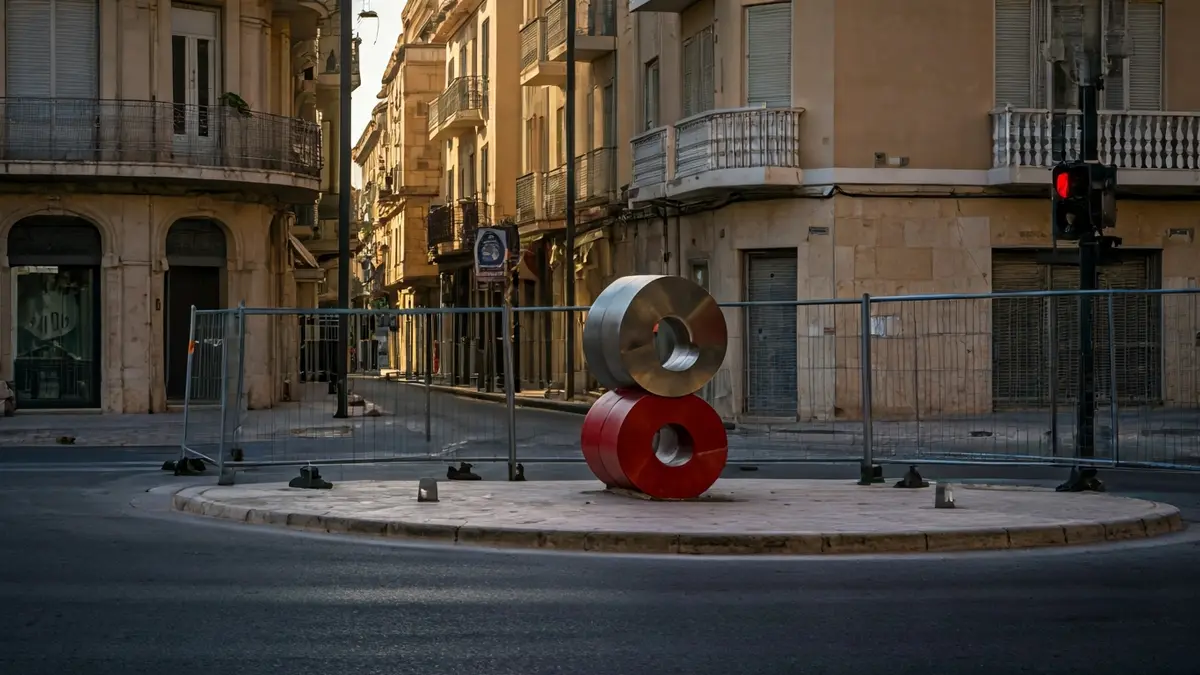
The artwork, which had been in its place for a quarter-century, has been reinstalled at the confluence of Pedro Juan Perpiñán with Pablo Picasso and Antonio Sansano Franco. Although the base is not yet fully completed, the presence of fences indicates that finishing touches are still underway. Its previous location was at the Puertas Coloradas, opposite the orchard from where the mythical coastguard traditionally begins his race every December 28.
The PP and Vox coalition in Elche removed Soria's work last November, claiming it was being restored. This decision raised concerns in artistic circles, who feared the permanent loss of the artwork. The local government's intention was to replace it with a religious image, as eventually happened with a sculpture of the Patroness of Elche, the Virgin of the Assumption, and Francesc Cantó. Explanations regarding the removal of Soria's work were vague, without specifying the new location or providing any reports.
A technical report from February, signed by Gemma Mira, head of Cultural Heritage Restoration Management at the Elche City Council, endorsed the sculpture's conservation. This document confirmed that the restoration in the municipal warehouses of Carrús was in its final stages. At that time, the local executive already indicated that the installation would be a matter of weeks and that it would be placed on Pedro Juan Perpiñán, near the Generalitat bridge, as has finally occurred, specifically near the Sansano’s restaurant.
The report detailed that the sculpture, made of polished and polychrome steel, in an abstract/constructivist style and measuring 7 x 1.40 meters, showed losses of polychromy, chipping, localized foci of oxidation, and deterioration in the structural base due to atmospheric exposure. Therefore, an intervention was deemed necessary for its stabilization and aesthetic recovery. The report also highlighted the relevance of Salvador Soria, winner of the VIII Plastic Arts Award of the Generalitat Valenciana in 2009, and his participation in an anthological exhibition at the Museum of Contemporary Art of Elche in December 1983, consolidating his link with the city.
The contextualization of the work indicates that the Dragon of Jaume I was installed in 2001 as part of Elche's urban renewal process at the beginning of the 21st century. Conceived as contemporary public art, the sculpture establishes a dialogue between the author's abstract constructivist language and the historical memory associated with the figure of Jaume I, integrating into the urban environment as a landmark sculpture. This historical memory is linked to the founder of the Kingdom of Valencia, precisely in the year marking the 750th anniversary of his death.