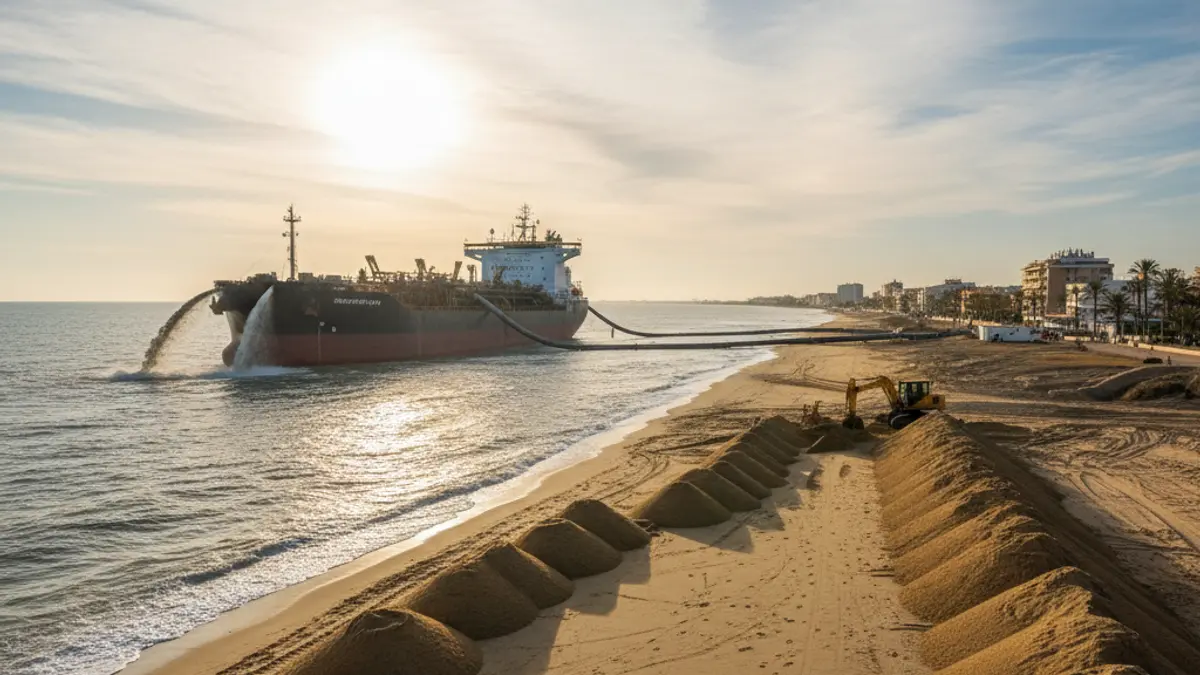
This operation marks the beginning of the key phase of a project valued at 16.3 million euros, aiming to recover approximately three kilometers of coastline lost due to marine regression. The comprehensive intervention is designed to restore the sedimentary balance of a coastal strip that has suffered decades of erosion.
The Bonny River, a trailing suction hopper dredger, is considered one of the most important specialized vessels currently operating in Europe for such operations. With a length of 158.2 meters and a large loading capacity, it extracts sand from a submarine bank about two kilometers offshore and pumps it onto the beach.
In total, nearly one million cubic meters of sand will be deposited, equivalent to the volume of 400 Olympic swimming pools. The objective is to restore the southern coastline of Cullera to its morphology around 1950, creating new sandy areas with a variable width of between 40 and 100 meters.
“"The combination of breakwaters and sand replenishment is the only formula capable of guaranteeing lasting results in coastal regeneration."
The project also includes the construction of three large breakwaters, which are now nearing completion. These structures, measuring 195, 280, and 222 meters, have the strategic function of interrupting the dominant coastal drift that historically carried sand northward, stabilizing the new beach and reducing wave energy during storms.
Furthermore, a new dune cordon will be created as a second line of natural defense, acting as a strategic sand reserve and mitigating the impact of storms. The municipal intention is to complete this phase with revegetation using native species.
This 16.3 million euro investment, funded by Next Generation EU funds, is one of the largest undertaken in Spain for coastal restoration. The project is part of a broader strategy to adapt the Valencian coast to climate change. Completion is scheduled for June 30, provided weather conditions allow.