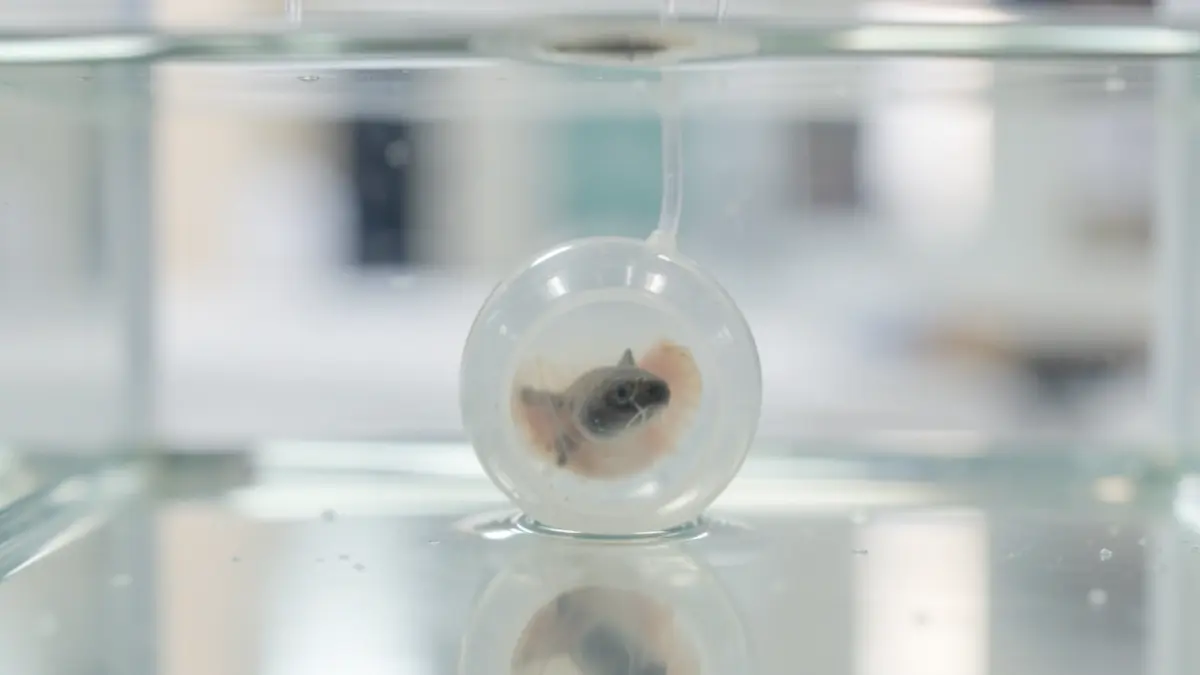
Coinciding with the end of the school year, Fundación Azul Marino reviews the pioneering educational project in the province that brought the breeding of small-spotted catshark eggs (Scyliorhinus canicula) to four educational centers in Castellón. Over the past few months, students from CEIP Santa Águeda in Benicàssim, CEIP Dean Martí and IES Torre del Rei in Oropesa del Mar, and Ágora Lledó International School in Castellón have cared for shark eggs in their classrooms and continuously monitored the embryos until their hatching.
As the hatchings occurred, the young sharks were progressively transferred to the Marine Species Conservation Center, a space coordinated by the entity along with the Oceanogràfic Foundation in the Bellver Blue Tech Zone. The program aims to strengthen the bond between the entire educational community and marine natural heritage, raising awareness about the importance of protecting the coastline.
The process began in February with training for teachers to ensure the correct handling and maintenance of embryos and incubation systems. Subsequently, the Fundación Azul Marino team installed aquariums in quiet, noise-free areas of the centers, such as libraries and laboratories, followed by educational sessions with students about Mediterranean sharks and the threats they face. Throughout the incubation period, students took on the weekly responsibility of monitoring parameters like temperature, salinity, and water quality. To mitigate the risks of conventional aquariums, the initiative used a system based on adapted wine coolers, which maintained the water in suitable conditions.
“"The initiative has allowed students to connect with the marine environment, a geographically close area yet still unknown in many aspects, awakening in them a greater awareness of its importance and the need to respect and preserve it. One of the most significant moments of the project is the hatching of the shark eggs, an experience that generates great satisfaction for both students and teachers. Furthermore, the activity has significantly contributed to values-based education, fostering responsibility, commitment, and care for living beings in students."
The small-spotted catshark, a common species in the Mediterranean Sea not currently considered threatened, has become the educational resource for awareness in classrooms through this project. It serves as a means to address issues such as accidental fishing, the origin of seafood, and the effects of climate change. Through direct observation of embryos and young sharks, students have been able to understand how any alteration of the marine environment compromises biodiversity.
The origin of these eggs stems from a local collaboration between the foundation and the province's fishing guilds. They safely recover eggs from female sharks accidentally caught in nets, allowing the foundation to collect them, incubate them in their facilities, and release them back into the sea after hatching.
These actions are part of the 'Tu Mar' project, an initiative that aims to bring marine natural heritage closer to the educational community and foster a greater connection with the coastal environment. Following this year's success, Fundación Azul Marino is already working on expanding the initiative for the upcoming year, which will allow for more training and reach a larger network of teachers in the province of Castellón. The pedagogical impact of this method was evident when, in earlier phases of the initiative, students from the province presented their learning at international education forums in Miami (USA). With the end of the academic period, the foundation concludes this edition's cycle, with all eggs hatched and the specimens now at the Marine Species Conservation Center (Bellver Blue Tech Zone).
With the conclusion of the academic period, Fundación Azul Marino wraps up this edition's cycle. All eggs incubated in classrooms have completed their development, and the young sharks are now at the Marine Species Conservation Center (Bellver Blue Tech Zone). These small sharks, now returning to the sea, have acted as ambassadors for the Mediterranean, sparking the curiosity of the school community towards the most threatened species on our coasts and the actions we can take to improve their conservation status.