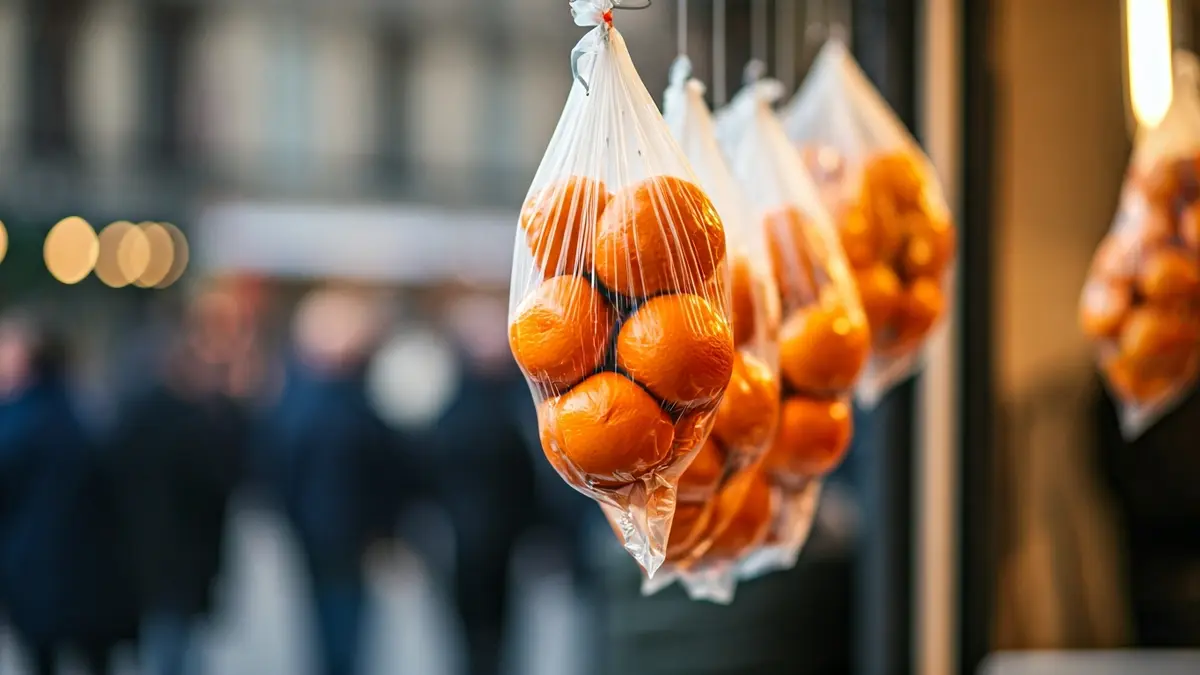
The Pego City Council presents this artistic proposal that seeks to move and highlight the problems faced by small agricultural owners in the Valencian Community. The work focuses on market dynamics and their environmental impact, using oranges collected from abandoned orchards.
The installation consists of vacuum-sealed oranges in three bags hanging from a metallic structure. As air penetrates, the fruits lose their tension and collapse, symbolizing the fragility and imminent collapse of agricultural production. According to the artist, the oranges function as a metaphor for the people who sustain agriculture under extremely precarious conditions,
“"they subsist with very little air, and this air does not represent salvation, but a minimal extension before the definitive collapse."
The plastic used in the work also carries a critical meaning, representing phenomena of the globalized economy such as massive imports and excessive packaging. Unsustainable advocates for local and proximity consumption as forms of resistance and environmental care.
“"Art is a very powerful force when it comes to making visible situations that affect us all closely, such as the agricultural crisis, a situation we are sensitive to."
The installation is curated by Chele Esteve, a professor at the Universitat Politècnica de València, and coordinated by Adrià Rubio. It is part of the Horizon Europe The Hut project, which involves seven European universities and climate research centers focused on adapting to droughts, heatwaves, and floods. The exhibition can be visited both outside and inside the Pego Municipal Library and is part of the activities for the 50th anniversary of the Vila de Pego Painting Competition, initially sponsored by the orange company Pascual Hermanos.