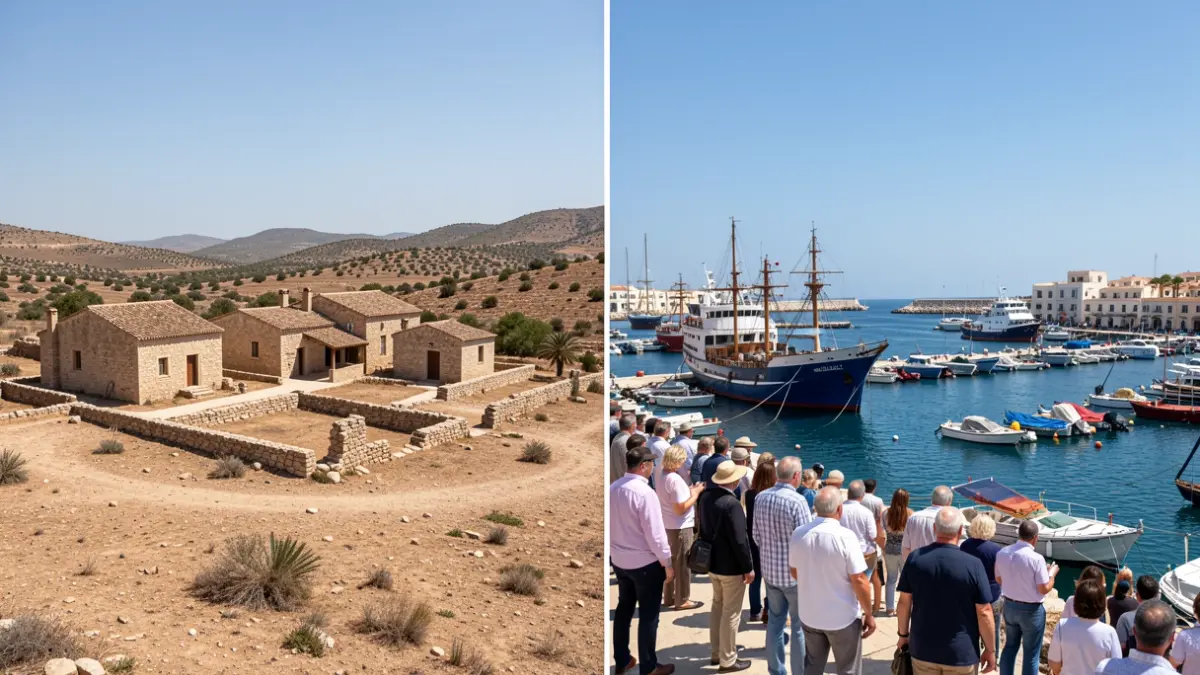
Places like the Moorish depopulated areas of l’Atzuvieta, la Queirola, and de la Roca, in Vall d’Alcalà, evoke the tragedy of the 1609 expulsion. That massive exile, which forced the embarkation of over 42,000 people from the ports of Dénia and Xàbia, emptied the interior of the Marina Alta.
A delegation from the Ribat Al Fath Association for Sustainable Development (Rabat) and officials from the Fundació Cirne of Xàbia have recently visited these ruins. Archaeologists Pasqual Costa and Joaquim Bolufer explained the constructive singularities and the life of their former inhabitants.
Remembered is Professor Hayat Dinia, a descendant of the Valencian Moriscos, who visited these sites in 2009, coinciding with the 400th anniversary of the expulsion. Dinia passed away in 2019.
The visit is part of a project to recover Moorish memory, coordinated by professors Kaoutar El Amri and Rajae El Khamsi. The Moroccan collective is preparing a collaboration agreement with Fundació Cirne to disseminate this history.
The Moroccan delegation, which also included Mohammed Benhsain, Aïcha El Alaoui El Belghiti, and Nabil Fenjirou, began their journey in Valencia and Dénia. There they visited the city and its port, a witness to the exile of thousands of Moriscos, and stood at the foot of Dénia Castle.
Subsequently, they traveled to Vall d’Alcalà to discover the Andalusian landscape of the interior of the Marina Alta. On Sunday, in Xàbia, they outlined the draft agreement with Fundació Cirne.
The objectives of the future agreement include disseminating Moorish history, publishing joint publications, and bringing to Morocco the traveling exhibition on the expulsion that Fundació Cirne organized in 2009. The aim is to strengthen the relationship between the two shores of the Mediterranean and reclaim their shared history.
The Ribat al Fath association is notable for its research into the Andalusian legacy, its organization of an international festival of Andalusian music, and its commitment to sustainable development, environmental defense, and the creation of more resilient cities.