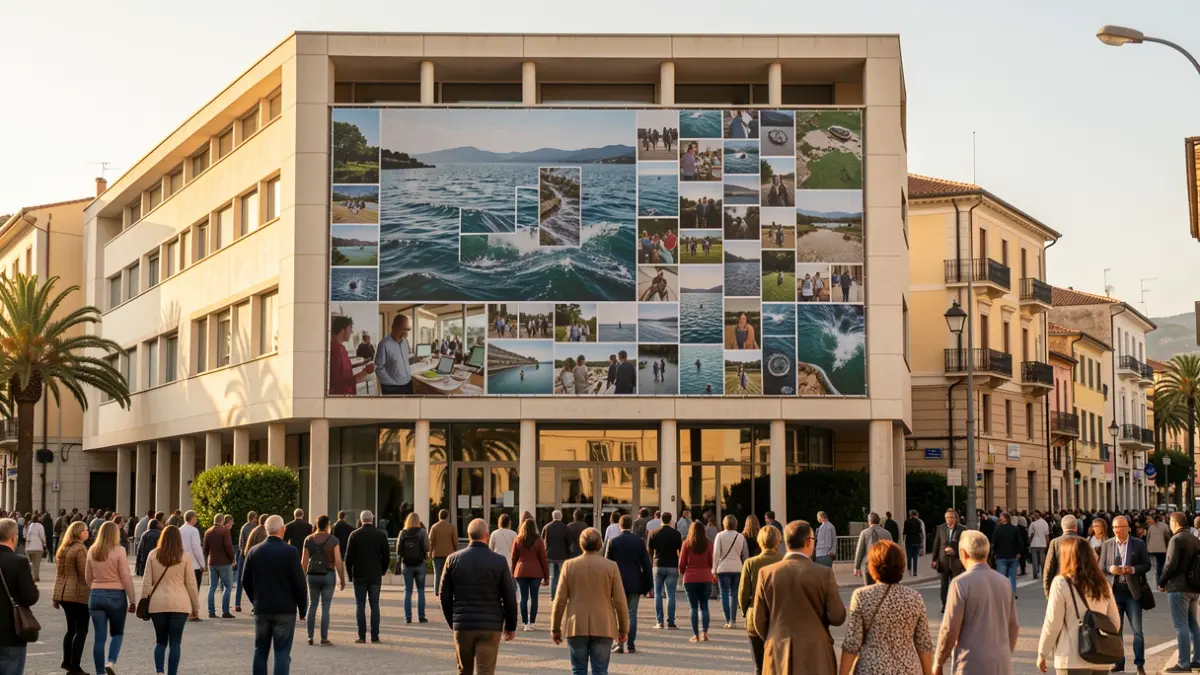

The Koinós Dénia project, dedicated to meetings on cinema, music, and thought, hosted its second session of the season on Thursday, April 16, featuring the author. The event took place in the auditorium of the Juan Chabás Public Library, which was filled to capacity.
Led by Javier López Alós, the regular host of these encounters, the author spent an hour reviewing her career and work, which spans journalism, essays, poetry, and narrative. She also revealed some key insights into her latest published work, Pueblo blanco azul (2026).
The first part of the dialogue focused on the author's time in the United States, where she resided for over a decade. It was during this period that the author, currently a columnist for the newspapers Público and El País, gained public prominence through chronicles analyzing the social and political polarization of the Trump era.
The author then explained the characteristics of her literary style, which blurs the lines between genres. She described her work as defined by careful language, lyricism, rigor, and critical analysis, whether in journalism, poetry, or narrative. Additionally, she revealed how her prose has been decisively influenced by reading the articles of María Zambrano.
The encounter also dedicated time to the author's poetic work, with special attention to the poetry collection Currículum. Also discussed was her essay Vivir peor que nuestros padres (2023), in which she analyzed the lack of hope affecting her generation, marked by chronic job instability, economic uncertainty, and the growing environmental crisis.
In the final segment, the conversation revolved around her two novels, first addressing the characteristics of Huracán de negras palomas (2023), which offers a harsh portrayal of US society, before moving on to her most recent work, Pueblo blanco azul (2026). Published last February, this novel emerged from the grief over the passing of her grandparents, which occurred while she was living abroad.
The author highlighted the importance of the novel's structure around two temporal axes: the present, with the protagonist, Elaia, returning to her village in Córdoba to reconstruct her family history; and the post-war period, recreating her grandparents' lives under the dictatorship and the harsh conditions of the Andalusian countryside. The writer emphasized the extensive research process undertaken to understand rural life, the details of the era, its customs, and daily routines, as well as the local dialect. The author underscored the significance of elements such as landscape, popular language, and metaliterary play in the work to address themes like the weight of the past, mourning rituals, the struggle for natural resources—such as water scarcity—and the need to keep memory alive.
The Koinós Dénia project, which began in the spring of 2025, is organized by the Fundació Creativa Dénia and technically directed by Cine-Club Pessic, the association L'Esperança Coronada, and Javier López Alós himself. The initiative receives support from the Premis Impulsa Cultura of the Fundació Salom Sabar and collaboration from the newspaper La Marina Plaza.
Following the interventions by pianist Noelia Rodiles and the author, the program will continue on May 21 with Dianense artist Dani Sanchis, known for his work in collage and graphic design. For next autumn, the participation of philosopher Marina Hervás has been confirmed, with the announcement of the author who will close the 2026 calendar still pending.