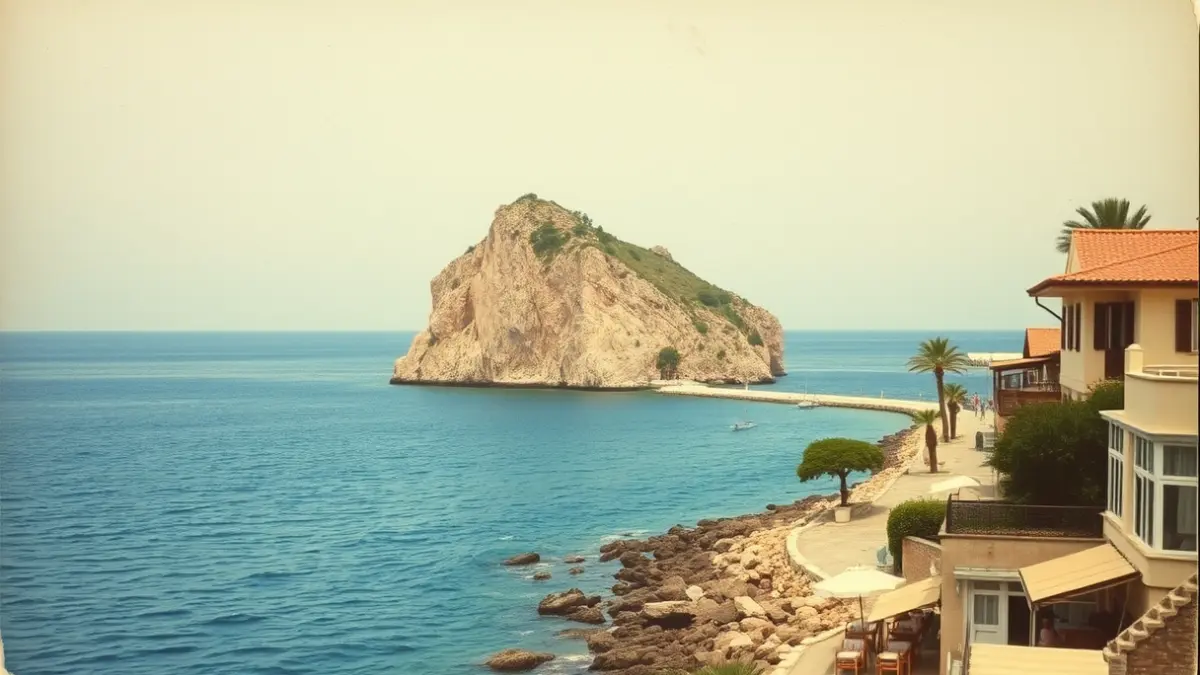
In the early 1960s, Calp was not yet a consolidated tourist destination, but it had already moved past its post-war period. The town had potable water, hotels, nightclubs, a development company, and roads, all key elements for its growth. The Franco dictatorship found in tourism a tool for its international projection, based on the appeal of a cheap, sunny, and politically controlled Spain.
The foundations of this transformation were laid in 1952 with the arrival of potable water to the urban core, a crucial event for the growth of any city. That same year, the Peñón de Ifach area was improved, and a branch of the Caja de Ahorros del Sureste was inaugurated. The Parador, renamed Paradero de Ifach, continued to grow, and the Hotel Miramar was acquired.
In 1953, Calp conducted its first tourist survey, revealing that it was already receiving visitors, mainly from Madrid (47%), Valencia (15%), and France (14%). This initial flow was driven by the first chalets built around the port and the rock. Although the municipality remained largely rural, with 2,300 legal inhabitants and 890 buildings, it began to open up to the world. During the period 1945-1954, fishing port works were consolidated, and in 1953, Astilleros Belliure was founded, diversifying the maritime economy.
The year 1956 was crucial, with the opening of the Hotel Peñón, the approval of the Land Law in Spain —which regulated the transformation of territory into urban areas— and the cessation of the last almadraba, turning the sea into a scenic element rather than solely a means of subsistence. The Caja de Ahorros del Sureste promoted the construction of public housing, the Grupo Antonio Ramos, fostering the city's internal growth.
In 1957, commercial aviation boosted tourism, and British European Airways opened a regular route to Valencia, coining the name Costa Blanca as a marketing strategy. This name was quickly adopted by the regime, and in 1958, NO-DO produced a short film about the Alicante coast. The name was officially registered in 1965 by the Ministry of Information and Tourism. The slogan Spain is Different, originating in 1932, was adopted by Francoism as a symbol of tourist openness.
By the late 1950s, tourism in Calp began to take its current form. In 1957, the first urbanization commission was created, and the road between Bol beach and Ifach was planned, the embryo of the current promenade. In 1958, the Hotel Las Salinas and the Victoria Party Hall and Cinema were inaugurated, expanding leisure options. In 1959, the filming of the movie Molokai once again put Calp on the map, and the opening of Bar Calp in Plaza de España underscored the importance of social spaces. The 1959 Economic Stabilization Plan devalued the peseta and opened the economy, making tourism a national strategy to obtain foreign currency.
In 1960, the arrival of the first televisions in Calp connected the town with the outside world, while the construction of a repeater in Sierra Aitana expanded the signal. New projects like the Hotel Adlon appeared, and Calp's inclusion in the Guía turística Caminos de España 1960 consolidated its presence on the tourist map.
The year 1962 marked a turning point with the creation of Urbanizadora Calpe, S.A., signifying the entry of organized capital and a business will to transform land into profit. That same year, Gabriel Miró Avenue was paved, and procedures for the Hotel Hipocampos on Fossa beach began, as did the La Manzanera project. The approval of the Sewerage Plan and home water supply completed the basic infrastructure. Central European tour operators began to promote hotel construction on the Costa Blanca, with Calp as a fundamental part of this logic, receiving external investment.
Between 1952 and 1962, not only did things change, but also the speed of change. In the early 1960s, Calp, despite not being a consolidated destination, already had water, hotels, roads, and its own narrative. But, above all, it had generated an expectation for the future that was the driving force behind its subsequent growth and tourist expansion.