VIU Techaton Winners: AI for Sustainable Data Centers
A student team develops a predictive platform to optimize resources and anticipate climate risks in critical infrastructures.
By Empar Soler i Martí
••4 min read
IA
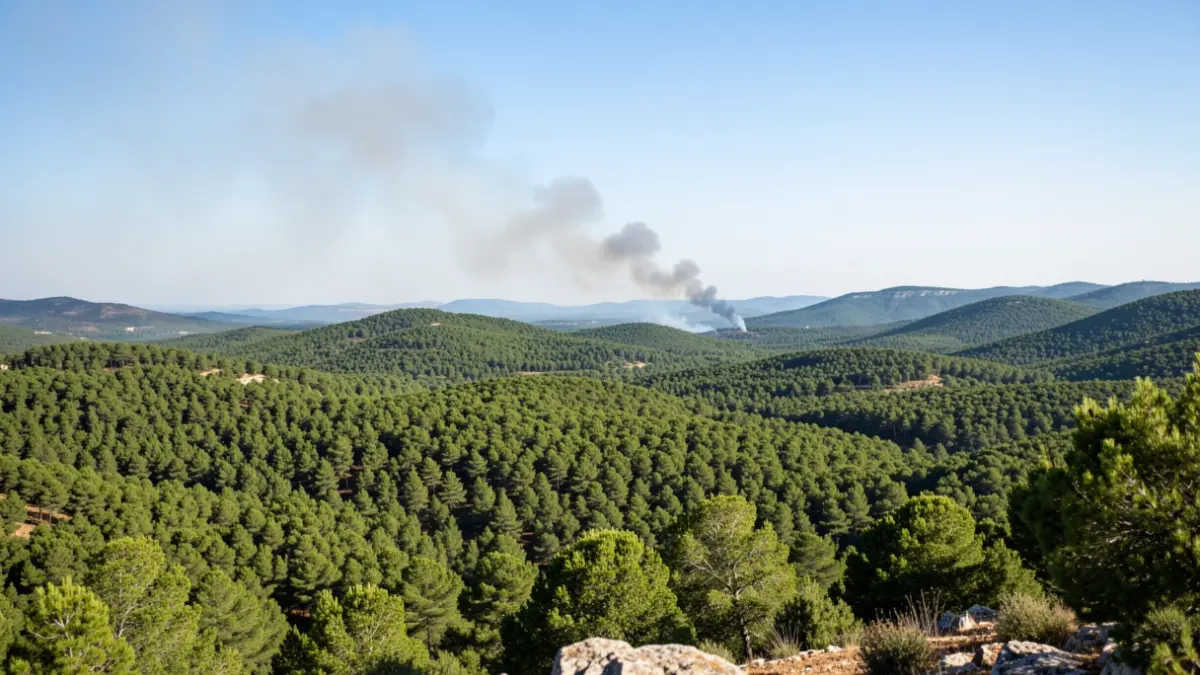
Generic image of technology and climate data analysis.
The Voltha-IS team has been proclaimed winner of the second edition of the VIU Techaton, thanks to the development of a predictive climate intelligence SaaS platform.
The Voltha-IS team has won the second edition of the Techaton organized by the Higher School of Engineering, Science and Technology (ESICT) and the Faculty of Social and Legal Sciences of VIU. They developed a predictive climate intelligence SaaS platform designed to anticipate operational risks and optimize resource consumption in critical infrastructures.
The International University of Valencia (VIU), part of the Planeta, Formación y Universidades education network, hosted this experiential learning initiative. A total of 56 students participated in the Aqua-IA challenge, aiming to improve the water and energy efficiency of data centers using artificial intelligence.
The Aqua-IA challenge was supported by Nex·ia, the Artificial Intelligence Center of Planeta Formación y Universidades, and its strategic partner Google Cloud. They provided technology and specialized knowledge in AI for business environments, connecting students with real-world challenges in sustainability and data management.
The Aquair team was a finalist with a solution based on a digital twin. This transformed climate data into operational alerts and economic estimates to anticipate energy and water risks.
The jury for this edition included Gustavo Martín Bouso (Head of Operations at Telefónica Tech), Guillermo Sáez Ripoll (Head of Corporate Development at Saeta Yield), José Antonio Mata Parrillas (Operations Delegate for Nedgia Cegas (Grupo Naturgy)), Néstor Sánchez (Director of ESICT at VIU), and Julia Martínez (Dean of the Faculty of Social and Legal Sciences at VIU).
“
"Both finalist proposals, Voltha-IS and Aquair, reflect how they have been able to combine Artificial Intelligence with business viability to improve water and energy efficiency in data centers."
“
"The level our students have demonstrated is, simply, exceptional. We are not seeing conventional academic work, but authentic business models."
For several weeks, 56 students from ESICT and the business area of the Faculty of Social and Legal Sciences at VIU, organized into 14 multidisciplinary teams, tackled the Aqua-IA challenge. They developed artificial intelligence-based solutions to optimize the water and energy efficiency of critical infrastructures.
The challenge presented a scenario replicating the real operation of a Technology-Based Company (EBT). Students had to develop an intelligent Software as a Service capable of operating in two different climatic and regulatory environments: Valencia and Santiago, Chile.
Among the challenges was optimizing the relationship between energy efficiency (PUE) and water efficiency (WUE). Solutions had to adapt to very different climatic contexts, such as the Valencia node focused on closed-circuit cooling systems under Mediterranean thermal stress, and Santiago, which required dry cooling architectures with near-zero water consumption.
“
"This second edition of the Techathon has highlighted the extremely high level, technical maturity, and strategic vision of our students when facing the Aqua-IA challenge. For the students, the Techathon provides a differential boost to their training, as they leave the traditional classroom to immerse themselves in a real, interdisciplinary environment, where technical and business profiles collaborate, as required in the current market."
“
"As a university, our goal is not only to impart theoretical knowledge but to prepare students for a complex, hybrid, and highly competitive job market. The Techathon brings fundamental value to their training because it immerses them in the real functioning of a Technology-Based Company. By facing real deadlines, learning to communicate with technical profiles, and making decisions under pressure, our students develop fundamental soft skills: leadership, negotiation, critical thinking, and multidisciplinary teamwork. They emerge from this challenge as much more complete professionals, capable of understanding the language of technology and translating it into real value for society and business."
The winning project, Voltha-IS, has developed a SaaS platform for climate intelligence and Green FinOps. It is designed to optimize key energy and water efficiency indicators in data centers.
The tool allows for anticipating risk scenarios through predictive analysis of climate variables and intelligent diversion of cloud computing loads, contributing to reduced operational costs and improved sustainability of these infrastructures.
Furthermore, it incorporates traceability and auditing mechanisms that facilitate regulatory compliance and transparency in resource management, aspects increasingly relevant in sectors subject to regulatory demands related to sustainability and governance.
The winning team comprised Alberto Mugica Ubegun (student of the Degree in Data Science and Artificial Intelligence), Judith Aguilera Infante (student of the Degree in Marketing), and Jefferson Andrés Solano Sarmiento (student of the University Master's Degree in Marketing Management and Commercial Management). The project was mentored by María Caridad Falcón Rodríguez, a lecturer at VIU.