
In a context marked by technological acceleration and the constant transformation of production models, postgraduate education is consolidating as a key factor for employability and professional leadership. Organizations seek profiles capable of adapting to complex environments, possessing technical knowledge, strategic vision, and transversal skills. Facing this reality, the Universidad Europea de Valencia has expanded its offering with over 40 postgraduate programs, designed to respond agilely to new labor market demands. Its catalog includes new official master's degrees in areas such as Artificial Intelligence, Big Data, Robotics, Cybersecurity, Applied Criminology, Marketing, or Project Management, disciplines leading the transformation of economic and social sectors.
The university offers undergraduate and postgraduate degrees in Spanish and English, with face-to-face, online, and hybrid modalities. This allows for tailoring education to diverse profiles and active professionals in an increasingly global and interconnected environment.
The academic proposal stands out for its practical approach and direct connection with professional reality. Programs in Artificial Intelligence and Big Data Analytics integrate advanced training in machine learning, predictive analytics, and management of large data volumes, with strategic applications in sectors like health, finance, or logistics. Artificial intelligence is also incorporated into the educational process to personalize learning and optimize assessment.
The Master's in Robotics and Automation combines programming, automation, and intelligent systems aligned with Industry 4.0 challenges. In Cybersecurity, training focuses on protecting critical infrastructures and managing digital risks. The Master's in Applied Criminology introduces technological tools for analyzing criminal behavior. Additionally, established programs are offered, such as the Master's in Law, Master's in General Health Psychology, MBA, Master's in Emergencies and Critical Care, or Master's in Advanced Orthodontics.
In the health sector, the university adopts a comprehensive approach aligned with the One Health concept, promoting transversal collaboration and the integration of scientific knowledge with clinical practice. Through strategic alliances with IVI RMA and the IVI Foundation, it drives advanced training, research, and knowledge transfer in biomedicine and biotechnology.
The connection with the business environment is structural, utilizing methodologies like Challenge Based Learning, where students work on real challenges posed by companies. Initiatives such as the Business Lab and the Business Lab and STEAM Awards recognize the best projects and technological solutions applied to social, industrial, and environmental challenges.
The result is an employability-oriented educational model, with a 91% employment rate. Universidad Europea is positioned in international rankings like the 'QS World University Rankings', excelling in internationalization, teaching quality, and global talent attraction, with five QS stars in teaching, employability, innovation, and social impact.
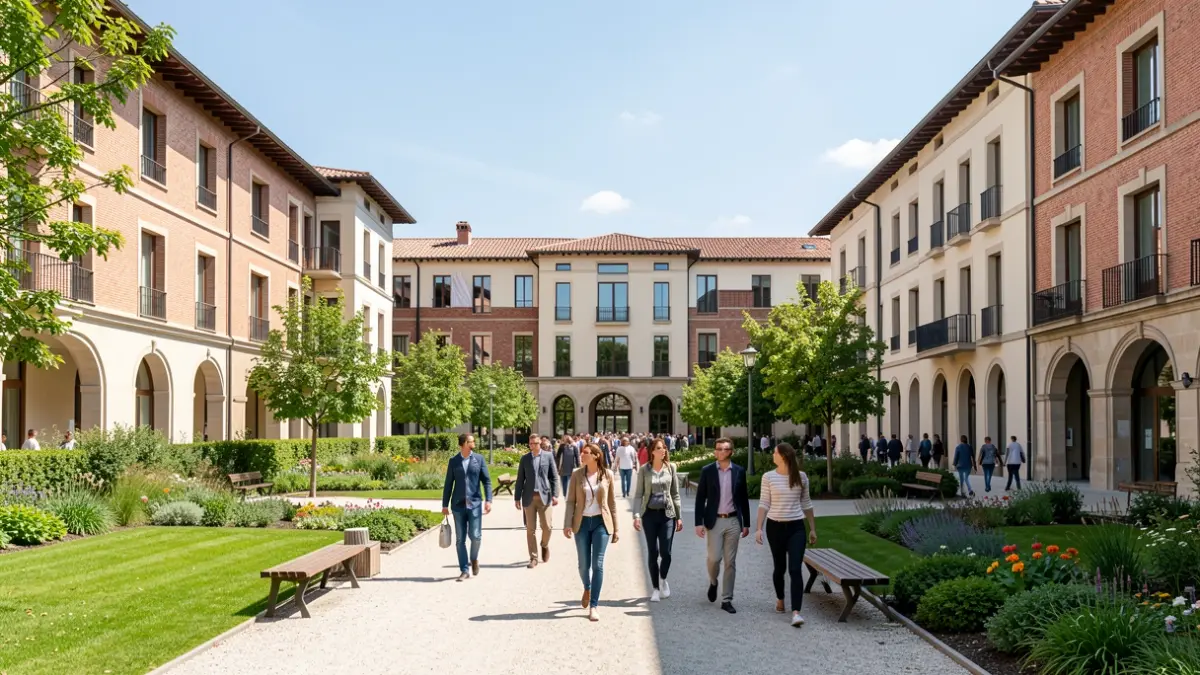
The institution extends its academic model through two campuses in the Valencian Community: Valencia and Alicante. The Valencia Campus, located in the Turia area, is an urban innovation hub with advanced technological facilities. The Alicante Campus strengthens the institution's territorial presence with a focus close to the professional and healthcare environment. Both campuses share an experiential, international, and employability-oriented model.