The Ministry of Industry, Tourism, Innovation, and Commerce, through Ivace+i Innovación, is funding an R&D&I project to transform polyurethane waste from the footwear industry into new materials for sole manufacturing. The initiative aims to reduce the environmental impact of these discarded materials, which predominantly end up in landfills.
A technology is being developed that combines advanced chemical and mechanical recycling processes to recover valuable raw materials and reincorporate them into new products. The goal is to move towards a more circular model, reusing sector waste to produce footwear components with performance equivalent to conventional materials.
The project, named ‘VAL-rPU-CALZADO’, is led by Synthelast, with participation from Pikolinos, the technology center Inescop, and the company Onditec. The initiative is supported by funding from the European Union through the FEDER Comunitat Valenciana program (2021-2027).
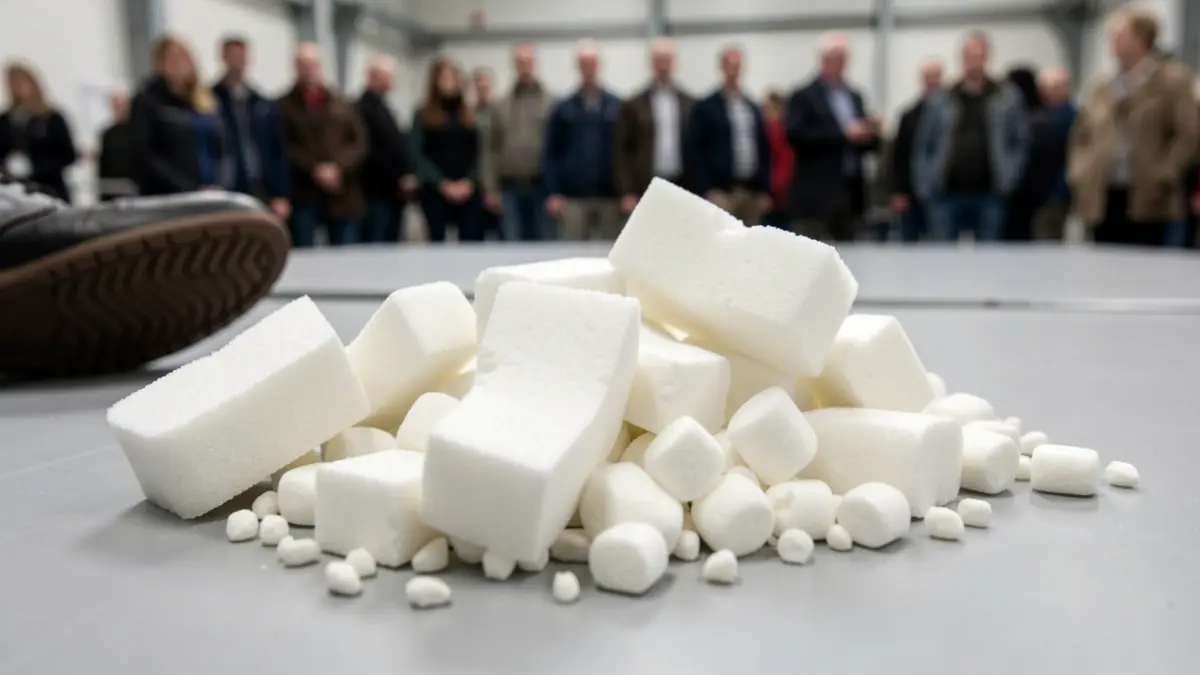
The main innovation lies in applying chemical recycling techniques to a complex material like polyurethane, a thermosetting plastic that cannot be melted and remolded like other materials. Unlike traditional systems that typically shred and reuse waste as filler, this technology recovers chemical components for use as raw material in new products.
Specifically, researchers employ a process called glycolysis, which breaks down the molecular chains of residual polyurethane to recover recycled polyols. These compounds are then incorporated into new formulations to produce soles and other footwear elements with mechanical properties tailored to specific application needs.
This project closes the polyurethane lifecycle within the footwear industry, reducing reliance on virgin raw materials and minimizing waste generation. The initiative is in an advanced stage of industrial validation, showing high potential for producing recycled polyurethane soles with quality levels close to those obtained from conventional materials.
Next steps will focus on completing pilot validation at a semi-industrial scale, advancing certification processes, and preparing for the technology's future commercial implementation. The results could also facilitate application to other polymers and industrial sectors with similar challenges.
Synthelast coordinates the project and leads the development of new polymeric materials, contributing its expertise in formulation, transformation, and validation of recycled polyurethanes. Pikolinos participates in validating the developed materials in real footwear applications, providing knowledge on design, manufacturing, and functional requirements to ensure new solutions meet market quality standards. Inescop handles the development of chemical recycling processes and the physical-chemical characterization of recycled materials, along with technical support for their incorporation into new soles and components. Onditec provides technological support in process optimization, results analysis, and instrumental assistance throughout the research and development phases.
This collaboration combines industrial knowledge, final product expertise, and applied research to drive new circular economy solutions specifically for footwear industry waste. The initiative aligns with the conclusions of the Strategic Innovation Committee Specialized in Decarbonization and the main axes of the Valencian Community's Smart Specialization Strategy, S3.