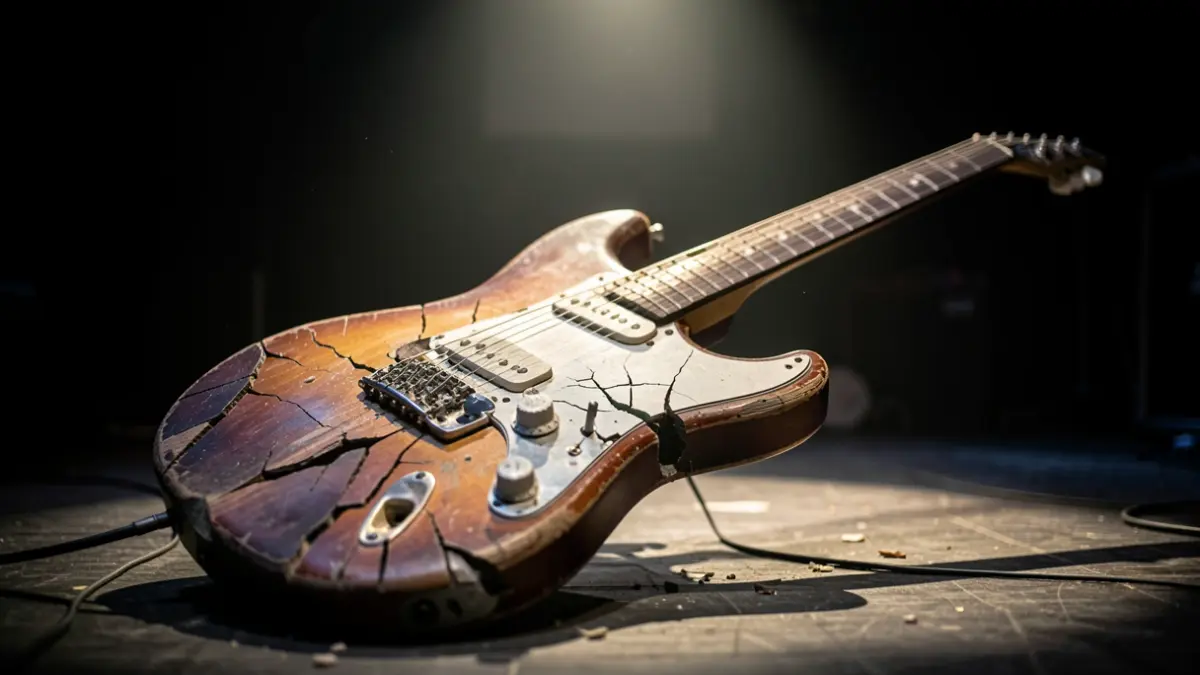
Pete Townshend is widely regarded as one of the musicians who best captured adolescent frustration through pop music. His ability to reflect generational and hormonal conflicts led him to see the guitar not just as a musical instrument, but as a symbol of fury. During a concert, he smashed it against the stage floor, making instrument destruction an iconic part of his image, even before Hendrix famously set his guitar ablaze at Woodstock.
Born in Chiswick in 1945, Townshend grew up surrounded by professional musicians, but his childhood was shaped by the decision to live with his grandmother, an event that erased his early memories. His musical calling emerged in 1957, after seeing his first rock & roll concert. Shortly thereafter, he formed The Detours with bassist John Entwistle, later joined by drummer Keith Moon and singer Roger Daltrey. Their managers, Chris Stamp and Kit Lambert, suggested they change their name to The Who.
Between 1965 and 1967, Townshend penned iconic compositions like 'My Generation' and 'I Can’t Explain,' which articulated the identity crises of transitioning from childhood to adulthood. 'My Generation,' with lines like “hope I die before I get old,” and 'I Can’t Explain,' expressing the confusion of first love, deeply resonated with young audiences. With 'Tommy' (1969), Townshend ventured into new territory, exploring childhood trauma and spirituality, effectively inventing the rock opera genre. The album told the story of a boy who becomes deaf, mute, and blind due to trauma, becoming a landmark work of the 1960s.
The band's tendency towards on-stage implosion intensified, fueled by Townshend's guitar chaos, Moon's drumming antics, and Daltrey's stage presence. The advent of cocaine exacerbated internal conflicts, particularly those related to ego. Townshend sought to counterbalance this lack of control by focusing on other projects, including conceptual albums. He began composing 'Lifehouse' in 1969, an ambitious project he never fully completed, though its songs later formed part of The Who's album 'Who’s Next' and his first solo album, 'Who Came First' (1972), inspired by his spiritual guru Meher Baba.
In 1973, The Who released 'Quadrophenia', a celebration of the mod generation that revisited Townshend's recurring themes of identity crisis, alienation, and youthful angst through its protagonist, Jimmy. Townshend described the work as an attempt to make the listener 'inhabit' the character. This album, almost immediately hailed as a classic, later received a film adaptation directed by Franc Roddam. The musical complexity of 'Quadrophenia' meant it couldn't be performed live until 1996.
Townshend's career and that of The Who were punctuated by crises, most notably the death of Keith Moon in 1978 due to alcohol excess, followed by John Entwistle's passing in 2002. These losses profoundly affected the remaining members. Following the shock of losing his drummer, Townshend reignited his solo career with 'Empty Glass' (1980), confronting his inner demons and personal struggles with alcohol. Despite his insecurities, Townshend was a pioneer in establishing narrative and conceptual lines in rock albums, amplifying noise and distortion as forms of expression and imbuing pop lyrics with depth.