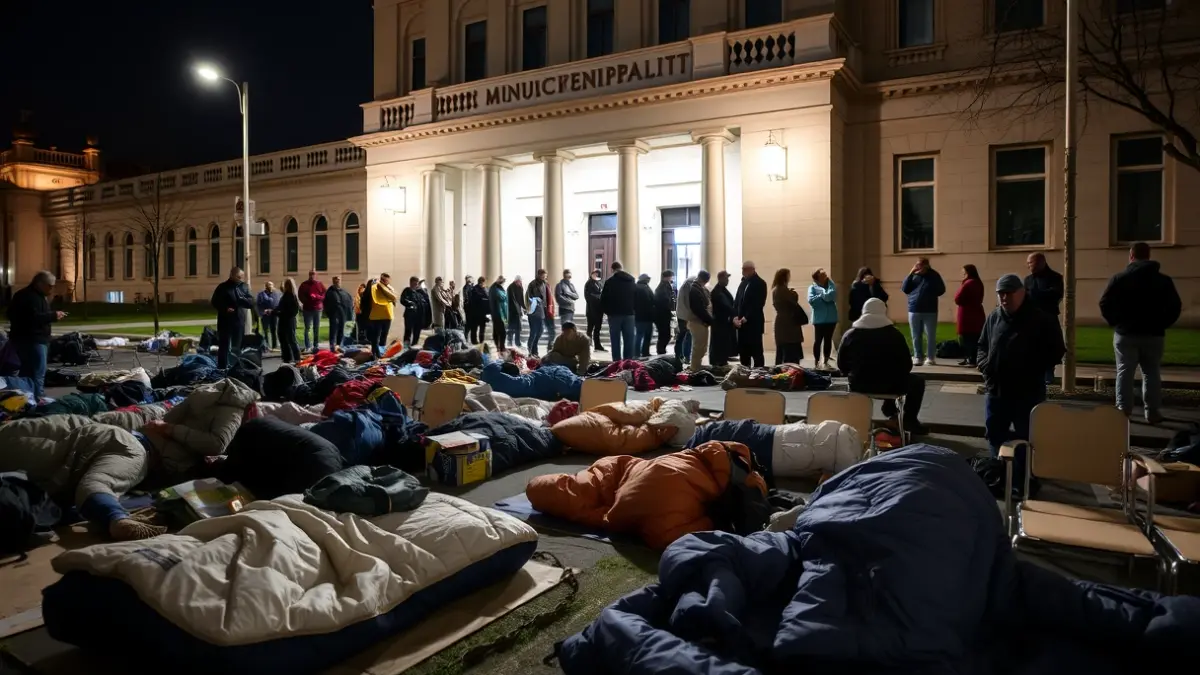
The system established by Valencia City Council for processing vulnerability certificates is creating a situation of duplicated bureaucracy and forcing many individuals to sleep on the streets. The goal is to obtain one of the daily numbers issued by the registries to submit their application. This certificate is essential for presenting their dossier in the extraordinary regularization process launched by the government, which aims to enable approximately 100,000 migrant individuals to obtain residence and work permits.
Interested individuals arrive with sleeping bags, pillows, or chairs to spend the night outdoors. The difficulty lies in the fact that Valencia City Council only allocates a limited number of daily appointments for entry registrations. For example, the Trànsits Municipal Board issues 70 numbers, and the Patraix Board, 100. This means that to be among the first, one must queue overnight, waiting for the municipal offices to open.
This situation is repeated in registries with more staff, such as the central registry of Valencia City Council or the Tabacalera registry, even though the number of daily slots for this procedure is higher there. The lack of clear instructions on how to process the vulnerability report for this extraordinary regularization process has led each city council to act differently. Valencia City Council has decided that individuals needing the certificate must submit their request via an official application through the entry registry. In the first three days, the city's registries received over 2,200 applications.
“"If the person has never been attended by Social Services, the process can be delayed. And time is pressing, as the deadline to submit the application for the regularization process concludes on June 30."
Applications go through two procedures. First, it is checked whether the person has been attended by municipal social services. If so, the process is faster. If not, technicians must schedule a personal interview, which can delay the process. Social entities warn that irregular administrative status prevents these individuals from receiving prior attention from Social Services, as they are required to have a NIE (Foreigner Identification Number) and be registered.
In contrast, other city councils have organized the procedure more efficiently. Burjassot City Council, for example, has created a specific reinforced attention protocol. Here, the first step is to request an appointment, and the second is to explain the necessary documentation to prove vulnerability. This allows the person to leave the same day of the in-person appointment with the certificate. While the ministry grants a one-month period to issue the certificate, Burjassot City Council expects to resolve each case within a week, a speed that Valencia City Council cannot guarantee.