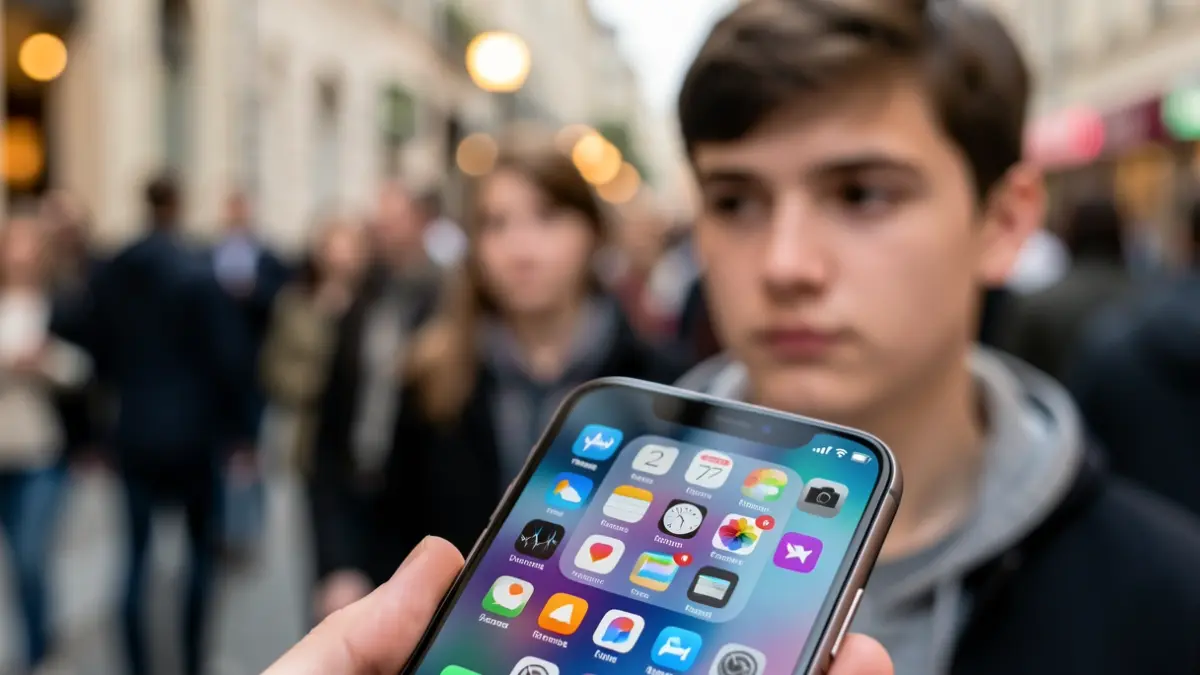
Spending many hours on social media, thinking about Instagram upon waking, or opening TikTok at every free moment does not necessarily make a person addicted. This is one of the main conclusions of an international scientific study led by Víctor Ciudad Fernández, professor at the Faculty of Psychology and Speech Therapy of the University of Valencia and researcher at the UV's Polibienestar Institute.
The research focuses on a key idea: what is truly concerning is not just the time a person spends online, but whether they begin to lose control over their social media use and if this behavior generates conflicts with family, partners, friends, or their immediate environment.
The work, authored by experts from the Swiss universities of Lausanne and Bern and the Catholic University of Louvain in Belgium, has been published in the specialized journal Journal of Psychopathology and Clinical Science. To reach its conclusions, the research team analyzed a population of 190,335 young people aged between 11 and 15 from 40 countries.
As Víctor Ciudad explains, many widespread behaviors, on their own, do not indicate a problem. 'You think about Instagram as soon as you wake up. You open TikTok every time you have a free moment. You feel like you want to spend a little more time on social media each day. Does that make you addicted? No,' states the researcher. For the expert, millions of people experience these behaviors without suffering negative consequences, so they should be understood as signs of intense use, not necessarily addiction.
Loss of control, conflicts, and distress are the signals that should indeed raise an alarm.
The study identifies as central criteria those signals consistently associated with psychological distress, sleep problems, and poorer quality of life. In everyday terms, these signals appear when a person tries to use social media less and fails, when they have serious arguments about it, or when they lie about the time they spend online.
Other behaviors should also be concerning, such as feeling bad, irritable, or restless when unable to use social media, neglecting studies, sports, or hobbies to dedicate that time to the platforms, or systematically resorting to them to escape problems or negative emotions.
'If you recognize yourself in several of these situations, it's worth pausing to reflect,' warns Ciudad. However, the researcher clarifies that thinking a lot about social media or wanting to use it more does not necessarily imply having a problem if these negative consequences are absent.
The distinction is important, especially for adolescents. Two young people might get the same score on a social media use questionnaire and be in completely different realities. One might be experiencing conflicts at home and losing control, while another simply enjoys social media without it causing any harm. 'With current tools, both are labeled the same, and that doesn't make sense,' explains the researcher from the University of Valencia.
The study warns of the risk of confusing frequent use with social media addiction.
The research suggests that many questionnaires currently used to measure problematic social media use are inspired by tools designed to diagnose addiction to substances like alcohol or drugs. The problem, according to the authors, is that these scales mix signals pointing to a real problem with others that merely reflect frequent use into a single score.
This can lead to many people, especially adolescents, being considered addicted who are not actually so. In Víctor Ciudad's opinion, this confusion can generate unwarranted alarm and, at the same time, divert attention from those who genuinely need help.
The researchers insist that it is not about denying the existence of problematic social media use. Such use exists and can cause real suffering. The key is to have tools capable of distinguishing between those who suffer negative consequences and those who simply spend a lot of time on these platforms because they enjoy them.
The study's conclusion does not depend on a specific country, language, or context. The data comes from 43 regions in 40 different countries, and the result is repeated in practically all of them: thinking a lot about social media and wanting to use it more are not good indicators of a real problem. The true alarm signal appears when social media use begins to deteriorate daily life, personal relationships, rest, or psychological well-being.