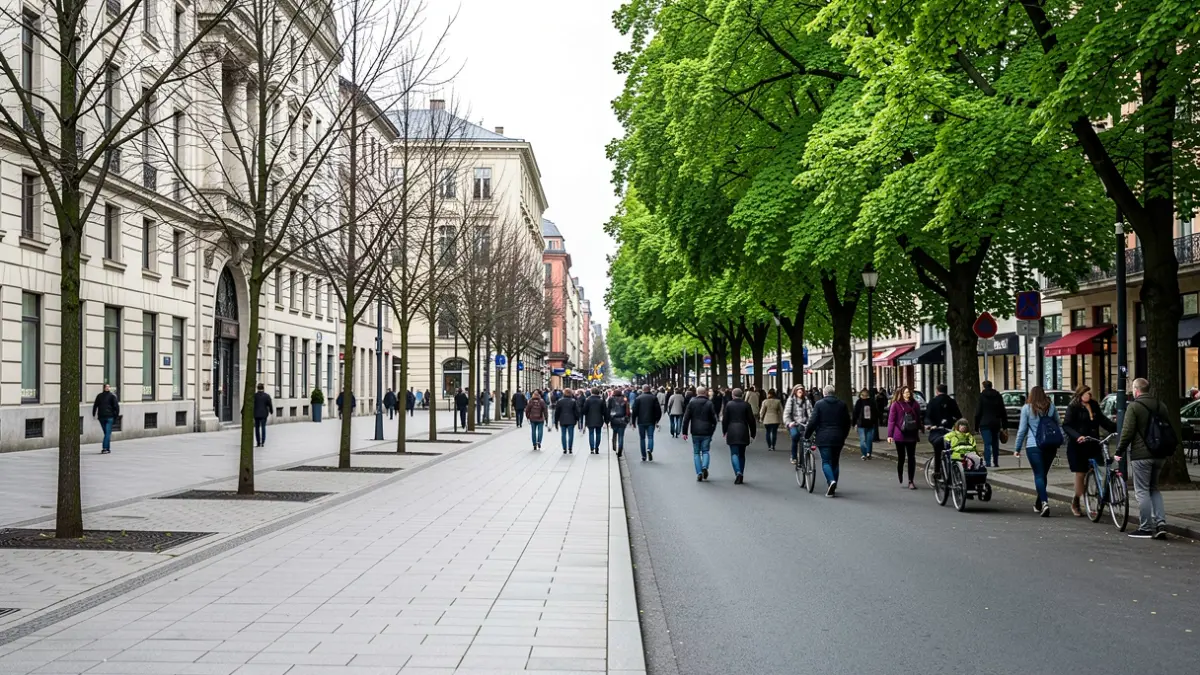
Psychiatrist José Luis Martín describes Bravo Murillo as an urban frontier, where four kilometers separate disparate socioeconomic realities. According to a study by the University of Madrid, this gap results in up to three fewer years of life expectancy on the less favored side of the street. This area features fewer trees, less green space, narrower sidewalks, and poorer public space cleaning, factors that, according to Martín, "the context makes you sick," causing anxiety, depression, and exhaustion due to living conditions.
Martín points out that the west side of the street experiences higher summer temperatures and has a lower cleaning budget, public data that highlights the disparity. The psychiatrist emphasizes that permanent nervous system activation, inflammation, and poorer sleep are common symptoms derived from this environment. Mortality and income rates coincide "almost exactly," and where life expectancy fell the most during the pandemic, there is higher unemployment, lower educational attainment, and more precariousness.
In contrast, residents on the greener side visit hospitals less often and take less medication. A neighborhood's health, according to the expert, can be assessed by observing the presence of children playing or elderly people sitting on benches. The absence of these elements indicates a neighborhood that "is making its residents sick," where loneliness in old age becomes a serious problem.
The brain, Martín explains, does not distinguish between traffic noise and a real threat, generating a constant state of alert that leads to chronic inflammation. Green spaces and contact with nature are key to reducing these effects. The doctor criticizes that in Spain there is a tendency to turn social malaise into individual diagnoses, ignoring the context and prescribing medication without considering the patient's living conditions.
Geographer and urban planner Antonio Giraldo corroborates that Bravo Murillo is a key artery for the Tetuán district, with notable differences visible at a glance between the right side, with higher incomes, and the left. He attributes "almost total" responsibility to the regional political class for not prioritizing urban planning focused on health and the green transition, as is done in other European capitals.
Giraldo notes that while air quality has improved within the M-30 thanks to car use restriction policies, other indicators such as housing prices or mass tourism have worsened. "Hopefully, the Madrid of a decade from now will be better, but for now, it won't be. At least, not for everyone," he concludes.