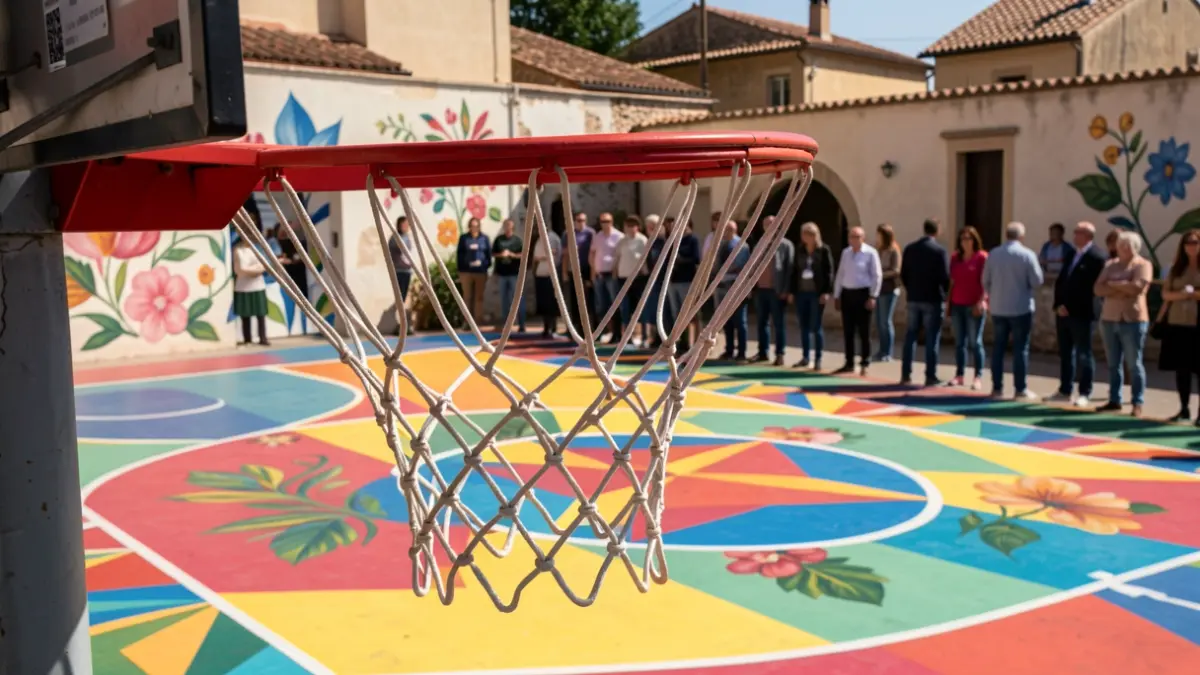
The Alicante neighborhood of Nou Alacant celebrated the opening of its new basketball courts this Saturday, following the artistic and community intervention by Floreciendo, a project driven by the creative studio Hoops Outside and winner of Cancha Solidaria Endesa 2026. The initiative has restored a main court and two 3x3 courts that had been closed since the pandemic. This transformation is particularly significant in a neighborhood with a strong identity and which ranks among areas with the lowest average income in Spain.
“These courts have always been a very important space for Nou Alacant. Activities for children were held here, and we also addressed many needs from the association, such as distributing food and clothing to vulnerable people. Seeing them clean, open, and full of life again is something that makes us very proud,” stated María Dolores Alavés, president of the Nou Alacant Neighborhood Association.
From June 3rd to 12th, artists ItisMariela and Uralde led the restoration and artistic transformation process of this 1,700 m² space, alongside volunteers, collaborating entities, and neighborhood residents. The intervention featured a vibrant palette inspired by the energy of the 90s, with intense colors, organic shapes, and flowers symbolizing growth, care, and community transformation.
“We wanted this court to come back to life from the very first splash of color. We sought a powerful image, capable of connecting with those who played here as children and are now parents, and with a new generation that can create their own memories in this same place. The flowers help us talk about care, growth, and community,” explained ItisMariela and Uralde, the project's artists.
The inauguration event, which was open and free, included a social 3x3 tournament, an exhibition match with basketball clubs and influencers, and a dunk exhibition. The event brought together children, families, clubs, associations, and sports figures in a celebration designed to make the court a new community meeting point.
“For us, courts are more than just sports spaces: they are places where play, culture, art, and neighborhood life intersect. Recovering a court means opening a stage for the community to meet, express itself, and recognize itself again in a common space,” said Daniel Arróniz, founder of Hoops Outside.
The initiative was selected from over 250 projects submitted to Cancha Solidaria Endesa 2026, a program by Liga Endesa supporting projects that use basketball as a driver for social transformation. After public voting, Floreciendo became one of the five winning initiatives, receiving a grant of 7,500 euros.
The Floreciendo project in Nou Alacant was made possible through the collaboration of public, private, and social entities sharing a common vision: transforming public space through sport, art, and community. The intervention is part of Cancha Solidaria Endesa 2026, an initiative by Liga Endesa aimed at improving sports facilities with social impact.
Locally, it involves the Fundación Lucentum Alicante, a benchmark in promoting basketball and social inclusion in the city; SCD Carolinas and Esport Pel Món, entities contributing to the project's sports and community dynamism; Tempe Inditex, which funded the installation work and donated over 6,000 shoe soles for creating sustainable elements from recycled materials; Pinturas Montó, which provided some of the necessary artistic intervention materials; and the Sports Department of the Alicante City Council, which supports the initiative.
Hoops Outside is a creative studio operating between Los Angeles, Mexico, and Madrid, specializing in transforming basketball courts and public spaces through art, sport, and urban culture. Their projects have intervened in spaces in cities such as Hermosillo, Pune, Seville, and Lleida, among others, with a shared goal: using basketball as a starting point to reclaim disused places, activate communities, and turn courts into spaces for encounter, identity, and coexistence.
With Floreciendo, Hoops Outside continues to develop a line of work that views courts as more than just sports facilities: places where play, art, and neighborhood life can intersect to foster new forms of community participation.