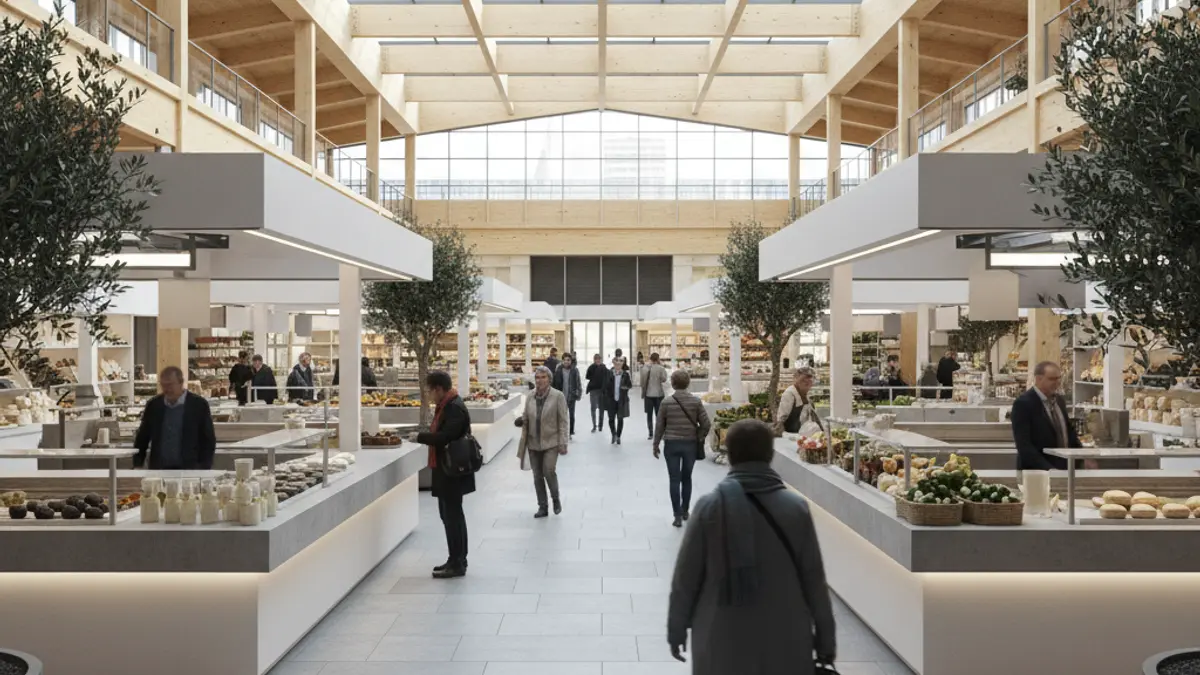
The renovation of the Sant Joan d'Alacant Market, which has transformed it into a more modern, comfortable, and accessible facility, is among the 209 proposals selected across Spain. These proposals were chosen by specialized committees from the Colleges and Autonomous Councils of Architects, which evaluated a total of 534 candidacies.
The list of selected projects includes 18 works carried out in the Valencian Community, of which five are in the province of Alicante. The market project is one of the 123 best building works that have reached this selection. A jury composed of prestigious architects will choose the finalist projects, which will be announced soon. The awards for the winning projects will be presented during a gala on June 9 at the Teatro Alcázar in Madrid.
The City Council promoted the renovation of the facilities with a total budget of two million euros. Of this amount, 1.6 million came from a subsidy from the Ministry of Industry, Commerce and Tourism, included in the Recovery, Transformation and Resilience Plan, funded by the European Union with Next Generation-EU funds, and the remaining 400,000 euros were contributed by the Council itself.
“"This intervention is conceived as a rehabilitation action that understands architecture as a continuous process, capable of integrating different times and uses."
The project, according to the jury, recognizes the architectural value of the original market and the clarity of its structural and spatial logic, recovering its open character and its section as an invariant element, not from the reproduction of a past image, but from the contemporary reinterpretation of its principles. Furthermore, the improvement of the building is considered inseparable from the transformation of its urban environment, understanding that heritage only remains active when it strengthens its relationship with public space and daily life.
Finally, it is highlighted that this is an austere, durable, and honest architecture where the continuity between interior and exterior, universal accessibility, and spatial clarity allow the market to function again as a civic facility, meeting place, and cultural reference.