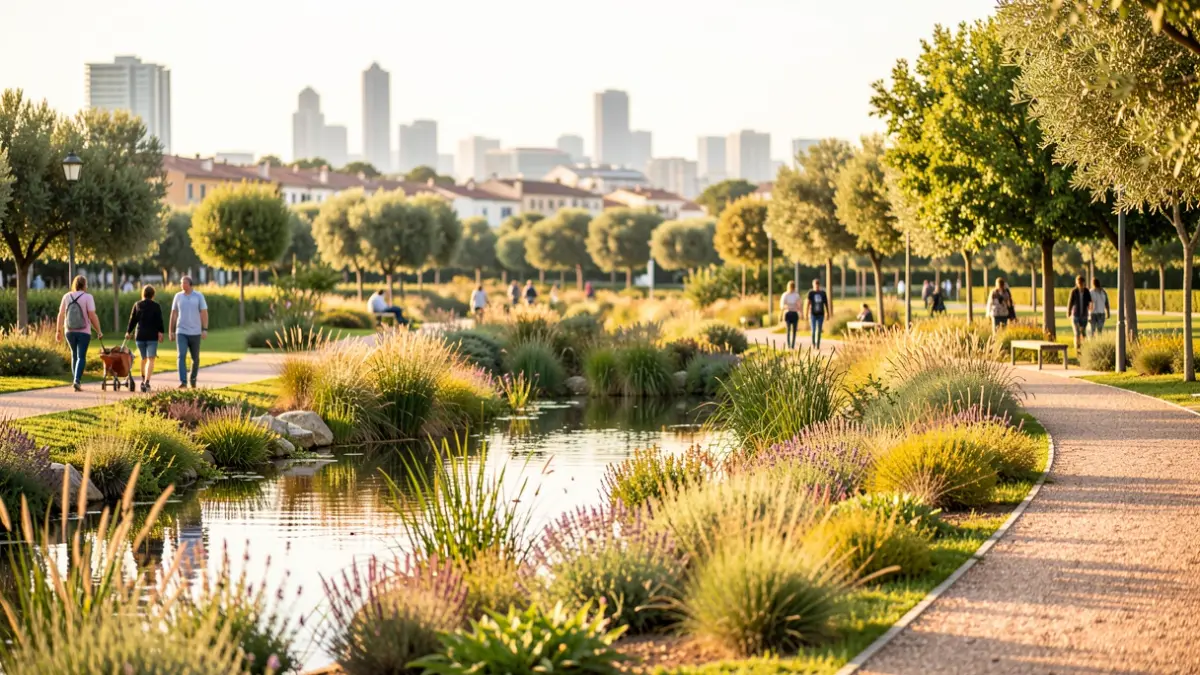
The floodable park of La Marjal in Alicante has been named a finalist in the New European Bauhaus awards in the Circularity, Sustainability, and Innovation category. It competes against candidacies from Zaragoza, Marseille (France), and Viscri (Romania), among the 21 proposals vying for the award across different categories. Public voting is now open, preceding the jury's decision.
Mayor Luis Barcala highlighted that "this is another recognition for Alicante, which aims to lead innovation and sustainability initiatives in Europe." He emphasized that the New European Bauhaus, an initiative of the European Commission, seeks to unite art, culture, science, and technology to transform cities. Barcala added that this recognition comes after celebrating the tenth anniversary of the hydraulic system, which has become a natural ecosystem, and places Alicante in the international spotlight.
The City Council submitted the candidacy through the Local Development Agency ‘Impulsalicante’ and as part of the municipal strategy Alicante Futura. The city had already shown its commitment to this European initiative when it hosted the MedCity festival of the New European Bauhaus in April 2024, promoting sustainability, inclusion, beauty, and quality of life in Mediterranean cities.
He encourages Alicantinians to support La Marjal's candidacy in the public vote.
The floodable urban park La Marjal is a prominent example of a nature-based solution. It merges ecological resilience with urban beauty, designed to absorb rainwater through natural wetland systems, transforming flood risk into a vibrant public space. Native vegetation, biodiversity corridors, and accessible paths create an inclusive green space where sustainability meets community life, embodying the values of the New European Bauhaus: beauty, sustainability, and coexistence.
Inaugurated in 2015, this 3.6-hectare park mimics native Mediterranean wetlands and functions as a large stormwater retention basin with a capacity of 45,000 m³. It has successfully prevented numerous floods, including those in March 2017 (15,500 m³) and August 2019 (22,000 m³), fully protecting surrounding urban areas from flood damage. The project, costing 3.67 million euros, has proven economically cost-effective, costing nearly four times less than a traditional underground stormwater storage alternative. Socially, it has connected previously isolated neighborhoods and become a sanctuary for over 120 bird species. In the long term, it acts as a vital tool for climate change adaptation, actively mitigating the urban heat island effect (local temperature reductions of up to 5ºC) and providing continuous carbon capture. It integrates circular economy principles, such as reusing all excavated earth for a recreational hill to completely avoid landfill transport, ensuring sustainable urban growth and inspiring replication in other Mediterranean municipalities.