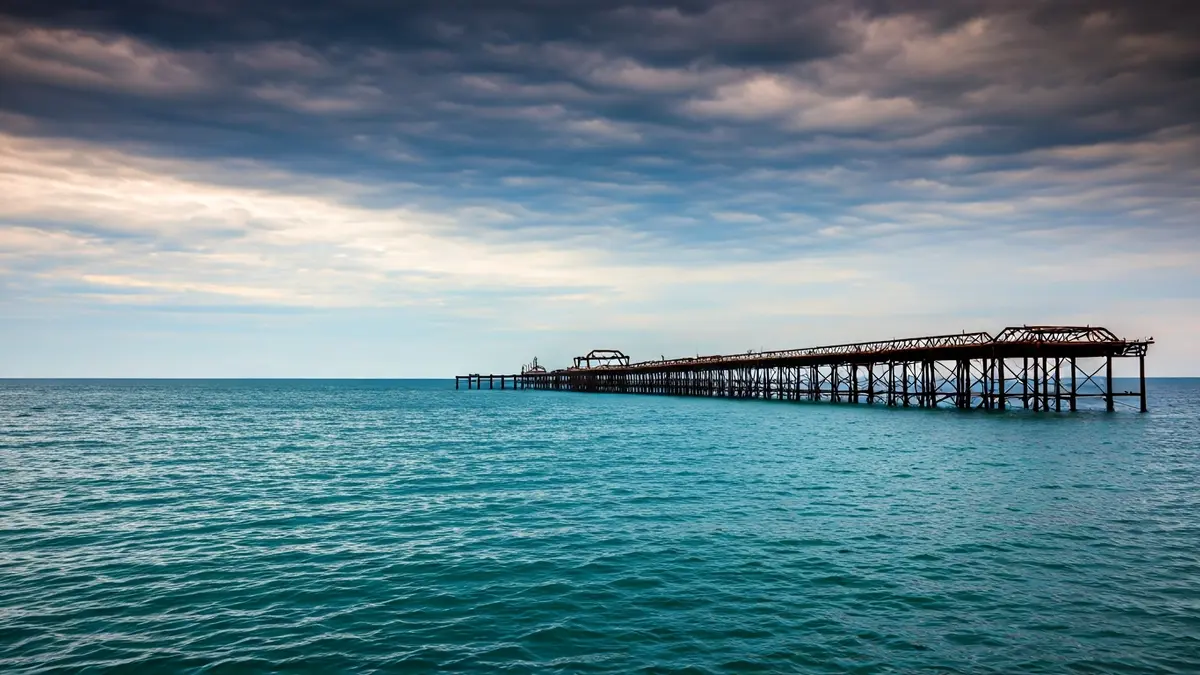
This demand was made public within the framework of the II Congress of Public Works Heritage, held in the Comunitat Valenciana. The professional association presented an updated catalog of actions, pointing out infrastructures in a deficient state of conservation that require urgent interventions by the administration.
The Port de Sagunto Pier is included in this new list of over a hundred elements. Its future is uncertain after the Port Authority of Valencia (APV) dismantled a significant part of the platform extending into the sea and built a promenade on the terrestrial section, showing reluctance to fulfill its commitment to extend the structure a few hundred meters over the sea.
“"The critical state of conservation of the Pier is a direct consequence of the lack of maintenance and the loss of cathodic protection that preserved its metallic elements."
This description, which does not include recent works, warns of the "serious effects" of corrosion on piles and structural joints, which caused the collapse of three of its 46 spans during storms in 2019 and 2020. The catalog describes this advanced deterioration as a threat to "one of the last physical traces of the Compañía Minera de Sierra Menera (CMSM) and the iron and steel past that gave rise to the Port de Sagunto".
The College of Engineers' proposal is not limited to lamenting the situation but suggests an "integral intervention of consolidation and enhancement, aimed at its rehabilitation as a cultural walkway and heritage viewpoint." Among the premises for this intervention is "preserving its layout and its symbolic value as an emblem of Sagunto's industrial identity."
The initiative suggests "reconstructing the collapsed spans" and carrying out "cleaning, structural reinforcement, and reinstallation of anticorrosive systems" to ensure stability and reactivate its public use. In this way, the Pier would become "a living symbol of the working-class memory and the technical development that shaped the 'Factory Town' of Sagunto."
The professional association recalls that the infrastructure, built between 1975 and 1977 by CMSM for iron ore unloading, had a limited lifespan. The closure of Altos Hornos del Mediterráneo in 1984 meant the loss of the main client, and CMSM ceased its activity in 1987. In 1990, the concession of the Pier passed to the APV, at which point it ceased to have commercial use.