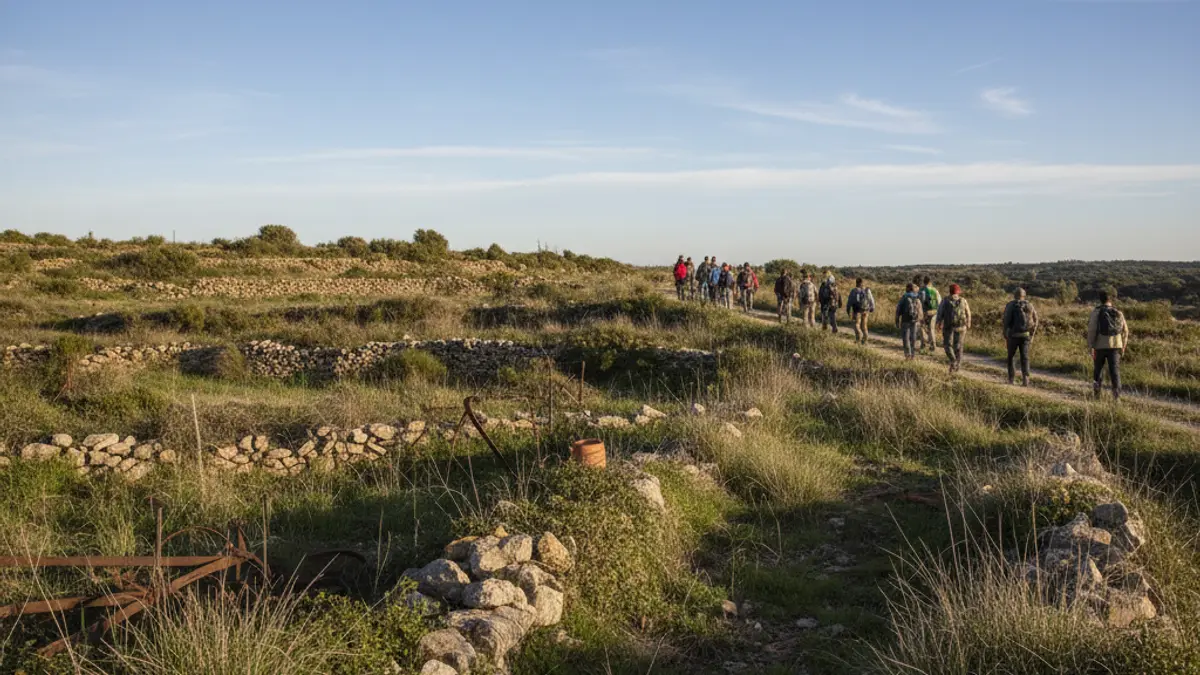
The relationship between humans and the natural environment has evolved throughout history, from depending on it for survival to transforming it and, finally, abandoning it. This continuous rural exodus empties villages and often causes irreversible impact if action is not taken promptly.
Last September, it was recalled that the province of Castellón has sixteen municipalities with fewer than one hundred inhabitants, distributed among the regions of Els Ports, Baix Maestrat, Alt Millars, and Alt Palància. It was highlighted that Castellón accounts for three out of every four villages with fewer than one hundred inhabitants in the entire Valencian Community, and that 86 of the 135 Castellón villages are officially threatened by rural exodus.
“"Castellón accounts for three out of every four villages with fewer than one hundred inhabitants in the entire Community, sixteen out of twenty-one."
The social implications of this reality are well known, and public policies already allocate investments to protect and create incentives to make these municipalities decent places to live. However, depopulation also has very important environmental impacts, as evidenced in extreme cases such as large forest fires.
In October, a study concluded that 87 municipalities in the province of Castellón, more than half of the 135, continue to lose population or are at risk of depopulation. These data underscore the need to seek solutions that address both the social and ecological dimensions of the problem.
“"87 municipalities in the province, more than half of the 135 (55%), continue to lose population or remain at risk of depopulation."
A researcher from the Centre for Ecological Research and Forestry Applications (CREAF) considers it surprising that the ecological dimension of depopulation has been overlooked or treated superficially, despite the current importance of environmental issues. They argue that economic activation policies should take sustainability criteria into account, promoting extensive land use that maintains economic activities and settles population in an environmentally sustainable way.
The Aquae Foundation, citing data from Greenpeace, states that in the last forty years, more than four million hectares of cultivated land have been abandoned and more than two million livestock farms have been lost. Furthermore, they warn that more than 80% of forest areas lack management plans to guarantee the preservation of mountains and forests. This abandoned space is precisely where the inhabitants of the 86 Castellón villages at risk of depopulation live.
In this scenario, public policies and investments are indispensable. Complementarily, citizen initiatives are emerging that seek to protect the rural environment and its heritage and natural values. An example is the heritage conferences organized by the University Jaume I (UJI) Extension Program, the town councils of Puebla de Arenoso, Fuente de la Reina, and Viver, and the Mancomunitat Riu Millars.
The eighth edition of these conferences, held on May 2, focused on the conservation of ponds and lime kilns, traditional constructions linked to rural economic activity. Information was also provided on initiatives such as the organic cultivation of rice in the Maimona river basin, irrigated with water from the Millars river.
Other proposals include the six activities organized by the Eslida Town Council between June and November to bring citizens closer to the Sierra de Espadán, with routes exploring history, natural heritage, and social issues. Likewise, the Valltorta Museum, the Generalitat, the Fundación Caixa Castelló, and the Ares del Maestrat Town Council launched the Els barrancs initiative, with a guided tour through the monumental forest of the Horts ravine on May 17.
La Vall d'Uixó, not at risk of depopulation, has also incorporated guided routes into its programs to delve into the past that shaped the population's development, preserving remains such as cisterns, irrigation channels, and fountains. These initiatives recall the relationship of necessity that humans have always had with the natural environment, which they have transformed and, in many cases, abandoned when it ceased to be profitable.
The CREAF researcher concludes that rural landscapes are the result of a co-evolution between human societies and natural processes. They warn that relying on human-transformed spaces to recover on their own is too simplistic a view, and advocate for intervention based on ecological knowledge to establish effective action plans.