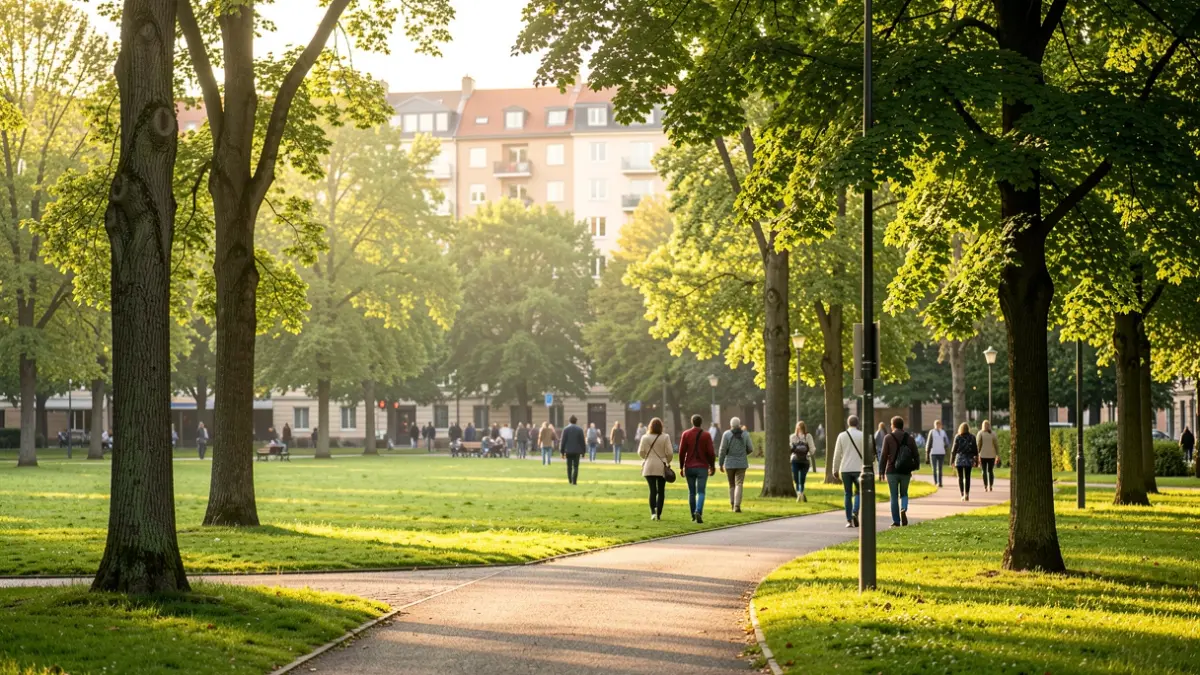
Having large green areas near home has become almost an invisible luxury in major Spanish cities. In the case of Valencia, 80% of its residents (around 640,000 people) lack a large green space in their immediate surroundings, a percentage that exceeds that of most major Spanish capitals.
This is reflected in the national report 'How to guarantee the right to nature?', edited by the environmental organization Amigas de la Tierra and developed by researchers from the Polytechnic University of Madrid. The document analyzes citizens' accessibility to public natural spaces of more than one hectare, the minimum size considered by experts for a park to provide real climate mitigation and health benefits, in a dozen Spanish cities. The results place Valencia at the bottom, as most of its residents do not have a large park within 300 meters of their homes.
The report relies on an international standard: the 3-30-300 rule. This recommendation, endorsed by the World Health Organization, states that every citizen should be able to see at least 3 considerable-sized trees from the window of their home, school, or workplace. Each neighborhood or district in the city should have at least 30% of its surface covered by tree canopies (vegetation cover) to efficiently mitigate the "heat island" effect. Finally, it establishes that no citizen should live more than 300 meters (about a 5-minute walk) from a quality public green space of at least one hectare in size. It is precisely in this last indicator where the UPM study has focused, and where Valencia scores worse than other analyzed cities.
The study indicates that Valencia's green spaces are configured around the central Turia Garden, which runs through the city as an axis, and a set of smaller green patches distributed throughout the urban fabric. However, the vast majority of these green spaces do not reach the 1-hectare size and classify the provision of large parks as "scarce," leaving a significant portion of the population underserved. Researchers identify four priority action zones due to their particular vulnerability and lack of permeable soil: Poblats Marítims and Camins al Grau, Rascanya and Benicalap, Jesús and Quatre Carreres, and Patraix and L'Olivereta.
The general conclusions of the study also reveal a worrying "green gap" linked to socioeconomic inequality. Researchers draw a relationship between household income and proximity to nature. In Valencia, the percentages of citizens without a large park in their immediate surroundings are high across most income levels: Very low incomes (Quintile 05): 87% of residents lack access (136,377 people). Low-middle incomes (Quintile 04): This is the most affected segment of the city. 90% of the population suffers this deficit (141,592 people), a record figure among the country's major capitals. High incomes (Quintile 01): 71% of the highest-income population (113,179 people) lives far from large green spaces.
Regarding large green surface area per inhabitant, Valencia is also at the bottom with 3.48 m2 of green zone over one hectare per inhabitant. The study argues that the solution for Valencia involves leveraging its radial structure to "densify" the green space network by connecting urban rings and radii, and allowing the city's edges to become permeable towards the valuable agricultural land of the 'huerta' through pedestrian and cycling routes.